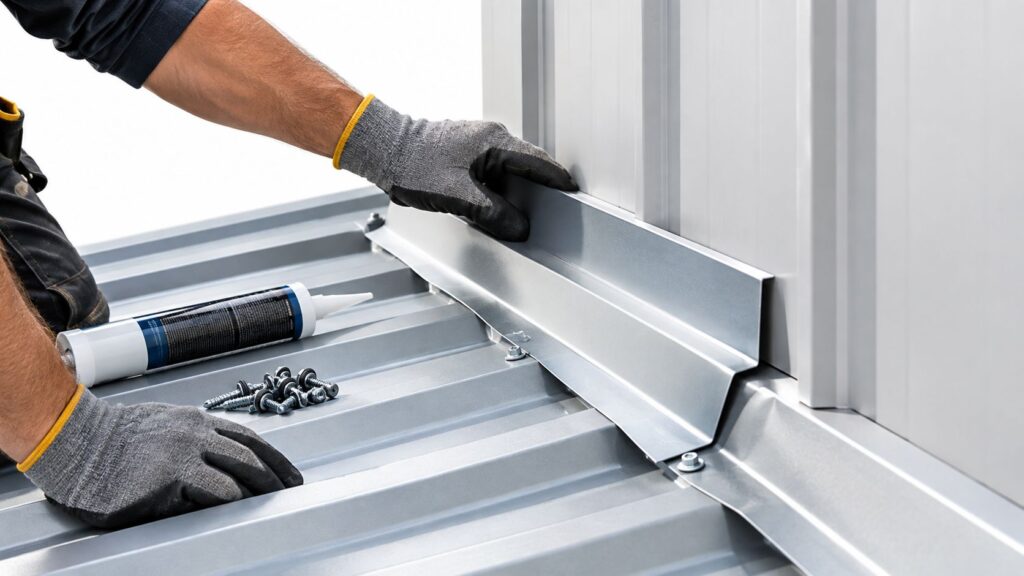
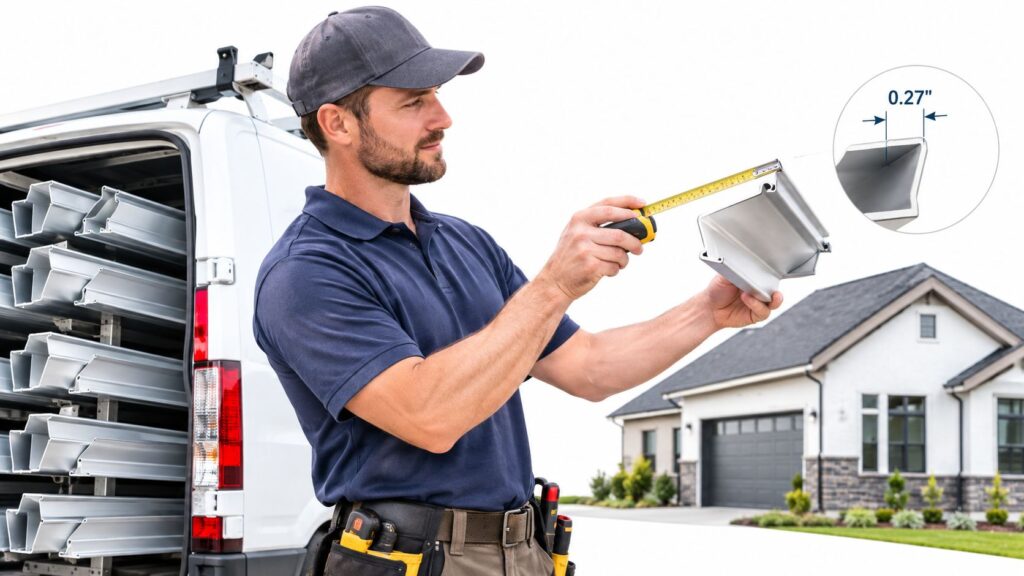
A siding crew in Fort Worth can move through a vinyl installation with a familiar rhythm: carry lightweight boxes, make quick cuts, lock panels together, and keep the wall moving. Fiber cement changes that rhythm immediately. Boards demand more careful handling, saw cuts require dust controls, fasteners must land in the right framing, and clearances at slabs, decks, windows, and rooflines have to be planned before the first panel goes up.
That difference matters to contractors in Arlington, Forest Hill, Mansfield, Keller, Southlake, Grapevine, and the rest of the Dallas-Fort Worth Metroplex. The finished wall may look like a straightforward wood-style exterior, but the profitable installation depends on labor planning, crew training, moisture detailing, safe cutting, and dependable material flow. These are the practical fiber cement siding pros and cons that determine whether a project performs well after the crew leaves.
Table of Contents
- Understanding Fiber Cement Siding for DFW Projects
- Evaluating the Durability and Fire Resistance Benefits
- Navigating Installation Complexities and Labor Requirements
- Managing Silica Exposure and Jobsite Safety Protocols
- Assessing Long-Term Maintenance and Lifecycle Expectations
- Optimizing Material Sourcing and Logistics in the Metroplex
- Final Verdict on Exterior Cladding Selection
Understanding Fiber Cement Siding for DFW Projects
On a remodel near Arlington, a crew replacing vinyl siding with fiber cement quickly discovers that the material isn't a drop-in substitute. The boards are heavier and more brittle, so carrying, staging, and fastening take more coordination. A cut list that worked for vinyl may also need revision because fiber cement demands cleaner layout, controlled cutting, and closer attention to corners, openings, joints, and trim.
The first operational change is at the cutting station. Crews need a suitable saw setup, dust collection, safe storage, and a plan for moving boards without chipping edges. The second change is on the wall. Fiber cement relies on compatible fasteners, solid framing support, correct penetration, protected joints, and carefully maintained clearances.
Field observation: The material usually doesn't fail because the cementitious board lacks strength. Problems more often start with rushed handling, overdriven fasteners, exposed cut edges, or a drainage detail that was never coordinated with the existing structure.
That makes fiber cement a system rather than a simple finish layer. The wall still needs a continuous weather-resistive barrier, flashing at openings and transitions, and a drainage path behind the cladding. Contractors evaluating fiber cement siding options for DFW projects should price the complete installation package, not just the boards.
For residential and commercial work in Fort Worth and surrounding Tarrant County cities, the central question is practical: can the crew execute the details consistently enough to justify the material's durability and fire-performance advantages? If the answer is yes, fiber cement can be a strong choice. If the project has a compressed schedule, limited cutting controls, or poor access for material handling, a lighter siding system may fit the business model better.
Evaluating the Durability and Fire Resistance Benefits
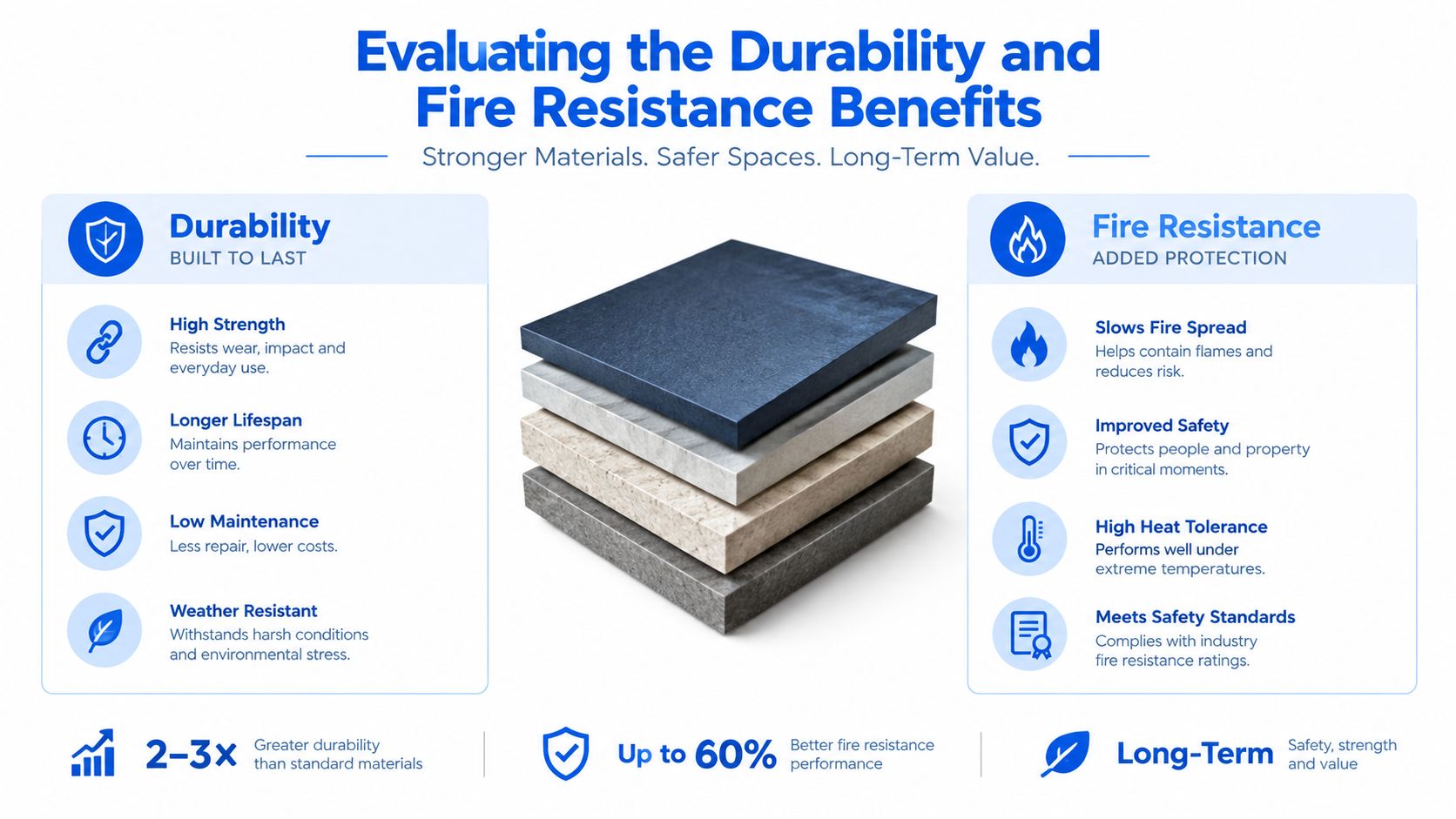
Fiber cement earns its premium position through a combination of biological resistance, dimensional stability, and fire performance. Its cementitious matrix resists rot, insects, ultraviolet degradation, and many forms of weathering more effectively than untreated wood. Cement content also limits the type of movement that can make wood siding vulnerable to swelling and shrinkage, while avoiding some of the impact and heat-related concerns associated with lighter synthetic products.
The material's history helps explain why contractors should distinguish modern fiber cement from older cement-based siding. Austrian inventor Ludwig Hatschek patented asbestos-reinforced fiber cement in 1901, and asbestos-cement siding and roofing were widely used during the twentieth century. Health concerns connected asbestos exposure with lung cancer and mesothelioma, which drove a transition toward cellulose and other reinforcing fibers during the 1980s. James Hardie reports that its products became 100% asbestos-free in 1987 in its historical account of the transition.
That history matters during renovation work. Cement siding installed in an older building shouldn't be cut, drilled, removed, or discarded under the assumption that it's asbestos-free. Contractors need to verify the installation date, manufacturer documentation, and applicable hazardous-material requirements before disturbing suspect material. Contemporary products are generally made with cellulose, synthetic, or mineral fibers, but fiber cement isn't one universal formulation.
Fire performance and dimensional behavior
Specifications based on ASTM C1186 commonly identify Type A, Grade II fiber-cement board, requiring noncombustibility under ASTM E136 and a flame-spread index of 25 or less under ASTM E84 as summarized in public construction specifications. Those specifications don't remove the need to follow the adopted building code or the selected manufacturer's installation instructions, but they explain why fiber cement is often considered where fire exposure and code compliance influence cladding selection.
For DFW contractors, the advantage is not only a rating on a product sheet. The cementitious composition gives the wall a more stable exterior surface than materials that respond strongly to heat or biological decay. That can support projects where owners want a wood-like appearance without accepting the same rot and insect vulnerability as untreated wood.
The trade-off is that fire resistance doesn't make the wall assembly automatically weatherproof. Fiber cement remains dependent on a properly detailed drainage plane, flashing, joints, terminations, and penetrations. A strong field board cannot compensate for missing head flashing or a failed kick-out detail.
Navigating Installation Complexities and Labor Requirements
The largest disadvantage of fiber cement is installation complexity. The higher labor allowance is justified when a project needs durable, fire-resistant cladding, but only if the bid reflects the actual work. Crews in Keller, Mansfield, Benbrook, and Fort Worth shouldn't estimate fiber cement as though they're installing lightweight vinyl.
Start with the fasteners. Manufacturer guidance requires corrosion-resistant fasteners placed no closer than 1 inch from board ends and 3/4 inch from edges, with penetration of 1 to 1 1/4 inches into solid wood framing according to summarized fiber-cement installation guidance. Those dimensions affect layout, framing verification, trim installation, and production speed.
Where installation estimates go wrong
A low bid often ignores the time required to locate framing, stage boards, predrill vulnerable areas, protect corners, and treat cut edges. Fiber cement can crack or chip when crews carry it carelessly, drive fasteners too deep, or place nails too close to an edge. Butt joints also need the specified joint treatment, whether that means a lightly butted, painted joint or a gap sealed with compatible paintable caulk.
Predrilling may be required within 1/4 inch of an edge or near sharp corners, depending on the product and location. Fasteners should sit flush or snug, not be overdriven. These aren't cosmetic preferences. They control whether the board stays intact and whether the attachment remains reliable through seasonal exposure.
Moisture clearance deserves its own line item. Common manufacturer specifications call for at least 6 inches between the bottom of siding and finished grade, plus about 1 inch above decks, steps, driveways, porches, and other horizontal surfaces. Some panel specifications call for 2 inches above non-grade horizontal surfaces, and a drainage-flashing gap may require 1/2 inch between flashing and the panel bottom as shown in public manufacturer specifications.
Critical Installation Clearances and Fastener Rules
| Installation Parameter | Required Specification | Failure Risk if Ignored |
|---|---|---|
| Fastener material | Corrosion-resistant fasteners | Rust staining, weakened attachment, and warranty concerns |
| Distance from board ends | No closer than 1 inch | End cracking or localized board damage |
| Distance from board edges | No closer than 3/4 inch | Edge splitting and broken corners |
| Fastener penetration | 1 to 1 1/4 inches into solid wood framing | Loose boards or inadequate holding power |
| Bottom clearance at finished grade | At least 6 inches | Splashback, trapped moisture, and edge deterioration |
| Clearance above horizontal surfaces | About 1 inch, or 2 inches for some panel specifications | Moisture exposure and damaged lower edges |
| Drainage-flashing separation | A specified gap, such as 1/2 inch where required | Restricted drainage behind the panel |
The crew should coordinate these clearances with slab edges, foundations, replacement windows, roof-to-wall transitions, porches, and driveways before cutting material. A detail that works on a new build may not transfer cleanly to a remodel with an uneven foundation or an existing deck.
The practical position is straightforward: higher labor is acceptable when it buys a performance advantage the project needs. Fiber cement makes sense when the owner values fire resistance, a wood-like finish, and long-term weather performance. It doesn't make sense to hide the labor in a thin estimate and hope production catches up.
Managing Silica Exposure and Jobsite Safety Protocols
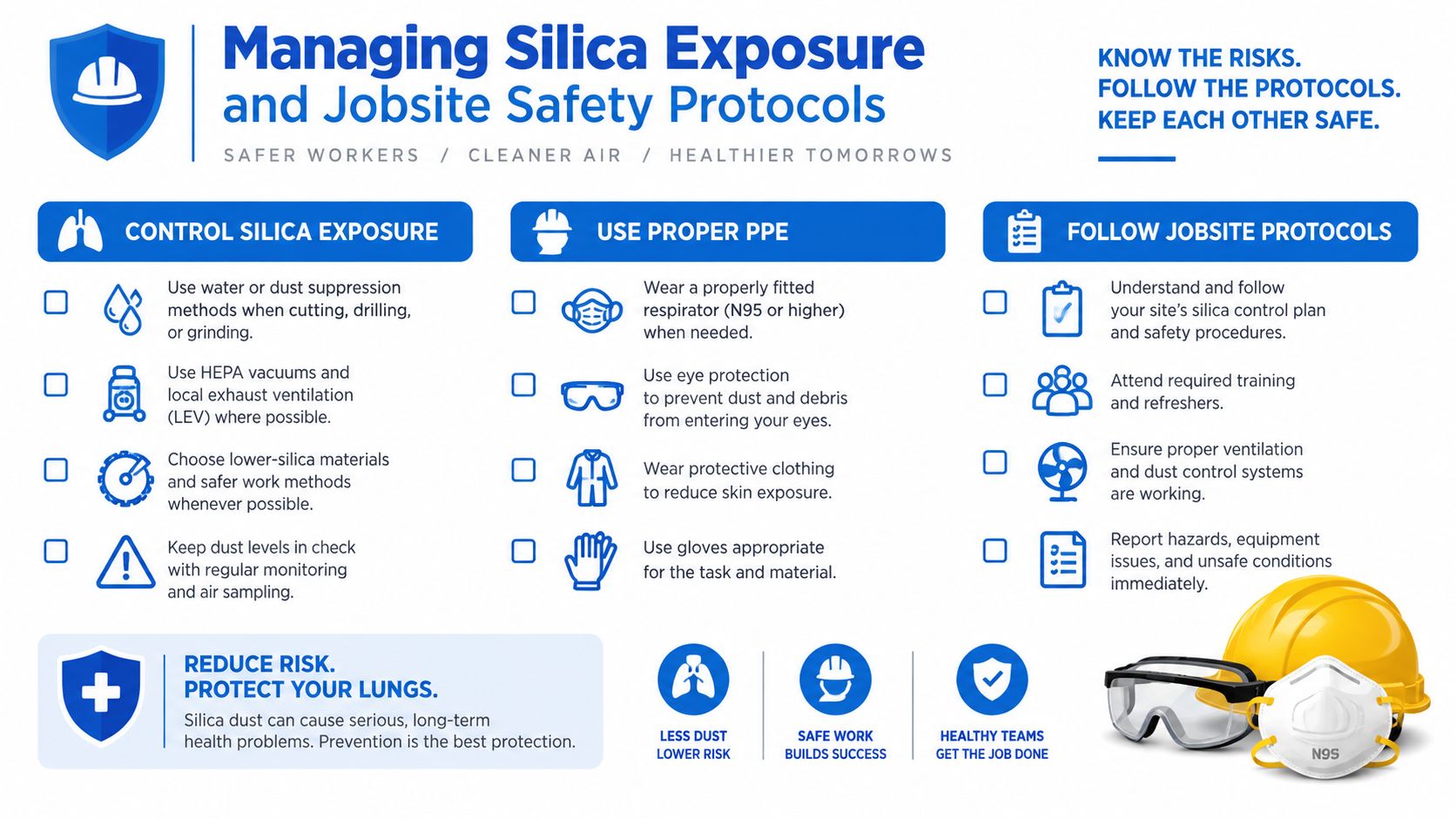
Fiber cement installation creates a jobsite safety responsibility that consumer siding comparisons often skip. Cutting, drilling, sawing, or cleaning the material can generate respirable silica dust. The risk isn't determined only by the product. It depends on the cutting method, equipment condition, ventilation, cleanup, and whether the crew follows the control plan.
A CDC/NIOSH evaluation found that cutting fiber-cement siding without dust controls creates potential for overexposure, while controlled cutting can maintain 8-hour respirable-silica exposures below applicable OSHA limits in its evaluation of fiber-cement siding work. That finding supports a practical conclusion: fiber cement isn't accurately described as either safe or unsafe. The installation workflow controls much of the exposure.
Build the cutting workflow before production starts
A compliant plan begins with the cutting station, not with a warning after dust appears. The foreman should select a cutting method that limits airborne dust, connect and maintain the appropriate dust-collection equipment, and place the station where wind and ventilation carry dust away from other workers.
OSHA's Table 1 approach can allow certain outdoor cuts with a power saw of 8 inches or less, a compliant dust-collection system, and proper operation without additional respiratory protection. Those conditions have to exist in practice. A disconnected hose, overloaded filter, damaged collection system, or indoor cut can change the exposure profile.
Use a short preproduction check:
- Confirm the method: Match the saw, blade, collection system, and work location to the task.
- Inspect the controls: Check hoses, filters, connections, and equipment maintenance before cutting begins.
- Separate the station: Keep cutting away from other trades, occupied spaces, and material staging.
- Control cleanup: Use methods that don't redistribute settled dust into the air.
- Train the crew: Workers should understand when controls are required and when respiratory protection may be necessary.
Respirators may be needed when controls aren't available or can't reliably limit exposure. Contractors should also account for the time spent moving boards to the cutting station, maintaining equipment, cleaning the work area, and replacing worn components. Those are real labor and operating costs, not administrative extras.
For practical field checklists and installation guidance, contractors can use the Blue Lake Roofing Supply contractor tips alongside the selected product manufacturer's instructions. The supplier resource doesn't replace OSHA compliance or a site-specific safety plan, but it can help crews organize routine material and installation questions.
Safety rule: If the crew can't control dust with the planned tools and setup, the estimate and workflow aren't ready for production.
Safe cutting also protects schedule performance. A poorly maintained cutting station creates cleanup delays, irritates workers, contaminates nearby work areas, and can force a foreman to stop production. Treat silica control as part of the installation method, just like flashing and fastening.
Assessing Long-Term Maintenance and Lifecycle Expectations
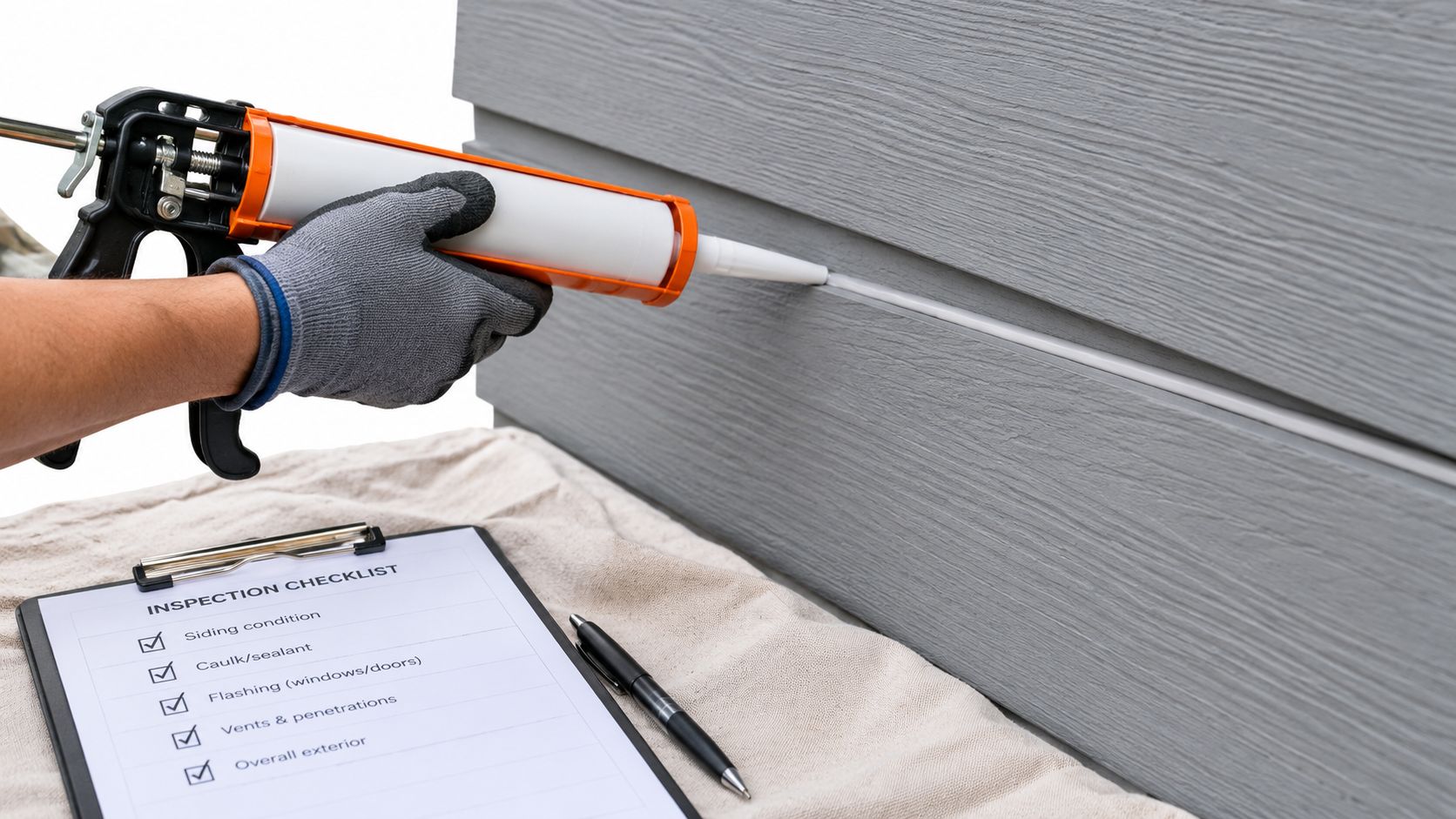
Fiber cement is low-maintenance compared with many wood cladding systems, but it isn't maintenance-free. Owners still need a plan for inspecting joints, coatings, flashings, clearances, and areas exposed to repeated splashback. In DFW, intense ultraviolet exposure, heat, wind-driven rain, and cyclic wetting can test the sealants and finish even when the board itself remains sound.
Industry sources place expected service life around 25 to 40 years under normal conditions, though weathering and cyclic wetting can accelerate deterioration if joints and coatings aren't maintained as summarized in a fiber-cement market assessment. Some reported installations and factory-finished systems reach 50 years or more with appropriate maintenance, but contractors should present that as a conditional lifecycle expectation, not an unlimited guarantee.
What owners should hear at handoff
A good handoff explains that the siding's durability depends on the entire exterior assembly. The field board can resist rot, insects, ultraviolet degradation, and fire, but failed caulk, exposed cut edges, blocked drainage, or damaged flashing can still create water intrusion.
The maintenance conversation should include:
- Joint inspections: Look for separated or failed sealant at butt joints, trim, windows, doors, and penetrations.
- Coating checks: Watch for peeling, chalking, exposed substrate, or finish damage that leaves cut areas vulnerable.
- Clearance reviews: Keep soil, mulch, decks, steps, and other horizontal surfaces from defeating the required drainage space.
- Flashing checks: Inspect roof-to-wall transitions, kick-out flashing, head flashing, and termination details after exterior modifications.
- Localized repairs: Replace damaged boards and address the source of moisture rather than covering the symptom.
A durability review of autoclaved cellulose-fiber cement composites found that approximately 50 years can be a reasonable expectation when the product is selected, installed, and maintained for its anticipated exposure, while also noting that weathering can increase moisture movement even when mechanical-property changes remain limited in mild climates in its durability research. The same research identifies wetting and drying as a limiting factor, which is especially relevant when cut edges, joints, and clearances are neglected.
Lifecycle claims need more than a green label
Fiber cement's long service potential may reduce replacement frequency and whole-life waste, but manufacturing cement is resource- and energy-intensive. A lifecycle analysis covering residential cladding identifies manufacturing energy, particularly Portland-cement production, as a major environmental factor, along with human-health impacts associated with processing in the Dovetail analysis.
That means contractors should avoid labeling the product as green or not green. The lifecycle result depends on service life, maintenance, transport, installation waste, replacement rates, and end-of-life handling. A durable cladding system can be a sensible long-term choice, but its environmental advantage must be evaluated against the actual project conditions.
Optimizing Material Sourcing and Logistics in the Metroplex
Fiber cement's weight and brittleness make logistics part of installation quality. Boards that arrive damaged create more than a replacement-material problem. They interrupt production, force unscheduled handling, and can leave a crew waiting while the jobsite loses momentum.
A fragmented national supply chain can also complicate trim, fasteners, soffit, flashing, and siding coordination. When each exterior component comes from a different source, the foreman has to reconcile delivery timing, product compatibility, quantities, and damage claims. A centralized supplier can reduce those handoffs, but the contractor still needs to verify the exact product line, profile, finish, trim, and manufacturer requirements before ordering.
Blue Lake Roofing Supply operates from Forest Hill and supplies fiber cement siding, cement soffit sheets, vented cement panels, cement trim, and Sierra cement sheet siding, along with James Hardie and Allura lap and panel products. Its fiber cement siding supply for Fort Worth contractors is relevant when a crew needs siding and related exterior materials coordinated through a DFW distributor.
Connect safety, waste, and delivery decisions
Ordering accurately reduces more than schedule risk. Fewer damaged boards mean less disposal, fewer replacement deliveries, and less repeated handling at the site. Better takeoffs also reduce unnecessary cutting, which lowers silica-generating work and keeps the cutting station more manageable.
The environmental and safety questions therefore overlap:
- Order the right profiles: Confirm lap, panel, trim, soffit, and vented components before dispatch.
- Protect the load: Stage boards on a stable, dry surface and plan how crews will move them to the work face.
- Coordinate delivery timing: Avoid leaving material exposed longer than necessary or blocking other trades.
- Limit field waste: Use accurate elevations and cut planning, while following the selected product's installation requirements.
- Keep documentation together: Store product instructions, warranty information, and delivery records with the project file.
For contractors serving Fort Worth, Arlington, Mansfield, Forest Hill, Keller, Southlake, and nearby DFW communities, local jobsite delivery can also support phased work. Blue Lake Roofing Supply offers jobsite-direct delivery across an approximately 40-mile radius and often provides same-day fulfillment for orders placed by 12:00 PM, according to the company's operating information. Those service details should still be confirmed when scheduling a specific project.
A trade account can help align material purchasing with project phases, while a single exterior supplier may simplify orders for siding, roofing, windows, doors, lumber, fasteners, and related accessories. That doesn't eliminate the contractor's responsibility for takeoffs and inspection, but it can reduce coordination points that often cause avoidable delays.
Final Verdict on Exterior Cladding Selection
Fiber cement is a strong fit when the project needs fire performance, resistance to rot and insects, a stable wood-like appearance, and a long service-life target. It works especially well for owners who value durable exterior protection and for contractors whose crews can control cutting dust, protect boards, install compatible fasteners, and execute flashing and clearance details without shortcuts.
The material is less attractive when the job is driven almost entirely by the lowest initial labor cost, the schedule leaves no room for careful handling, or the crew lacks the tools and training required for safe cutting. Vinyl may be easier to move and install, while wood may offer repair flexibility or historic authenticity on selected projects. Those alternatives don't carry the same combination of fiber cement's fire and biological resistance, but they may fit a particular building, budget, or production model better.
The local supply chain can influence that decision. A fragmented national source may create more opportunities for late deliveries, damaged boards, and mismatched trim. A DFW distributor with coordinated exterior inventory and jobsite-direct delivery can help keep the crew supplied, but the contractor should still confirm product availability, delivery timing, and manufacturer specifications before committing to the installation schedule.
For DFW contractors, profitable fiber cement work comes from treating the siding as a complete assembly and workflow. Price the handling, cutting controls, fasteners, flashing, clearances, joint treatment, inspection, and maintenance conversation. Then choose the material when its performance advantages justify those requirements.
Blue Lake Roofing Supply supplies installer-grade fiber cement siding, cement trim, soffit products, and related exterior materials for contractors working across the DFW area, with trade accounts and jobsite-direct delivery from Forest Hill. Visit Blue Lake Roofing Supply to discuss the material package and delivery plan for your next siding project.