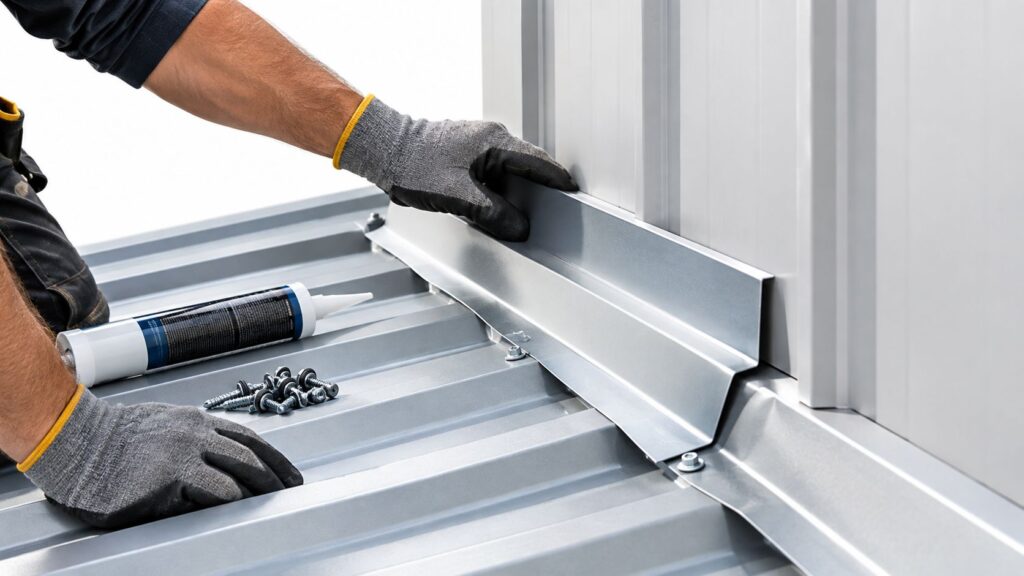
A crew is ready near Fort Worth. Tear-off is complete, the panels are on site, and the installer is waiting for one small box that never made it onto the delivery truck. Then someone discovers that the clips match a different standing seam profile, the rake trim is too short, or the fasteners aren't approved for the substrate. The roof work stops while the estimator starts making calls.
That kind of delay rarely comes from the panels themselves. It comes from treating metal roofing supplies as a single product instead of a complete roof assembly. In the Dallas-Fort Worth area, the order has to account for wind exposure, thermal movement, weather, roof geometry, jobsite access, and the distance between a supplier yard and the crew. The right list protects production before the first panel is installed.
Table of Contents
- Why the Right Metal Roofing Supplies List Matters for DFW Contractors
- Understanding Metal Roofing Supplies Components
- Complete Metal Roofing Supplies Checklist
- Comparing Standing Seam and Exposed Fastener Metal Roof Systems
- Sourcing Metal Roofing Supplies for DFW Jobsites
- How to Order Metal Roofing Supplies Like a Seasoned DFW Contractor
- When Metal Roofing Supplies Are Actually the Smart Cost Choice
- Next Steps for DFW Contractors Sourcing Metal Roofing Supplies
Why the Right Metal Roofing Supplies List Matters for DFW Contractors
A residential job near Fort Worth can lose a full work period because of one missing transition flashing. On a commercial building in Arlington or Grand Prairie, the same omission can affect several trades, delay inspections, and force a crew to return after another delivery is scheduled. The material cost may be modest, but the labor disruption and customer communication take a much larger bite out of the job.
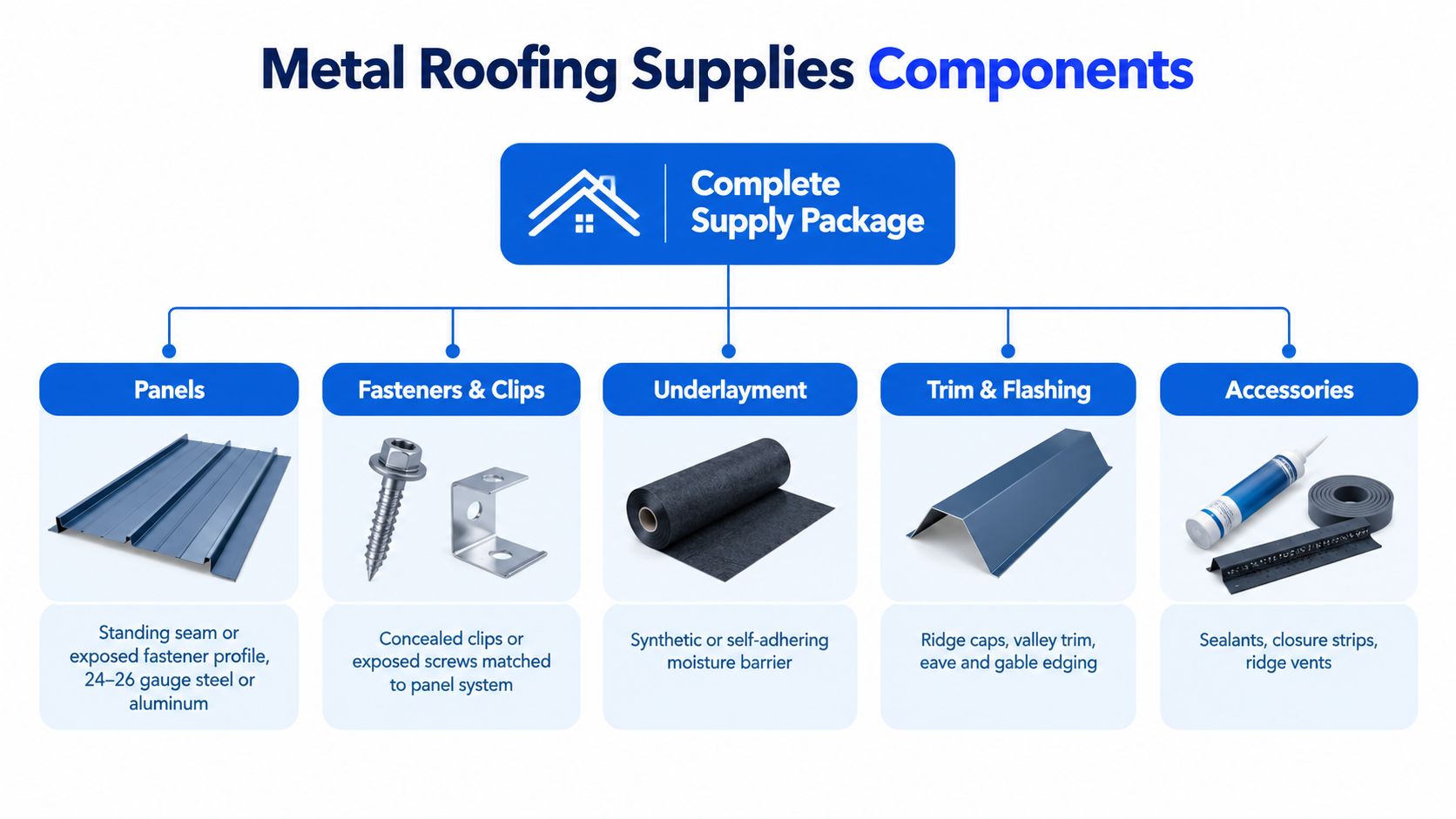
I train estimators to separate the roof into panels, attachment, weatherproofing, trim, and finishing accessories before they price anything. Panels establish the profile and coverage. Clips or exposed screws secure the system. Underlayment protects the substrate during installation and after the roof is closed in. Trim and flashing finish the edges, valleys, walls, ridges, and penetrations. Sealants and closures complete the water-management details.
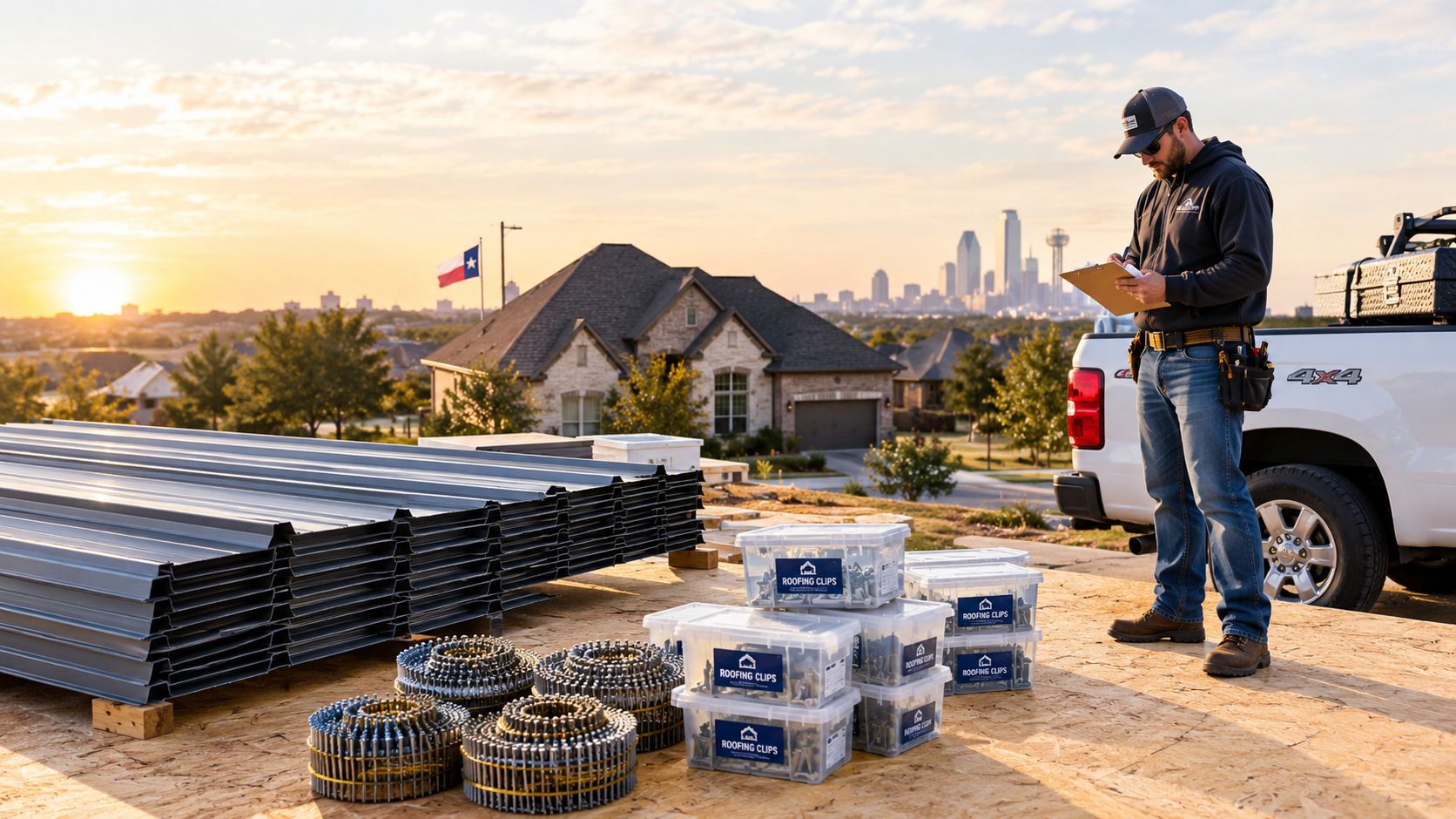
Field rule: If an accessory appears on the installation drawing, it belongs on the purchase order, not on a last-minute callback list.
DFW contractors also need to price for the actual project location. Forest Hill sits between Fort Worth and Arlington, and the city reports more than 300 businesses, making it a practical commercial and residential supply point for nearby work (Forest Hill city materials). Forest Hill is also positioned along the I-20 corridor between Fort Worth, Arlington, and Mansfield, which supports dispatch planning into several western and southern DFW markets (Forest Hill FY26 budget document).
A complete list keeps the crew productive, makes the estimate defensible, and reduces the chance that a substitute component creates a leak or warranty dispute. The cheapest order is rarely the one with the lowest panel price. It's the one that arrives complete and works as specified.
Understanding Metal Roofing Supplies Components
A metal roof package has several independent decisions hidden inside it. The panel profile determines how the roof sheds water and how the installer handles laps, seams, and edges. The attachment method determines how the assembly responds to wind and thermal movement. The underlayment, trim, closures, and sealants control the details where water usually finds a way in.
The main supply categories
Panels may be standing seam, corrugated, or another exposed-fastener profile. Steel is common, while aluminum may suit projects with different corrosion concerns. DFW is inland, but that doesn't mean every coating or fastener is suitable for every building. Industrial emissions, water exposure, incompatible metals, and poor edge treatment can still accelerate corrosion. A coastal-grade corrosion package may be unnecessary for an ordinary inland home, but a project with unusual exposure should be evaluated by coating, substrate, and manufacturer documentation rather than by appearance.
Clips and fasteners are not interchangeable. Standing seam systems generally use concealed clips and fasteners, while exposed-fastener panels use screws with washers selected for the panel and substrate. The clip design must allow the panel to move as temperatures change. A screw that looks close enough can create a fit, movement, or warranty problem.
Underlayment provides a secondary moisture barrier over the deck. Choose it for the roof assembly, slope, exposure, and installation method. Trim and flashing include eave, gable, rake, ridge, valley, wall, headwall, counter flashing, and transition pieces. For corrugated applications, use a coordinated corrugated roof flashing package rather than improvising from unrelated stock.
Why DFW wind changes the order
Standing seam procurement should start with the tested assembly and the building's design conditions. Guidance for metal roofs references ASTM E1592 for structural behavior under uniform static air-pressure difference, while high-wind installation also depends on manufacturer instructions and uplift resistance matched to the design wind pressure. UL 2218 Class 4 is commonly used where hail performance matters (Pacific Northwest National Laboratory metal roof guide).
That means gauge alone isn't an adequate buying rule. Panel profile, clip type, clip spacing, fastener pattern, deck, insulation, and edge details all work together. A complete supply package respects those relationships.
Complete Metal Roofing Supplies Checklist
Before the order is released, compare the takeoff against the roof plan, manufacturer details, and installation conditions. The checklist below is designed for the estimator who has to catch an omission before the truck leaves the yard.
| Supply Category | What to Verify | Common DFW Use Case |
|---|---|---|
| Panels | Profile, coverage, substrate, finish, gauge, length, and tested assembly | Residential replacements in Fort Worth, Arlington, and Mansfield |
| Standing seam clips | Clip type, height, material, spacing, and compatibility with the panel lock | Premium homes and low-slope assemblies requiring concealed attachment |
| Exposed-fastener screws | Length, washer type, coating, substrate compatibility, and approved spacing | Shops, barns, additions, and fast-install projects around Grand Prairie |
| Underlayment | Synthetic or self-adhering type, deck compatibility, laps, and exposure rating | Re-roofing where the deck needs a continuous secondary moisture layer |
| Drip edge | Profile, metal compatibility, eave dimensions, and finish | Eaves that need a clean discharge path into the gutter system |
| Rake and gable trim | Leg dimensions, return, hem, finish, and panel fit | Wind-exposed gable edges in open subdivisions and rural properties |
| Ridge caps | Profile match, width, closure method, venting detail, and lap treatment | Vented or non-vented ridges on pitched residential roofs |
| Closure strips | Profile match, density, UV suitability, and placement | Corrugated and exposed-fastener panels at ridge, eave, and transitions |
| Sealants | Approved chemistry, color, movement capability, and surface compatibility | Sidewalls, penetrations, laps, and detail work where the manufacturer requires sealant |
| Valley and transition flashing | Dimensions, bends, metal compatibility, and connection to adjacent materials | Roof-to-wall changes, valleys, porch tie-ins, and additions |
| Counter flashing | Reglet or surface-mounted detail, height, material, and finish | Masonry walls, commercial parapets, and existing wall conditions |
| Accessories | Ridge vents, pipe boots, snow retention where specified, touch-up paint, and repair materials | Completion work and project-specific penetrations |
Start with the panel manufacturer and profile, then work outward. The clip, screw, closure, and trim must fit that system. Don't buy a generic trim bundle and hope the installer can make it work at the rake or wall intersection.
Check quantities in linear feet as well as pieces. Trim, closures, sealant, and fasteners disappear quickly when the roof has dormers, valleys, skylights, wall transitions, or multiple ridgelines. Include the approved cutting and overlap allowance in the takeoff, then identify which pieces are custom-formed before dispatch.
Practical rule: A complete metal roofing supplies order should let the crew install, finish, and weatherproof the roof without a second trip for basic accessories.
Comparing Standing Seam and Exposed Fastener Metal Roof Systems
Standing seam and exposed-fastener roofs can both be useful in DFW, but they aren't interchangeable packages. The right choice depends on the building, slope, appearance, maintenance expectations, and the tested details available for the assembly.
Standing seam
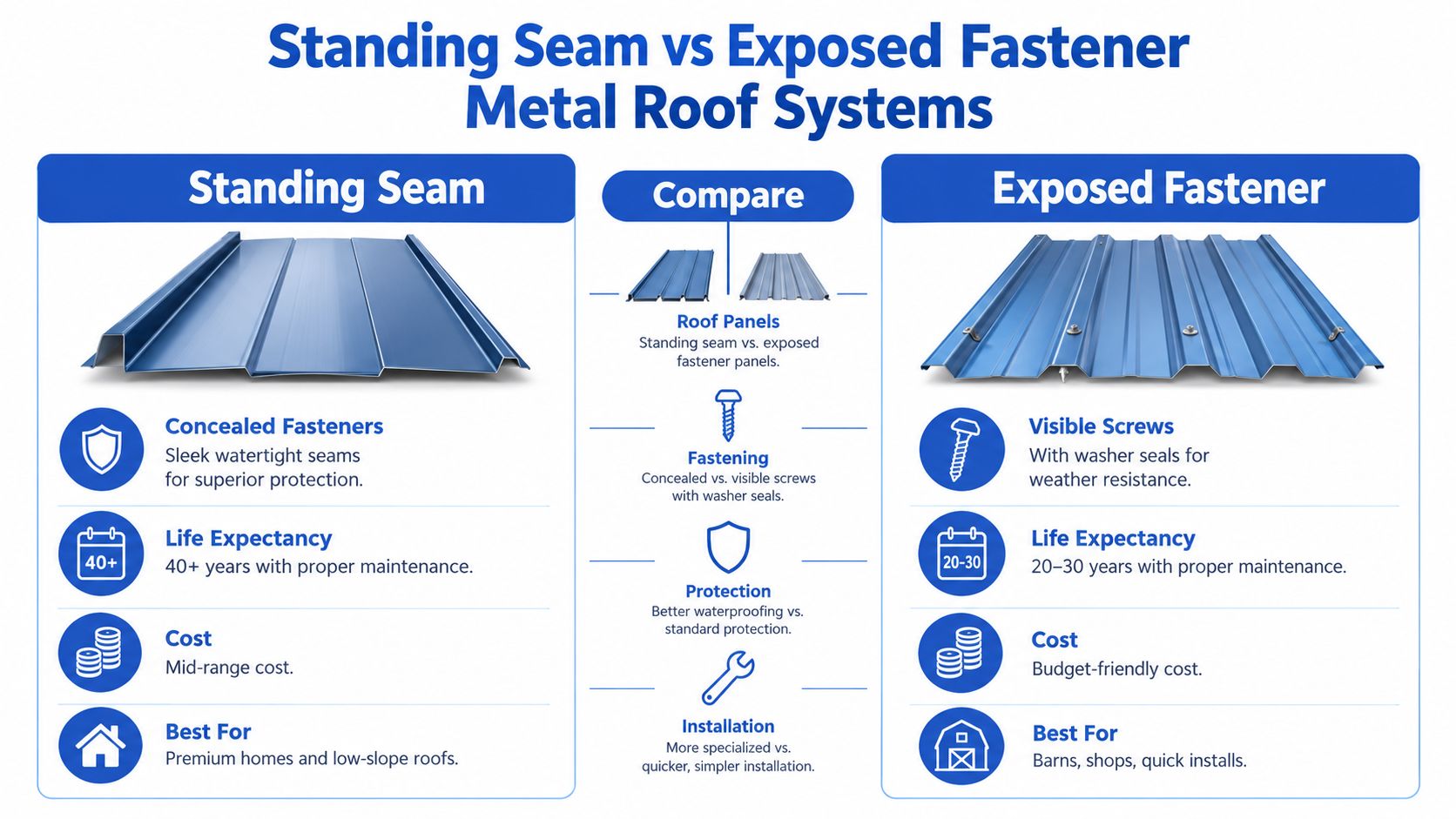
Standing seam uses concealed clips or fasteners beneath raised seams. That appearance suits higher-end homes, additions where clean lines matter, and commercial work where exposed screw heads would create a maintenance concern. The clips also give the panel room to move thermally, provided the system is installed according to its details.
A common benchmark for standing seam panel slope is 1/4:12, although the approved slope depends on the specific product and assembly. Architectural specifications may call for seam heights around 1.5 inches to 2 inches, and some avoid transverse seams to reduce leak paths and movement constraints (University of Houston standing seam specification). Verify the slope, seam height, substrate, clip spacing, and panel length together.
The order normally includes panels, continuous or specified clips, concealed fasteners, underlayment, eave and gable trim, ridge treatment, valley metal, wall flashing, and compatible sealants. A standing seam roof isn't a place to substitute exposed screws because a clip shipment is late.
Exposed fastener
Exposed-fastener panels use visible screws with sealing washers through the panel face. They're often practical for agricultural buildings, workshops, detached garages, porches, and budget-sensitive additions. Installation can be straightforward, but screw placement, washer compression, panel overlap, and future maintenance deserve close attention.
The package typically includes panels, stitch screws where specified, substrate fasteners, closures, ridge caps, eave and rake trim, valley flashing, and sealant. The installer needs the correct screw length for the deck or framing, not just the screw color that matches the panel.
For system-specific ordering, review the standing seam metal roofing materials before combining items from different profiles.
The mistake that causes trouble is mixing supply strategies. A standing seam panel with exposed-fastener trim, an incorrect clip height, or a closure made for another rib profile can create installation friction and compromise the manufacturer's requirements.
Sourcing Metal Roofing Supplies for DFW Jobsites
A supplier decision affects more than material cost. It determines whether the crew receives one coordinated package or spends the morning reconciling multiple purchase orders from different vendors. That distinction matters when a roof is being installed in Fort Worth, Arlington, Keller, Mansfield, or Grand Prairie and the delivery window has to match traffic, access, and crew progress.
Forest Hill is a useful dispatch location for contractors working across the western and southern Metroplex. It's about eight miles southeast of downtown Fort Worth, according to an independent city profile (Texas Almanac profile of Forest Hill). The broader Dallas-Fort Worth-Arlington metroplex includes 11 counties and had a 2020 census population of 7,637,387, with cities including Fort Worth, Arlington, Plano, Irving, Garland, Frisco, McKinney, and Denton (Dallas-Fort Worth-Arlington overview). Those distances and market spread make route planning part of procurement, not an afterthought.
Build the delivery around the work
Send the supplier a complete material schedule with panel lengths, trim breakdown, clips, fasteners, underlayment, closures, flashing, and jobsite contact information. Ask the yard to confirm whether each item is physically available, fabricated, or subject to a separate lead time. One missing ridge cap can be just as disruptive as a missing panel.
Provide practical drop instructions. Note the driveway direction, gate access, crane or forklift needs, roof elevation, staging restrictions, and whether the site can accept a long bundle. A driver who knows the site conditions is less likely to leave material at the wrong entrance or arrive when the crew can't unload.

A single-source order can also reduce compatibility checks between panels, trim, and accessories. Review the available brands and stocked product lines against the project specification, then confirm substitutions in writing before the truck is dispatched.
The best workflow is simple. Release the order only after the supplier reads back the profile, finish, trim, clips, fasteners, delivery location, and requested arrival window. That check catches more problems than a frantic phone call from the roof.
How to Order Metal Roofing Supplies Like a Seasoned DFW Contractor
A reliable order starts before anyone calls the supplier. Use the following workflow for a Fort Worth re-roof, an Arlington new build, or a commercial repair moving through several phases.
Lock the roof system first. Write down the panel profile, metal type, finish, slope, substrate, and attachment method. If the project is standing seam, identify the exact clip and seam configuration instead of ordering by the phrase “metal roof.”
Create a measured takeoff. Break the roof into panel coverage, eaves, rakes, ridges, valleys, walls, penetrations, transitions, and counter flashing. List trim by profile and length, not as one general accessory allowance.
Match the attachment. Confirm screw length for the actual substrate, clip height for the seam, washer or sealant requirements, and attachment spacing from the approved details. The fastener box should be traceable to the panel system.
Add the weather layer. Specify underlayment, closures, ridge ventilation, sealants, pipe boots, and flashing. Check that dissimilar metals won't contact each other where the assembly doesn't permit it.
Review the difficult details. Circle every valley, wall intersection, porch tie-in, skylight, chimney, and roof penetration. These locations determine whether standard trim is enough or custom brake work is required.
Confirm the delivery plan. Give the supplier the site address, contact, access notes, staging area, and preferred drop window. For multi-phase work, separate the order into roof-ready packages so trim and accessories don't get buried under unrelated materials.
Perform a receiving check. Count bundles, inspect finishes, compare trim lengths, verify the clips and screws, and photograph any damage before installation. Keep the packing list with the project records.
A small backup quantity of sealant, closures, and touch-up material can prevent an unnecessary return trip. Do not substitute a different profile because the original item is unavailable. Get approval from the manufacturer or project authority first, especially where the roof carries a tested wind or hail requirement.
When Metal Roofing Supplies Are Actually the Smart Cost Choice
Metal roofing makes sense when the estimator compares the entire ownership burden, not just the panel line. The package may require more specialized trim, clips, and installation discipline than an asphalt roof, but the decision changes when the owner values durability, reduced maintenance, heat management, or resistance to recurring weather exposure.
Market coverage places metal roofing in a major global category. One 2026 projection estimates growth from about $32.1 billion to $51.2 billion by 2030 at a 5.8% CAGR, while another forecast estimates US$19.36 billion in 2025 rising to US$31.56 billion by 2034 at a 5.6% CAGR (metal roofing industry estimates). These estimates differ, but both point to a substantial category rather than a niche material.
The practical question for a DFW property owner is whether the roof's expected service, maintenance, and replacement profile justify the initial package. A contractor should compare:
- Upfront scope: Panels are only one line. Include clips, screws, underlayment, trim, flashing, closures, sealants, labor, and difficult-access details.
- Maintenance exposure: Exposed fasteners, penetrations, finish condition, and edge details may require different inspection attention than a concealed-fastener assembly.
- Weather requirements: Use the tested uplift and hail information that matches the building and site. Don't infer performance from gauge alone.
- Heat strategy: Evaluate cool-roof finishes, ventilation, insulation, and roof color as an assembly. A reflective coating can't compensate for a poorly detailed roof.
- Future use: Solar attachments, additions, and equipment penetrations should be considered before the panels are ordered.
Recent market analysis identifies renovation and replacement work, energy-efficiency requirements, and demand for durable, low-maintenance systems as important drivers of metal roofing demand (metal roofing market analysis). In hot and storm-prone DFW conditions, that makes metal a rational option for some homes, shops, facilities, and remodels. It isn't automatically the lowest-cost answer. It becomes the smart cost choice when the owner pays for the performance the project actually needs and the contractor supplies the complete system to deliver it.
Next Steps for DFW Contractors Sourcing Metal Roofing Supplies
Before the next job starts, turn the roof plan into a component list. Confirm the panel profile, substrate, slope, coating, clips or screws, underlayment, trim, closures, flashing, sealants, and tested performance requirements. Then compare that list with the delivery plan, not just the material quote.
For crews working between Fort Worth, Arlington, Mansfield, Keller, Grand Prairie, and the surrounding Metroplex, a Forest Hill supply yard can simplify dispatch and support same-day jobsite delivery options. Keep the receiving checklist with the estimator's takeoff, and don't release an incomplete package because the panels are already available. Complete planning protects installation quality, schedule control, and warranty compliance.
If the project needs standing seam materials, exposed-fastener panels, coordinated trim, or related roofing accessories, ask for a supplier review before ordering. The right conversation should resolve compatibility, availability, delivery access, and the details most likely to stop the crew.
Blue Lake Roofing Supply provides contractor-focused metal roofing materials, including standing seam panels, trim, fasteners, and clips, with jobsite-direct delivery from its Forest Hill yard and same-day options for qualifying orders. Visit Blue Lake Roofing Supply to review available materials, trade account support, and delivery options for your next DFW roofing project.