A crew can set the shingles clean, nail every course straight, and still get a callback if the underlayment under them was the wrong choice for the slope or the weather. That's the part newer foremen learn the hard way in Fort Worth, Arlington, Forest Hill, Burleson, Mansfield, and the neighborhoods pushing out toward Crowley and Benbrook, the roof fails where nobody can see it first.
On a North Texas reroof, the deck is exposed, the sky can change fast, and the underlayment is what buys you time. It's the hidden layer that helps the roof pass inspection, resist wind-driven water, and protect the warranty when the shingles themselves were installed correctly. For contractors working in the DFW area, especially when material has to move quickly from a local yard to the jobsite, the decision isn't about picking a commodity roll, it's about matching the assembly to the roof and the code. Blue Lake Roofing Supply keeps residential roofing materials moving through its residential roofing materials lineup, which matters when the dry-in window is tight.
Table of Contents
- Introduction Why Underlayment Decides Roof Success in DFW
- What Asphalt Shingle Underlayment Does Beneath the Shingles
- Comparing Felt Synthetic and Ice and Water Underlayment Options
- Spec Compliance and ASTM Standards Contractors Must Meet
- Installation Details for Fort Worth Area Asphalt Shingle Roofs
- Choosing the Right Underlayment for Your DFW Project Conditions
- Final Takeaways and Next Steps for DFW Roofing Crews
Introduction Why Underlayment Decides Roof Success in DFW
A good foreman knows the last sheet of shingle isn't the finish line. If the underlayment was wrong for a low-slope porch tie-in in Forest Hill, or if the eaves on a Mansfield home didn't get the right barrier treatment, the roof can look done and still be vulnerable the first time weather pushes water uphill.
The layer nobody sees
Think of asphalt shingle underlayment as the rain jacket under the work shirt. The shingle is the outer shell, the part the homeowner sees and the sun hits. The underlayment is the secondary layer that sheds water that gets past the shingle, gives the crew a temporary dry-in during the reroof, and separates the shingles from the deck so the assembly doesn't rely on one surface alone.
That hidden role is why underlayment isn't just a box to check. In the Fort Worth area, crews have to think about slope, wind exposure, valley detailing, and whether the roof will face ice-barrier requirements or a standard field assembly. The wrong roll can still let a roof pass for a while, but it raises the odds of a leak at the detail points where water likes to move.
Practical rule: If the underlayment decision feels vague, slow down and ask one question, is this roof asking for simple water shedding, or for a code-specific waterproofing detail at an eave, valley, or low-slope transition?
The next decision is material family. Felt, synthetic, and self-adhering membrane all show up on DFW roofs, but they don't do the same job in the same place. Once a crew understands that difference, the rest of the job gets easier to price, order, and install without surprises.
What Asphalt Shingle Underlayment Does Beneath the Shingles
Underlayment does four basic jobs, and crews get in trouble when they treat all four as if they were one. It sheds secondary water, protects the deck from abrasion and resin transfer, gives the roof a temporary dry-in while shingles are off, and helps the assembly match the code language inspectors expect.
Start with the roof system, not the roll
The easiest way to explain it to a new hand is this, the shingles take the weather, the underlayment catches what gets through. That includes wind-driven rain, splash-back at details, and water that works around fasteners or laps during a storm. It also means the deck isn't naked while the crew is staging bundles, running field courses, and trimming around penetrations.
That's why not every underlayment can be swapped freely. A traditional felt roll can do the basic job in the field, but a self-adhering membrane behaves differently at laps and penetrations, and a synthetic sheet brings different handling and tear resistance. The correct product depends on where it goes on the roof, not just what's cheapest on the purchase order.
Where underlayment stops and detailing takes over
Underlayment is not a substitute for flashing. Valleys, chimneys, skylights, and penetrations still need their own water management details, and eaves can become a separate waterproofing zone when the code calls for it. That's the point many crews miss, they think the field underlayment is doing everything, when the roof really works as a layered system.
A foreman who sees the roof that way orders better. He doesn't ask, “What's the cheapest underlayment?” He asks, “What layer belongs at this slope, this detail, and this weather exposure?” That's the question that keeps callbacks down around Fort Worth, Forest Hill, and the jobs east toward Arlington.
Comparing Felt Synthetic and Ice and Water Underlayment Options
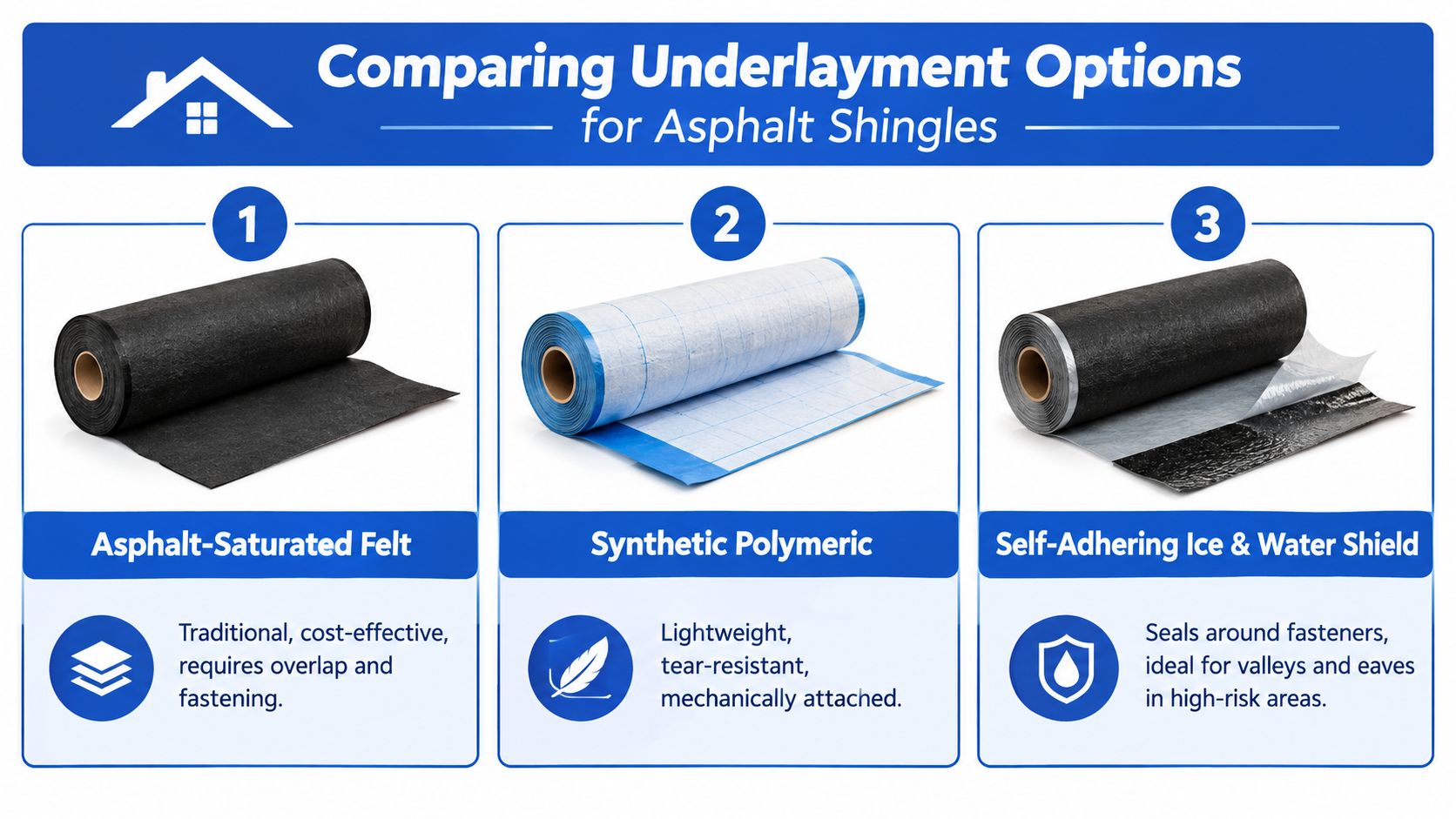
The three families most DFW crews handle are asphalt-saturated felt, mechanically attached synthetic polymeric underlayment, and self-adhering ice and water membrane. They're all underlayment, but they're not interchangeable in the field, and the jobsite tells you which one makes sense if you listen to the slope, the detailing, and the weather risk.
The old ladder still matters
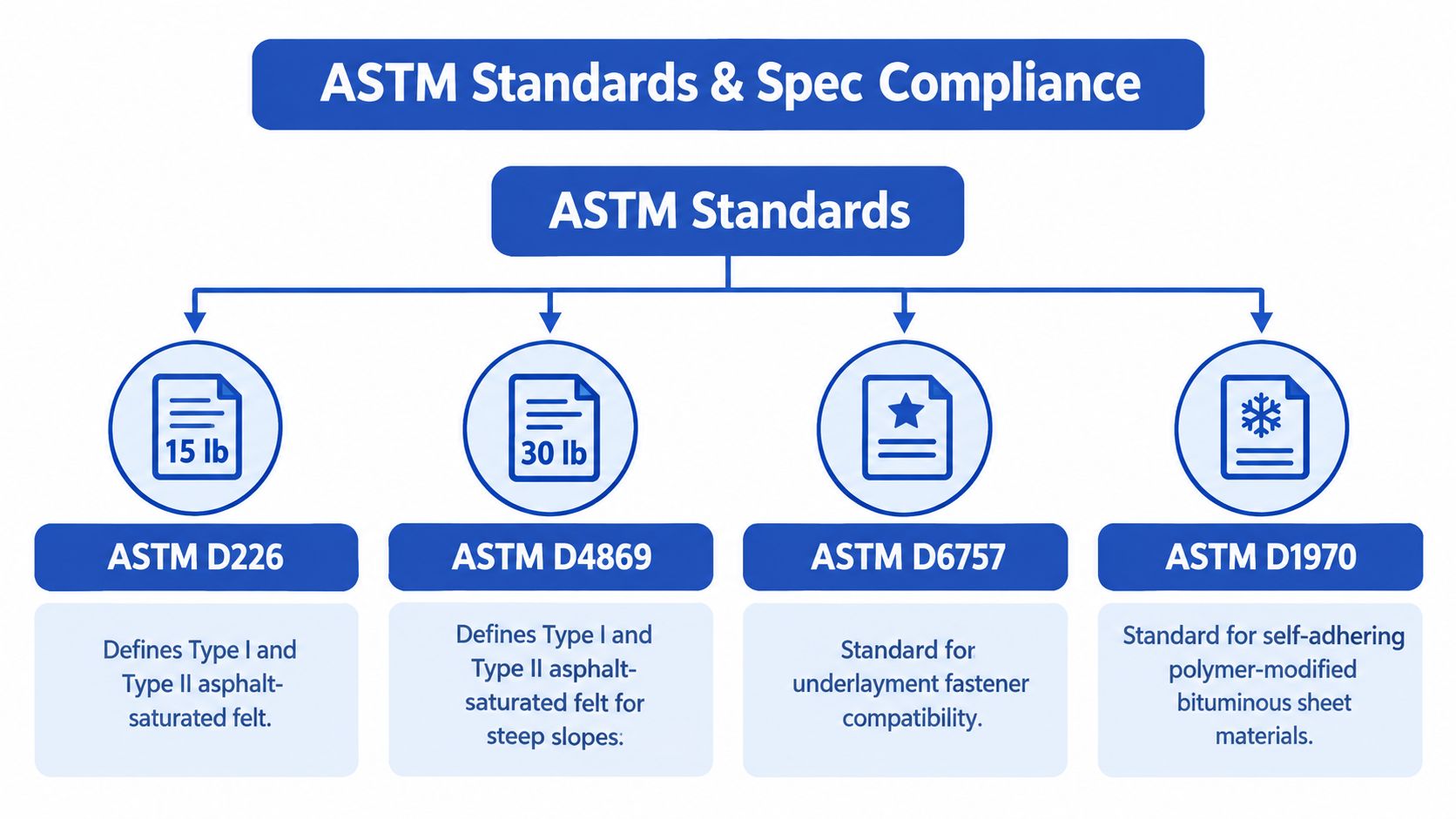
The felt side of the market still carries a historic weight ladder. A neutral industry summary links ASTM D4869 Type I to #8 felt, Type II to #13 felt, Type III to #20 felt, and Type IV to #26 felt, while ASTM D226 Type I is associated with #15 felt and Type II with #30 felt up.codes underlayment summary. That matters because the terms crews hear in the yard, on the bid, and on the inspection form don't always mean the same thing.
| Underlayment Type | Strengths | Limitations | Best Use in DFW |
|---|---|---|---|
| Asphalt-saturated felt | Familiar, widely accepted, easy to source | Less tear-resistant than synthetic, more sensitive to handling | Standard field coverage when the spec calls for felt |
| Synthetic polymeric | Lighter to handle, better tear resistance, cleaner walkability | Must still match the required standard and installation method | Steeper roofs, longer dry-in periods, busy crews |
| Self-adhering ice and water membrane | Seals around fasteners and laps, strong detail protection | Too much product for full-field use on many Texas roofs | Eaves, valleys, penetrations, and other risk zones |
Use the right product in the right place
A self-adhering membrane is a detail material first. It earns its place at valleys and eaves, where water can back up or travel in ways field underlayment can't control as well. On the other hand, a synthetic field sheet is often easier for a crew to walk, fasten, and keep flat on a hot DFW deck.
The wrong choice is usually not dramatic on day one. It shows up later in the place the water always finds first.
For crews working around Fort Worth, Crowley, and nearby neighborhoods, the decision is usually simple once the roof is broken into zones. Use the field underlayment that matches the spec, then upgrade the risk points where water can concentrate. That's a better habit than overbuilding the entire roof without thinking through the actual exposure.
Spec Compliance and ASTM Standards Contractors Must Meet
A roof can look right from the street and still fail the inspection table if the underlayment does not match the spec. For asphalt shingles, code pathways and industry guidance tie the assembly to standards such as ASTM D226, ASTM D4869, ASTM D6757, and ASTM D1970, depending on slope, region, and the roof system being built Roofing Contractor technical details.
What the label has to tell you
The wrapper is the crew's first inspection check. If the roll does not show the right ASTM designation, clean shingle work can still end in a failed inspection. Read the label before the material reaches the ladder, because the mismatch is easier to catch in the yard than after the inspector points to it.
Slope and wind exposure decide a lot of the choice. In higher-wind regions, the IRC and IBC call for two layers in some assemblies, while low-slope steep-roof situations often call for a self-adhering polymer-modified bitumen membrane that complies with ASTM D1970. In Fort Worth, Haltom City, and Benbrook, the foreman should start with the assembly requirements, then match the product to those requirements.
Don't confuse names on the yard ticket
A lot of trouble starts with the phrase No. 30 felt. Products sold under that name are not all the same, and ASTM D4869 includes multiple types, so purchase language and inspection language can drift apart quickly. A crew can load the wrong roll, think the roof is ready to dry in, and still miss the spec.
Field habit: Check the ASTM designation on the wrapper, then match it to the slope and detail requirement before the first roll goes down.
Clear specs make procurement easier. Unclear specs push the problem to the deck, where the wrong underlayment becomes rework instead of a material line item.
Installation Details for Fort Worth Area Asphalt Shingle Roofs
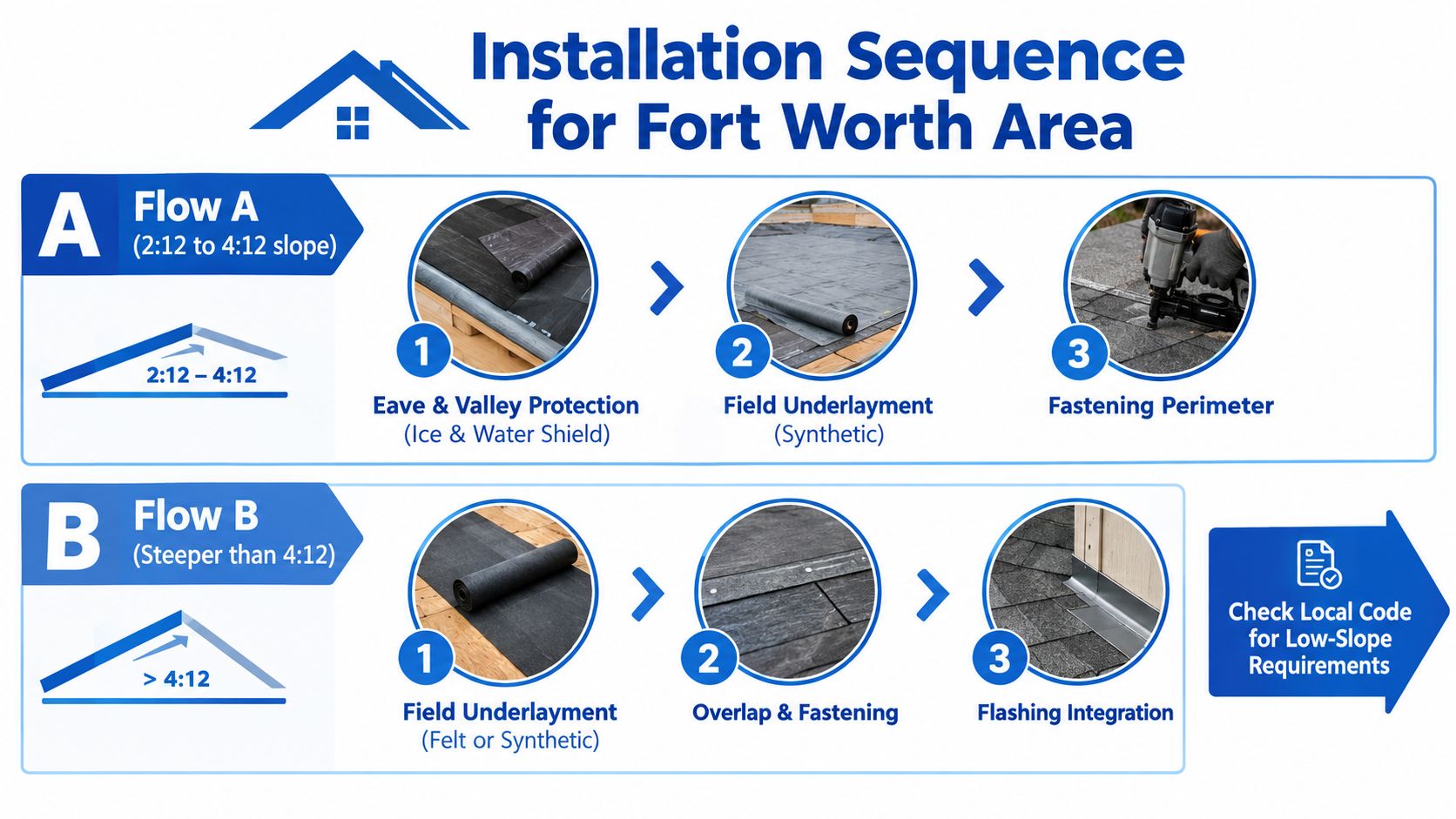
On Fort Worth residential roofs with asphalt shingles, the 2021 code draws a hard line at low slope. For slopes from 2:12 up to 4:12, crews need two layers of underlayment, starting with a 19-inch starter strip at the eaves, then 36-inch-wide sheets with each course overlapping by 19 inches, and end laps set at 4 inches and offset by 6 feet Fort Worth IRC 2021 roof assemblies.
How the low-slope roof gets built
That layout is not busywork. It creates redundancy where water has less gravity help and more opportunity to move sideways. In plain terms, the roof needs a thicker path to keep water from sneaking under the shingles when the pitch is shallow.
Dallas uses the same residential rule set, which means the low-slope logic is familiar across the Metroplex Dallas IRC 2021 roof assemblies. For crews working between Forest Hill, Arlington, and the eastern side of Tarrant County, the same measurements keep showing up, so there's no excuse for guessing on the deck.
The eave detail gets its own treatment
Texas Department of Insurance guidance says asphalt shingle installations need at least No. 15 underlayment, with two layers required for 2:12 to 4:12 slopes and one layer required for 4:12 and greater slopes TDI roof repair guidance. That slope break is the decision point a foreman should teach every new guy to watch for before the first row starts.
For ice-dam risk areas, code language gets even more specific. The barrier must be either two cemented layers of underlayment or a self-adhering polymer-modified bitumen sheet, and it needs to extend from the eave to at least 24 inches inside the exterior wall line. On roofs with slopes of 8:12 or greater, the coverage has to extend at least 36 inches upslope from the eave ice dam protection code summary.
One practical way to keep that straight is to treat the eave as its own waterproofing zone, not as part of the normal field sheet. That's how a crew keeps winter backwater from becoming a spring callback.
Blue Lake Roofing Supply's Fort Worth residential roofing supply page is one place crews can pull the field materials and accessories they need without splitting the order across multiple stops.
Choosing the Right Underlayment for Your DFW Project Conditions
The right choice usually comes from the roof, not from brand loyalty. If the slope is straightforward, the detailing is light, and the crew wants fast dry-in, a standard field underlayment may be the clean answer. If the roof has more risk points, the answer shifts toward local reinforcement at eaves, valleys, and penetrations.
Read the job before you read the product brochure
A warm-weather or mixed-climate roof in Fort Worth doesn't always need premium membrane across the entire field. The better question is where water will concentrate, where fasteners will matter most, and where the crew's time gets spent during tear-off and dry-in. That's why over-specifying peel-and-stick on the whole roof can be a poor trade in many Texas jobs.
A 2025 ARMA technical bulletin identifies ASTM D8257 for mechanically attached polymeric roof underlayment, which shows the category is still evolving beyond the older felt-and-membrane split ARMA steep-slope underlayments bulletin. At the same time, the code-based ice-barrier rule still centers on eaves and specific coverage zones, so the smartest upgrade is often localized, not universal.
A simple decision frame for DFW crews
- Use field underlayment first: Pick the standard that matches the slope and the inspection path, then confirm the roll label before unloading.
- Upgrade the risk zones second: Put self-adhering membrane where the roof geometry concentrates water, especially at eaves, valleys, and penetrations.
- Match labor to material: If the crew is short-handed or the roof is hard to walk, synthetic often makes the install smoother than felt.
- Treat the eave zone separately: Don't assume the field underlayment solves the ice-barrier or backwater detail.
Blue Lake Roofing Supply stocks brands and product lines for residential roofing that fit this kind of project planning, so a contractor can keep field rolls and detail materials aligned with the roof spec instead of improvising on the truck.
The cleanest takeaway for a DFW foreman is simple. Buy the underlayment for the roof you have, not the one you wish you had, and don't spend premium money across the whole deck if only the details need it.
Final Takeaways and Next Steps for DFW Roofing Crews
The roof doesn't care what the invoice called the underlayment. It cares whether the roll matched the slope, the wind exposure, and the detail risk at the eaves and penetrations.
For crews working across Fort Worth, Everman, Saginaw, Arlington, and the surrounding Metroplex, the checklist is straightforward. Verify the ASTM label, match the assembly to the slope, keep the eave zone separate when code calls for it, and make sure the field material and the detail membrane are both on the truck before tear-off starts.
Bottom line: The best underlayment choice is the one that fits the roof design and passes inspection without forcing the crew to guess.
If you're ordering for a mixed-slope neighborhood, keep synthetic field rolls, felt where the spec calls for it, and ASTM D1970 membrane for the localized risk zones. That keeps the job moving, the inspection clean, and the warranty conversation simpler when the roof is done.
Blue Lake Roofing Supply carries residential roofing materials, including underlayment systems that fit asphalt shingle work in the DFW market. If you're lining up a Fort Worth-area job and need field rolls, detail membrane, or jobsite delivery from a local supplier, visit Blue Lake Roofing Supply and get the order matched to the roof before the crew rolls out.