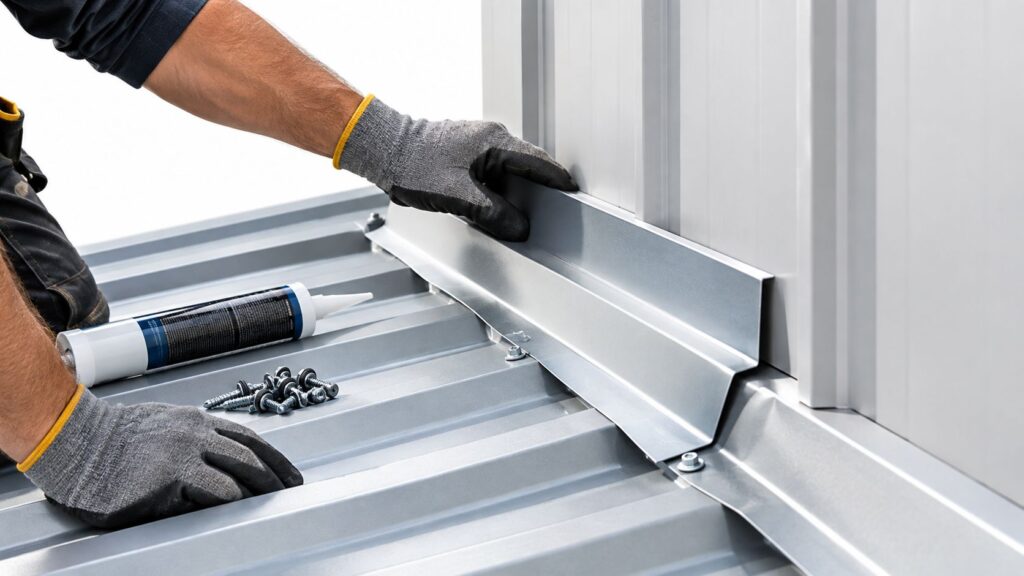
A proper fiber-cement job should give you 30 to 50 years of substrate life, and I'd budget it at about 30 years before I call it the conservative planning baseline. That's the board life, though, not the whole wall, because the finish, caulk, and joint details run on shorter clocks that need attention long before the siding itself is done.
A lot of DFW owners don't realize that until somebody is on a ladder in Benbrook after a hail claim, or on a 22-year-old house in Hurst that still looks decent from the curb but is already asking for finish work. That gap between “still looks fine” and “needs money now” is where callbacks happen.
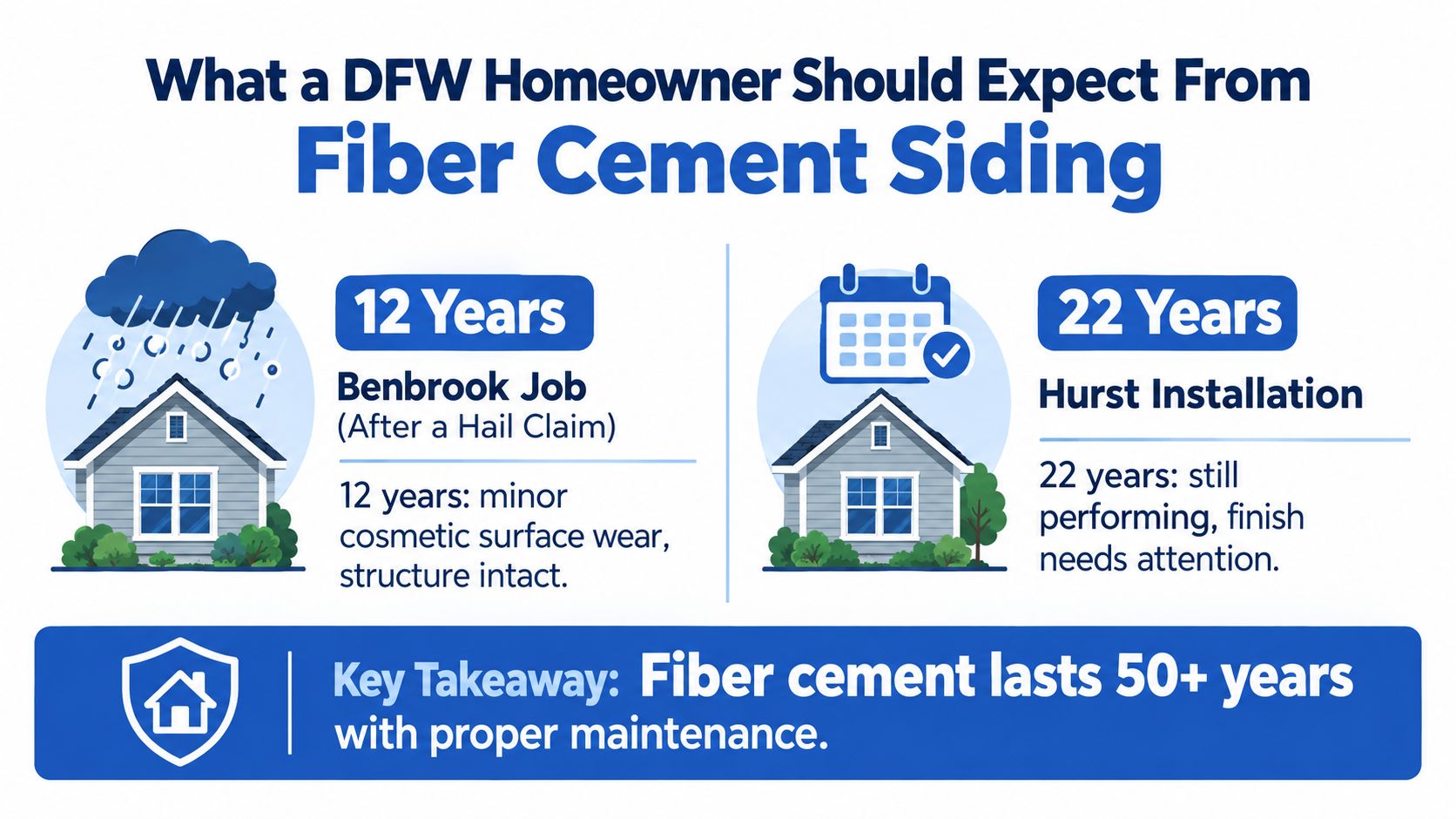
Table of Contents
- What a DFW Homeowner Should Expect From Fiber Cement Siding
- The Three Clocks Every Contractor Must Track
- Installation Quality, Climate, and Maintenance as Lifespan Multipliers
- Factory Finish vs Field Paint and When Each Runs Out
- How Moisture and Freeze-Thaw Cycles Stress DFW Walls
- Annual Inspections, Storm Response, and a DFW Maintenance Calendar
- Warranty Language, Code Compliance, and Pre-Handover Documentation
- Rethinking Lifespan as a Maintenance Program, Not a Calendar
What a DFW Homeowner Should Expect From Fiber Cement Siding
A Fort Worth job walk tells the whole story fast. One side of the street has a 12-year-old Benbrook install that took hail and still has sound boards, just battered paint and a few tired sealant joints. Down the road, a 22-year-old Hurst house still sheds water fine, but the finish is starting to ask for money, and the owner thinks the siding is wearing out when the coating and sealant cycle is what needs attention.
That is how you read fiber cement. The substrate is the cement board itself, and under correct installation and maintenance it is generally expected to last about 30 to 50 years (a lifespan and maintenance guide for fiber-cement siding). For planning, I use 30 years as the conservative baseline, because budgets need a number that survives bad weather, average workmanship, and imperfect maintenance. If you are comparing board profiles and trims, see the siding options stocked for DFW contractors.
Practical rule: if the boards are sound, you are usually dealing with a finish or joint problem, not a siding replacement problem.
The reason this matters in DFW is simple. Heat, UV, spring hail, and freeze swings do not attack the same part of the wall the same way. A south-facing elevation in Arlington ages differently from a shaded side wall in Euless, and a roof-to-wall detail in North Richland Hills can fail years before the field of boards does.
| System Layer | Typical Service Life | DFW Renewal Trigger |
|---|---|---|
| Substrate life | 30 to 50 years | Board damage, repeated water intrusion, widespread failure |
| Finish life | Shorter than the board life | Chalk, fade, peeling, loss of protection |
| Watertight system life | Shortest cycle on many walls | Split sealant, failed flashing, joint movement, leaks |
The Three Clocks Every Contractor Must Track
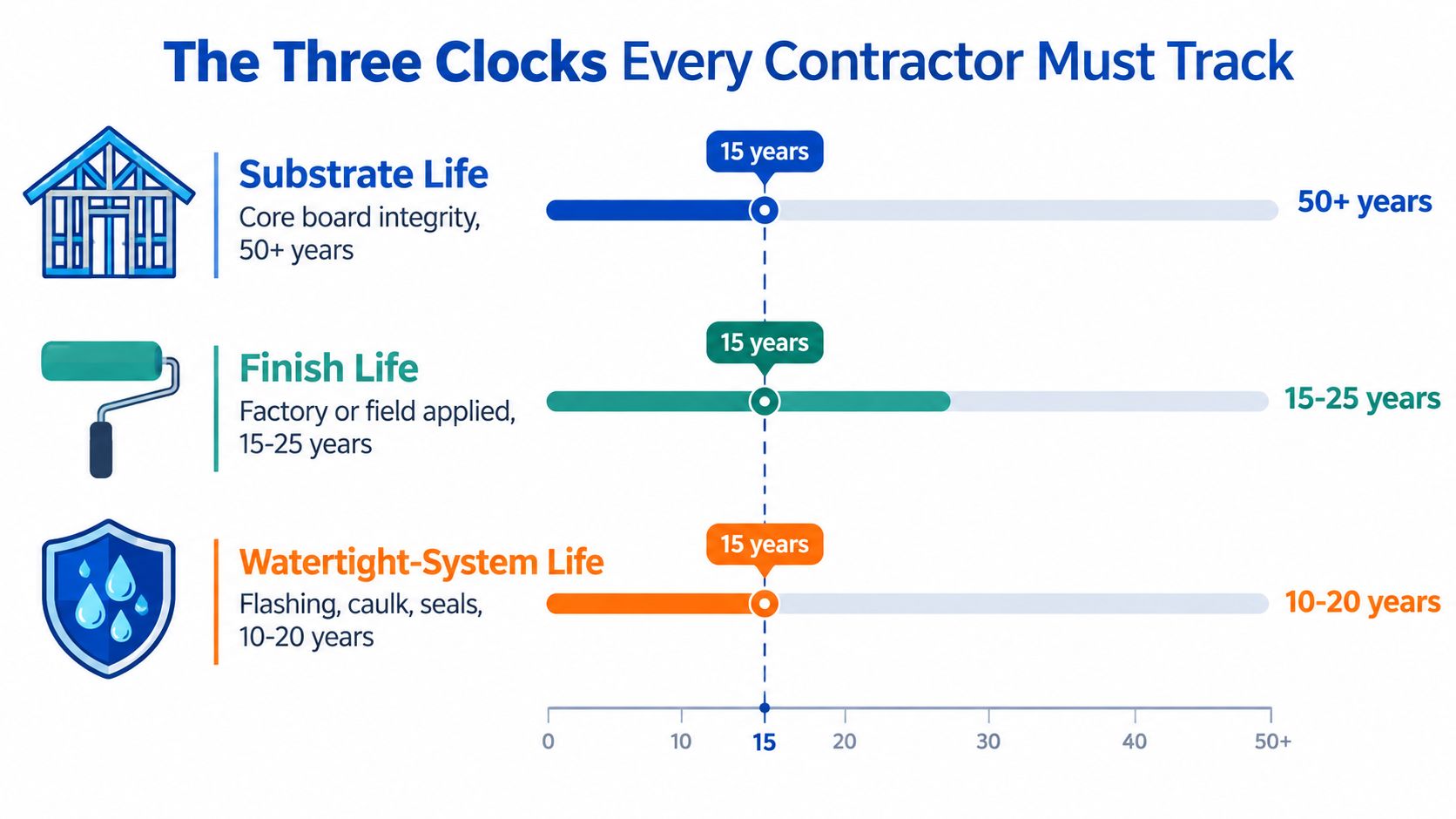
Stop asking one number to do three jobs. On a DFW wall, you are tracking substrate life, finish life, and watertight-system life at the same time, and each clock fails on its own schedule.
Substrate life
This is the board itself, the cementitious panel that gives fiber cement its long run. The board can stay serviceable for decades because it resists rot, insects, and moisture-related deterioration better than many wood products. That is the number people mean when they talk about the siding lasting a long time, and it is the clock that gets closest to the 30 to 50 year range.
Finish life
The coating is a different story. Factory-applied finishes usually hold up longer than field paint, while field-applied paint cycles are shorter and need more maintenance. I have seen Arlington jobs where the boards were still sound, but the west side had chalked hard after years of sun and too little upkeep.
Watertight-system life
Callbacks start here. Sealant joints, flashing, drainage planes, and transitions at windows, doors, corners, and butt joints all run on their own timetable. On warranty callbacks, butt joints and window heads are the first leak points to probe with a moisture meter. A wall can look clean from the street and still be wrong at the joints if the drainage plane or transitions were handled badly. That is how you get trouble in North Richland Hills after a wind-driven rain, or fastener and corrosion issues in Grand Prairie when the wall never had proper water management.
A siding job lasts only as long as its weakest layer. If the board is strong and the sealant is failing, the wall is already in trouble.
| Factor | Effect on Service Life | DFW-Specific Risk |
|---|---|---|
| Installation quality | Pushes the wall toward the top of the range, or cuts it short fast | Poor clearance, bad flashing, sloppy joint treatment |
| Climate exposure | Stresses finishes and sealants first | UV, hail, storm-driven rain, heat cycling |
| Maintenance | Delays cosmetic and watertight-system failure | Missed caulk checks, skipped washdowns, delayed repainting |
Installation Quality, Climate, and Maintenance as Lifespan Multipliers
The board brand matters less than the detail work. A clean install with the right clearances, flashing, fastening, and cut-end treatment can age like a survivor. A sloppy one can fail early enough to make the owner think fiber cement itself is the problem, when the issue is the wall assembly.
What actually moves the needle
Historical field observations matter here. A 2014 review discussing 15 years of observations reported degradation stages beginning in less than 2 years, primary destabilization at about 3 to 5 years, and advanced degradation during the 10 to 30 year period (degradation review). It also noted that service lives of 10 years or less can occur under certain current construction practices. That's not a reason to panic, it's a reason to stop pretending installation discipline is optional.
In DFW, the multiplier effect is obvious. Heavy UV cooks finish layers. July heat punishes caulk and joints. Spring hail bruises coatings and exposes weak spots. January freezes turn absorbed water into movement that the wall has to absorb somewhere, usually at a bad joint or an unsealed cut.
Contractor takeaway
Use a simple rule set on every project:
- Clearance first: keep the siding off grade and away from roof edges where water can wick back.
- Flash like you mean it: every roof-to-wall transition needs proper water shedding.
- Seal the cuts: exposed edges shouldn't be left to soak and swell.
- Inspect before you promise: if the details are wrong, don't sell the wall on lifespan language.
For sourcing trim, siding, and the accessories that keep a wall honest, Blue Lake Roofing Supply carries fiber cement-related materials for DFW contractors and can keep a job moving without the usual yard-to-yard scavenger hunt.
Factory Finish vs Field Paint and When Each Runs Out
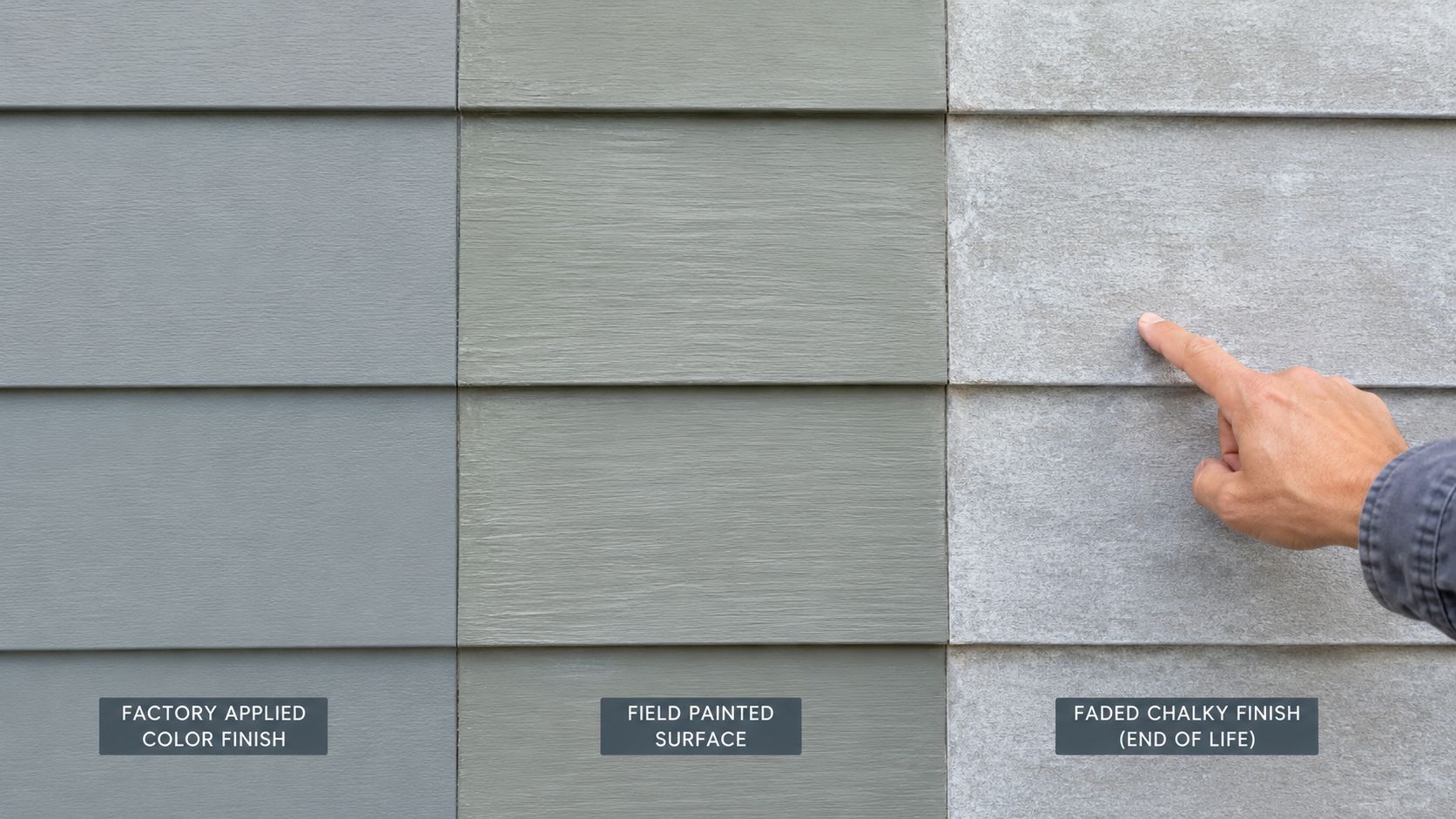
Owners love to blame the board when the color gives out. Wrong target. Most of the time, the finish is what failed, while the siding underneath still has useful life left.
Factory-applied finishes usually run longer than field paint. They can hold up for 15 to 25 years before renewal, while field-applied coatings usually need repainting sooner, often around 7 to 10 years on exposed walls and 10 to 15 years on better-protected elevations (finish and repaint timing). That is a finish cycle, not a siding death sentence. A repaint quote and a replacement quote solve different problems.
Budgeting rule: if the wall is field-painted, plan for more than one repaint cycle inside the board's service life.
Benbrook west elevations get hit first. Same story in Hurst and Arlington on the most exposed sides. UV drives chalking and fade. July heat beats up the coating film and opens caulk. If you want a practical checkpoint, expect the west side to look tired before the shaded north side, so schedule washdowns and gloss checks by year 6. That is where the ugly starts showing up first.
How to read the wall correctly
- Factory finish still intact: the boards are probably fine, and you are looking at maintenance.
- Field paint fading or chalking: repaint before the coating stops protecting the substrate.
- Recoat over an existing finish: common on DFW repaint work, but only if the surface is prepared right and the primer matches the condition of the wall.
A smart owner budgets for finish work on schedule. Waiting until the wall looks cooked and then calling the siding a failure is how people waste money. The board may still be sound. The finish is just the first layer to quit doing its job.
How Moisture and Freeze-Thaw Cycles Stress DFW Walls
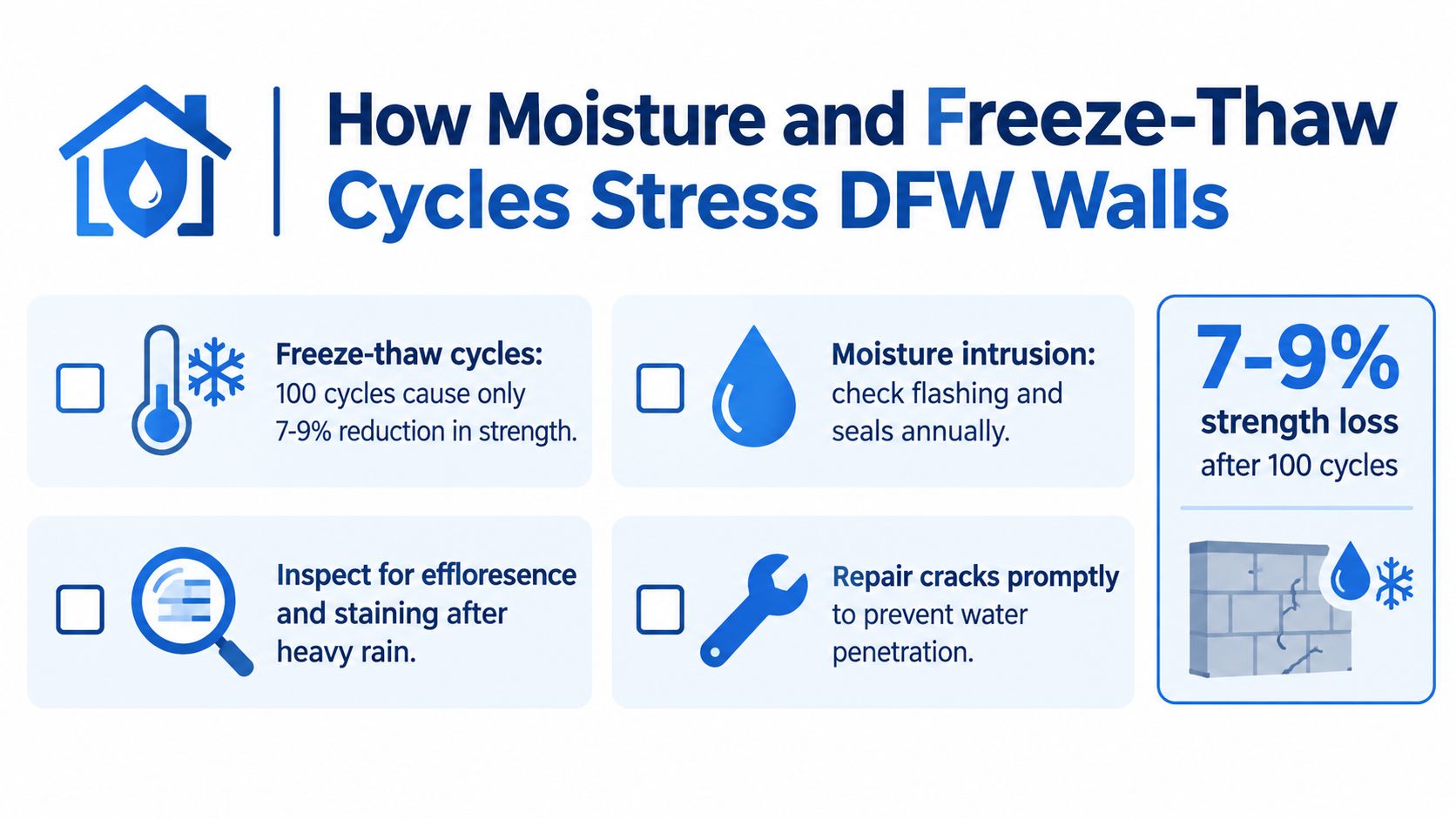
Laboratory testing backs up what field crews see after bad seasons. One assessment found that 100 freeze-thaw cycles caused only a 7 to 9% reduction in modulus of rupture, while soaking and drying reduced toughness more sharply, with reductions reported at about 25% and 35% (lab durability results). The lesson isn't that cold is harmless. The lesson is that water is the true enemy.
What the wall needs to survive
If water can drain, flashings do their job, and fasteners are placed correctly, the board keeps performing. If water sits behind the cladding or keeps entering at a cut edge, that absorbed moisture becomes the failure starter. In freeze-prone weather, expansion can crack weak edges. In hot, humid North Texas weather, repeated wetting and poor drainage do the same kind of damage without the freeze event.
That's why I don't trust any fiber-cement story that ignores detailing. The material can take abuse, but the assembly has to be built to shed water, not hold it.
The specs I'd hold on every DFW wall
- Maintain clearance to grade. Don't bury the board where splashback keeps it wet.
- Slope horizontal trim away from the wall. Flat trim traps trouble.
- Seal cut ends on site. Unprotected edges are asking for early failure.
For contractors who want the wall detail tied back to code-level installation thinking, the Fort Worth area's exterior-wall provisions and manufacturer instructions matter more than casual rules of thumb, and roof-to-wall flashing details should match the wall's water-shedding design. A solid reference for that transition is this roof-flashing guide.
Annual Inspections, Storm Response, and a DFW Maintenance Calendar
Fiber cement lasts longer when somebody walks the building before the damage turns into a claim. That's not glamorous, but it's the difference between a wall that makes it and a wall that gets peeled apart by a few ignored details.
Start with an annual inspection. Look for cracks, loose joints, soft spots at corners, storm bruising, and gutter alignment. Wash the cladding with a garden hose and soft brush every 12 to 18 months, which is the kind of routine that keeps chalk, dirt, and mildew from hiding real damage under cosmetic grime (maintenance intervals and inspection guidance).
What to check after a storm
Fort Worth, Arlington, and North Richland Hills get enough hail and wind to justify a post-storm walk every time the roof does. Check corner caulk, butt joints, flashed openings, and any trim that got impact marks. Log the damage cleanly for warranty purposes. Don't guess later, because “it looked fine” is useless after the fact.
Field habit: write down the date, elevation, damage location, and what was touched up. Good notes beat bad memory every time.
The practical side matters too. Contractors working out of a single DFW yard can get siding trim, sealant, and touch-up materials on the same delivery route instead of losing a day chasing parts. That's where local logistics save a maintenance visit from turning into a second mobilization.
If you're also dealing with gutter discharge or overflow, this local guttering resource is the kind of thing that helps keep water from running straight back onto a wall you just fixed.
Warranty Language, Code Compliance, and Pre-Handover Documentation
A fiber-cement warranty does not cover a sloppy wall. Substrate coverage is usually the long one, while finish, sealant, and workmanship sit in separate buckets, often on separate terms. That split matters on real DFW jobs, because the board may be fine while the coating edge or flashing detail is what failed first.
Fort Worth's adopted exterior-wall provisions allow fiber cement on Types I, II, III, IV, and V construction when the product meets the applicable code section and is installed to the manufacturer's approved instructions (Fort Worth code provisions). The code also ties approval to wind-pressure resistance, wind-speed exposure, and the product's listing and label. That is the paper trail you want when a hail claim or water intrusion claim gets looked at later.
What to hand over before closeout
- Matched wind-performance documentation: prove the product fits the project exposure.
- Fastener record: note type and spacing.
- Sealant record: keep brand and lot information.
- Install guide copy: file the manufacturer instructions with the warranty packet.
File photos of clearances, flashing laps, and lot numbers in the closeout PDF so a 2029 claim can be resolved from records. That package keeps the conversation tied to facts, not memory. Three winters later, the contractor who documented the assembly can separate a product defect from bad detailing.
Rethinking Lifespan as a Maintenance Program, Not a Calendar
Fiber cement is durable, but it's not a set-it-and-forget-it wall. The substrate can run 30 to 50 years, the finish needs renewal on its own cycle, and the watertight system asks for attention much sooner than either of them. The owner who budgets for all three clocks usually gets the long wall life everyone talks about.
That's the DFW reality. Heat, storms, freeze swings, and bad details punish lazy installs. The contractor's job is to specify the wall as a system, deliver it to the listing specs, and hand the client an inspection rhythm, not a replacement year.
If you want the wall to reach the back end of that service-life range, don't treat maintenance as an afterthought. Open a trade account, keep matched trim and sealant SKUs ready for the next service visit, and put a yearly inspection on the calendar before the next hail season rolls through Fort Worth, Benbrook, Hurst, Euless, Arlington, or North Richland Hills.
Blue Lake Roofing Supply stocks fiber cement siding, trim, and soffit for DFW contractors who need the right materials before the next service call. If you're planning a fiber-cement install, a repaint cycle, or a warranty repair, visit Blue Lake Roofing Supply and set up the materials you'll need before the wall starts asking for attention.