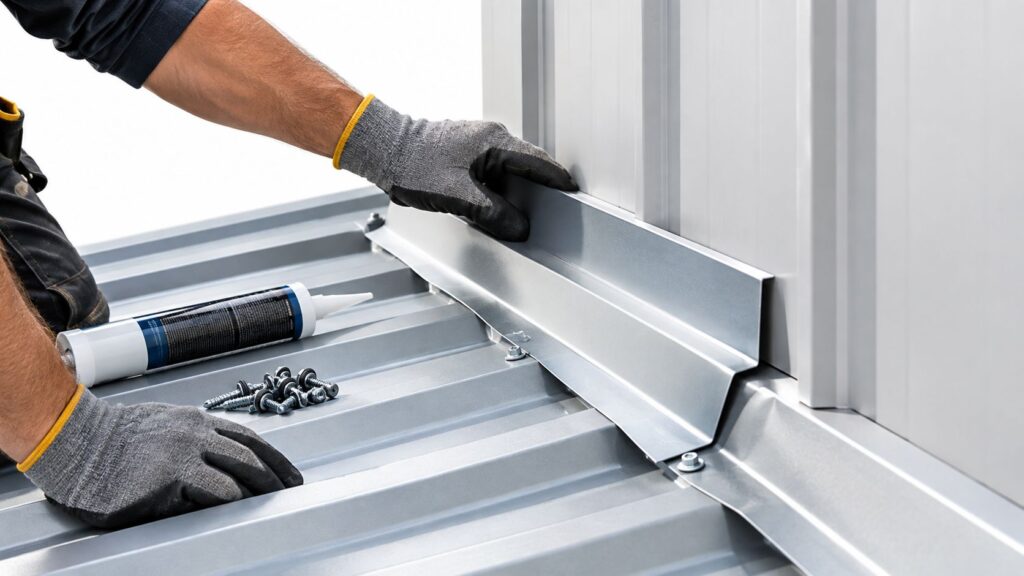
If you're standing on a roof in Arlington, Mansfield, or right here in Fort Worth with tile that still looks decent but a leak call keeps coming back, the problem usually isn't the tile. It's the layer underneath it. Tile sheds water, underlayment stops it, and that concealed membrane is what usually decides whether a tile roof makes it through another season or starts staining ceilings.
Contractors in the DFW Metroplex know the pattern well. A roof can look serviceable from the street, yet the felt beneath it has aged out, the laps have opened, or the fastening details never matched the tile system in the first place. Choosing the best tile roof underlayment is really choosing the right assembly for the slope, code, wind load, and jobsite reality, whether the house is in Benbrook, White Settlement, Lake Worth, Forest Hill, North Richland Hills, Hurst, or Euless.
| Underlayment Family | Key ASTM Standard | Typical Lap | Best Fit in DFW | Main Limitation |
|---|---|---|---|---|
| Asphalt-saturated felt | ASTM D226 Type II or ASTM D2626 Type I | Commonly 2-inch horizontal joints and 6-inch side laps, with higher headlap where required | Straightforward tile reroofs where the code package and manufacturer instructions support it | Shorter service life in heat and moisture exposure |
| Mechanically attached synthetic | ASTM D8257 | Usually product-specific, often with 4-inch side laps and 6-inch end laps in representative specs | Crews wanting lighter handling, better tear resistance, and code-aligned tile systems | Must match the approved fastening pattern and tile assembly |
| Self-adhered membrane | ASTM D1970 | Product-specific, with sealed laps and strict exposure limits | High-exposure roofs, direct-deck work, and areas needing stronger water protection | Installation sequence and temperature limits matter a lot |
Table of Contents
- Why Tile Roof Underlayment Matters in DFW
- How Fort Worth Code Shapes Your Underlayment Choice
- Comparing the Three Main Underlayment Families
- Lap, Fastener, and Flashing Details That Decide Performance
- Why Assembly and Approval Matter More Than the Membrane
- Diagnosing Underlayment Failure Before You Quote a Tile Job
- Matching Underlayment to DFW Jobs and Sourcing From a Local Yard
Why Tile Roof Underlayment Matters in DFW
A Mansfield tile roof can fool a homeowner for years. The clay or concrete still looks clean, the color still holds, and from the curb it seems like the roof should be fine. Then the call comes in after a storm, the leak traces back to aging felt, and the visible tile turns out to be the least important layer in the assembly.
That's the part many people miss. Tile is water-shedding, not waterproof, so the concealed underlayment controls the roof's real service life. Field-oriented industry data reports that concrete tile commonly lasts about 30 to 50 years, while clay tile can last 75 to 100 or more years, but conventional asphalt-saturated underlayment is often reported to need replacement after roughly 18 to 25 years, especially in hot, humid, or coastal environments. Those numbers come from a service-life perspective, not a sales pitch, and they show why the underlayment has to be judged on its own terms, not just the tile above it. Roof lifespan data and service-life comparison
What DFW does to underlayment
North Texas punishes the membrane in ways homeowners don't see. Summer heat bakes exposed sections during repair work, hail and wind events stress weak laps, and long UV exposure on open decks can shorten the useful life of whatever is sitting under the tile. If a crew has to lift tile, replace broken pieces, or wait on material, the underlayment is exposed to the exact conditions it was never meant to take on for long.
Practical rule: if the tile is halfway through its life but the underlayment is near the end of its service window, the roof is already a candidate for underlayment renewal even if the visible tile still looks solid.
That's why a contractor in Fort Worth shouldn't spec the membrane by brand reputation alone. The question is whether the complete roof assembly can keep resisting heat, moisture intrusion, wind-driven rain, and the disturbance that happens when tiles are repaired or replaced. In practice, that means looking at service life, fastening method, flashing details, and climate as one system, not separate line items.
How Fort Worth Code Shapes Your Underlayment Choice
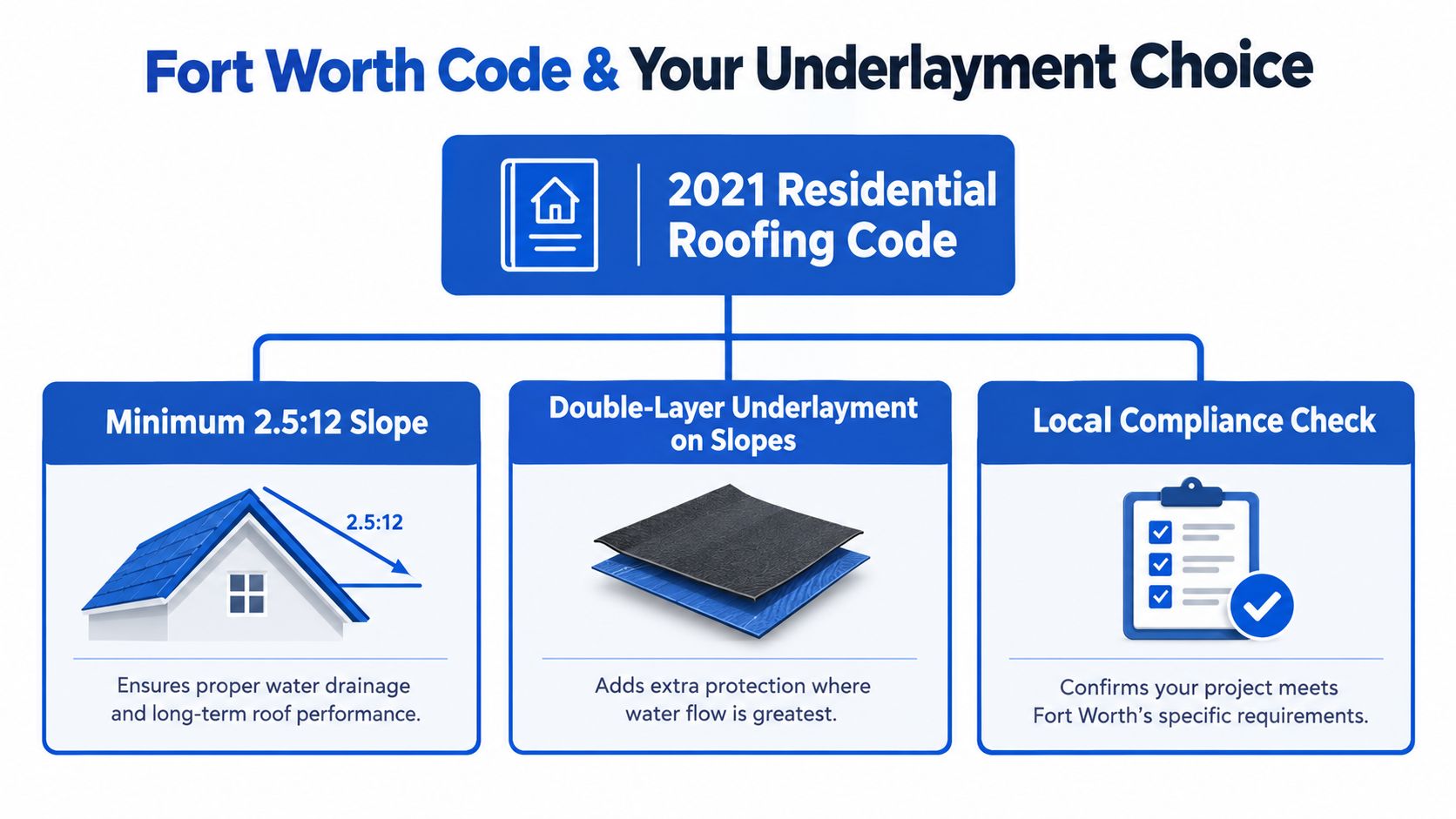
Fort Worth puts clear limits on tile roof underlayment. The city's residential provisions set a minimum slope of 2.5:12, and slopes from 2.5:12 through 4:12 require double-layer underlayment instead of a single layer. The code also names acceptable underlayment standards for clay and concrete tile, including ASTM D226 Type II, ASTM D2626 Type I, and ASTM D6380 Class M mineral-surfaced roll roofing. That matters across Arlington, Grand Prairie, Mansfield, and the rest of Tarrant County because the code narrows the choice to a defined assembly, not a generic membrane. Fort Worth residential roofing provisions
The structural requirements matter just as much. Fort Worth's adopted provisions require tile assemblies to use underlayment installed under the roof-assembly chapter, and the tile has to go over solid sheathing designed for applicable components-and-cladding loads. The chapter also recognizes multiple attachment methods, including loose-laid on battens, mechanically fastened, mortar-set, and adhesive-set tile. A membrane that fits the slope is still the wrong choice if it does not match the deck design and the way the tile will be attached. Fort Worth structural provisions
What this means on the truck and on the roof
For crews working in Benbrook, White Settlement, Lake Worth, Forest Hill, North Richland Hills, Hurst, and Euless, the job starts with two checks. The underlayment has to match the city's adopted code, and it has to fit the tile manufacturer's approved system. If those two documents conflict, the stricter rule governs, and the job file should show how the spec was reconciled before materials ever hit the roof.
Before the first sheet goes down, verify the approved underlayment list against the city standard in writing and keep both documents with the permit packet. That saves time during inspection and avoids the common failure point where a product is legal in general but wrong for the slope, attachment method, or tile assembly on that roof.
Comparing the Three Main Underlayment Families
The three families get lumped together too often, especially in sales conversations. On the job, they perform differently, age differently, and fail differently. A contractor in DFW needs to know what each one is good at before the bid is written, not after the tear-off starts.
Asphalt-saturated felt still has a place
Type 30 felt remains the basic benchmark for some tile jobs, and IIBEC notes it can be used as a common baseline on slopes of 3:12 or steeper. Some manufacturers call for two layers of Type 30 felt or one layer of Type 43 coated base sheet, and Type 43 is commonly favored where rainfall is heavier or the roof needs more durability. Felt still makes sense when the assembly is straightforward and the code package supports it, but it's the least forgiving of the three when the roof sits exposed too long before tile installation. IIBEC tile roof guidance
Synthetic and self-adhered membranes solve different problems
Mechanically attached synthetic underlayments tied to ASTM D8257 are attractive when crews want better tear resistance, easier handling, and a cleaner install on large roof planes. Self-adhered systems tied to ASTM D1970 make more sense when water protection and wind-driven rain resistance are a bigger concern, especially around penetrations, valleys, and direct-deck conditions. Each one can be the right answer, but only if the approval matches the tile assembly and the fastening method.
Quick comparison for DFW takeoffs
| Family | Moisture and wind behavior | Walkability and exposure | Code fit in Fort Worth | Main drawback |
|---|---|---|---|---|
| Asphalt-saturated felt | Familiar, but more vulnerable to long exposure and moisture stress | Adequate for short exposure, less forgiving on long jobs | Acceptable where the approved assembly calls for it | Shorter service life in hot North Texas conditions |
| Mechanically attached synthetic | Better tear resistance and handling | Usually easier to move on during install | Can fit well when the approved system lists it | Fastening pattern and exposure limits have to be followed precisely |
| Self-adhered membrane | Strong water barrier at laps and penetrations | More demanding to install cleanly | Strong option when the assembly and temperature conditions line up | Cold-weather or sequencing problems can create installation issues |
If a crew is already running a tile roof with battens or direct-deck work, the membrane choice needs to match that system, not just the material budget. For crews that also work in asphalt shingles, this roof underlayment guide for shingles can help keep product families straight across scopes.
The best-looking spec sheet doesn't matter if the membrane can't survive the roof's exposure window before tile goes back on.
Lap, Fastener, and Flashing Details That Decide Performance
Most tile underlayment failures are quiet at first. They start at laps, at walls, around fasteners, or at the lower roof edge where wind-driven rain keeps testing weak points. In Fort Worth, those mistakes show up fast on west-facing slopes and at two-story wall intersections from Saginaw to Grand Prairie.
The lap and turn-up measurements that pass inspection
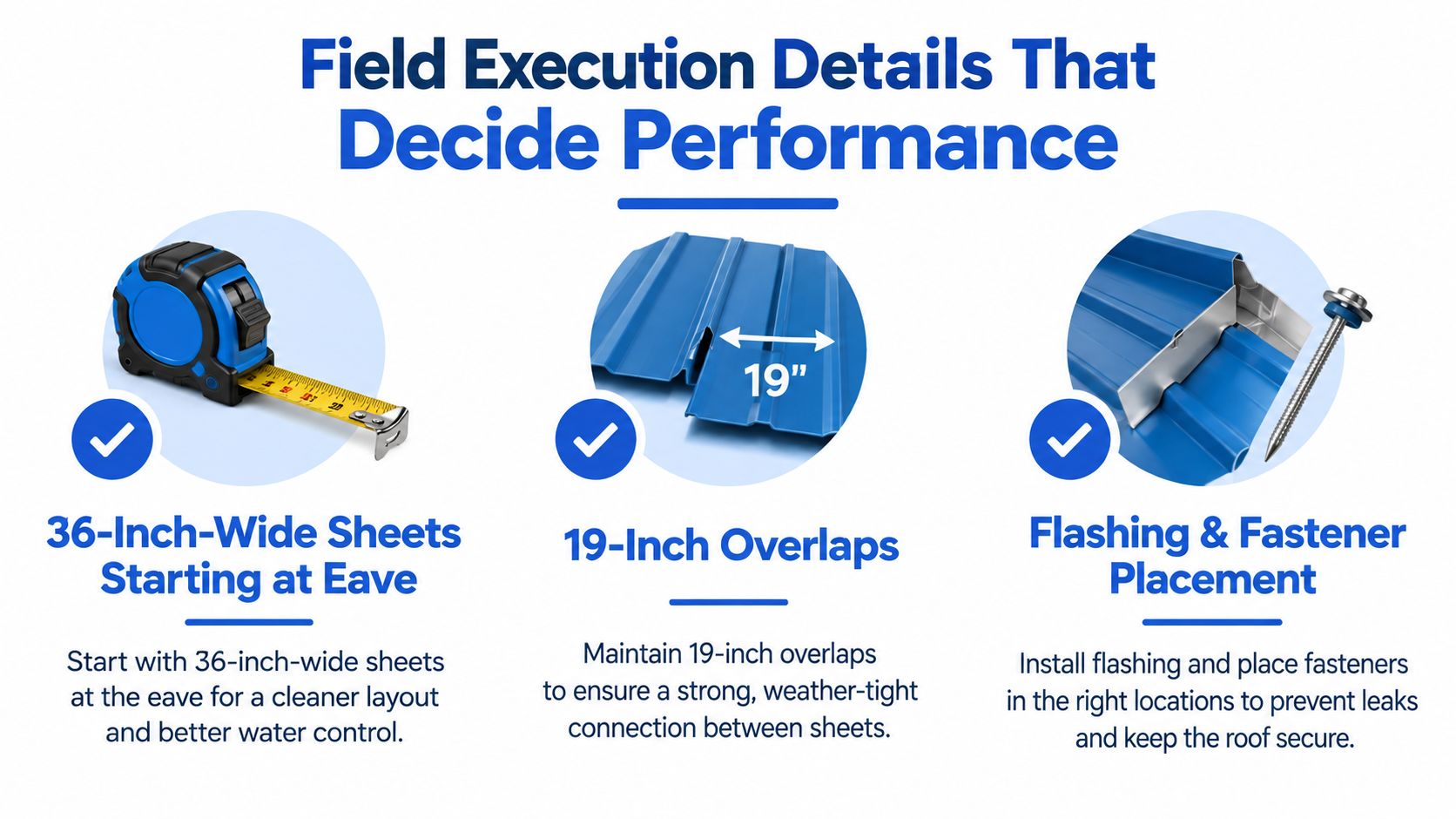
Representative tile-roof specifications call for a 36-inch-wide sheet at the eave, with successive sheets overlapped by 19 inches. They also call for 4-inch side laps, 6-inch end laps, and a minimum 4-inch turn-up at vertical walls. Those are not shop-floor preferences. They control where water can move and where the assembly stops it. representative tile underlayment specification
Fasteners matter more than people want to admit
IIBEC specifically cautions against staples because wind resistance depends on the approved fastening pattern. Corrosion-resistant fasteners belong in the system for a reason, and the membrane has to stay pinned where the assembly expects it to stay pinned. If a crew changes the fastening method to move faster, the product may still go down, but the roof is no longer built to the approved detail.
A crew-lead checklist for the detail phase
- Check the eave start: Confirm the first course begins at the eave and stays square before the next sheets go down.
- Measure the overlaps: Verify the lap pattern against the specified dimensions instead of assuming close enough will pass.
- Inspect all fasteners: Use corrosion-resistant fasteners only, and reject any staple-driven shortcut.
- Verify wall turn-ups: Keep the membrane turned up at vertical walls where the detail requires it.
- Protect exposed areas: Do not leave membrane exposed longer than the manufacturer allows.
Flashing details deserve the same discipline. Crews that stage membrane work with roof flashing tape during the detail phase usually give themselves a cleaner transition at penetrations and edges. That matters because a tile roof only performs as well as its laps, fastening pattern, and flashing tie-ins.
Why Assembly and Approval Matter More Than the Membrane
A lot of contractors still shop tile underlayment the way they shop lunch, by picking the biggest, thickest, or most expensive option and hoping that takes care of the risk. It doesn't. A product can be premium on paper and still be wrong for the roof if the approval, attachment method, tile loading, or slope restriction doesn't match the job.
Florida product evaluation data makes that clear. A representative direct-deck adhered system was evaluated with a maximum design pressure of -45 psf, but the same evaluation also limits tile loading and slope conditions unless battens are used. That's the point most sales sheets skip. Underlayment performance is assembly-specific, so the membrane alone doesn't tell you whether the whole roof is qualified. Florida product evaluation for self-adhered underlayments
Wind, fire, and local jurisdiction change the answer
That matters in Tarrant County, and it matters even more west of Fort Worth where wildfire exposure can become part of the conversation. FEMA's 2025 wildfire guidance says tile itself may contribute to a Class A assembly, but it also recommends considering an enhanced underlayment, such as a mineral-surface cap sheet rated for Class A use, instead of assuming the tile alone is enough. PNNL likewise notes that fire-resistant underlayment may be recommended or required in wildfire areas, and local requirements can exceed the IRC. FEMA wildfire guidance
That's why the smartest spec is the highest-rated code-approved system that matches the tile assembly. A thick roll by itself doesn't protect a deck if the listing, attachment, or exposure sequence is wrong. The crew still has to install it in a way the manufacturer and jurisdiction approve.
Buying criterion that holds up in the field: choose the membrane that fits the approved roof assembly first, then compare service life and cost.
Diagnosing Underlayment Failure Before You Quote a Tile Job
The easiest mistake on an old tile roof is calling it a tile replacement when the actual issue is hidden below the surface. I see that on homes in Crowley, Kennedale, and older parts of Fort Worth where the tile still looks usable, but the membrane has turned brittle and the leaks keep showing up in the same areas.
Start with the deck, not the tile color
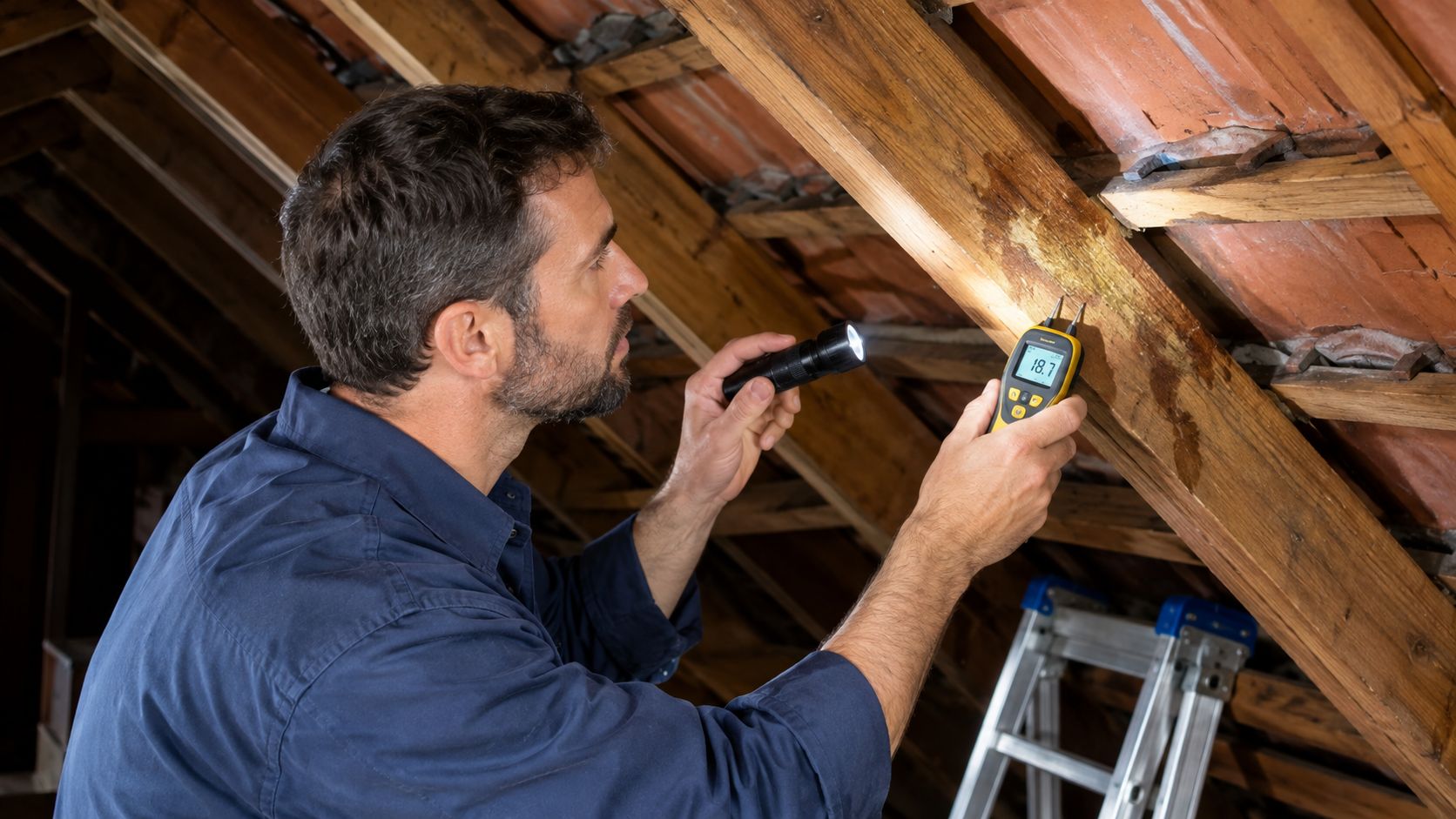
A good inspection begins in the attic with moisture mapping, staining, and a look at the underside of the roof deck. From there, lift tile selectively at the eaves, valleys, penetrations, and any wall intersection that has a history of leaking. Document previous overlays if they're there, because old layers change both the repair plan and the risk profile.
InterNACHI notes that concrete tile can become more porous over time and that freeze-thaw moisture can cause spalling, while PNNL points out that clay and concrete tile can be brittle and break under impact. That matters because a roof can look intact from the street while the concealed membrane has already been punished by age, water, and previous repairs. InterNACHI tile roof reference
What tells you the underlayment is done
- Brittleness at exposed edges: The membrane cracks instead of bending cleanly.
- Wrinkling or shrinking: The sheet no longer lies flat where it should.
- Fastener back-out: The pattern no longer holds the sheet tight against the deck.
- Repeated leak paths: The same locations keep returning on service calls.
If those signs show up, preserve reusable tile where you can, but stop promising a cosmetic fix. The smarter move is often tile salvage with full underlayment replacement, because the visible roof still has value even when the hidden layer doesn't. That approach protects the homeowner's budget and protects the contractor's reputation.
Matching Underlayment to DFW Jobs and Sourcing From a Local Yard
A 6:12 concrete tile reroof in Arlington with battens does not need a fancy answer. It needs a code-compliant underlayment assembly, the right lap pattern, and fastening that matches the tile attachment method and the roof's exposure. A synthetic field membrane can work well when the approved base or cap layer fits the assembly, but the true test is whether the whole system suits the deck and the job, not whether the membrane sheet costs less.
A 3:12 clay tile custom home in Westlake calls for a different setup. Double-layer underlayment is the starting point, and the lap, headlap, and wall detailing carry more weight because water leaves the roof more slowly. Eaves and valleys often justify self-adhered membrane, since those areas take the most water pressure and usually show the first leak history. Concrete roof tile product information
For WUI-adjacent or commercial tile work in Benbrook or Mansfield, the fire-rated assembly question comes back into play. At that point, the cheapest membrane is the wrong filter. The job needs the approved system that fits the jurisdiction, the attachment method, and the fire exposure profile. In that part of the market, “good enough” usually turns into a callback.
Blue Lake Roofing Supply dispatches jobsite-direct deliveries across the DFW Metroplex within an approximate 40-mile radius, with same-day fulfillment on orders placed by 12:00 PM from its yard at 5609 Wichita St, Forest Hill, TX 76119. When underlayment and flashing are ordered together by noon, they can land on the same truck day, so the tear-off crew is not waiting on a second drop. Visit Blue Lake Roofing Supply to source tile underlayment, tile roofing materials, and jobsite-direct delivery from Forest Hill for the next roof you need to get right.