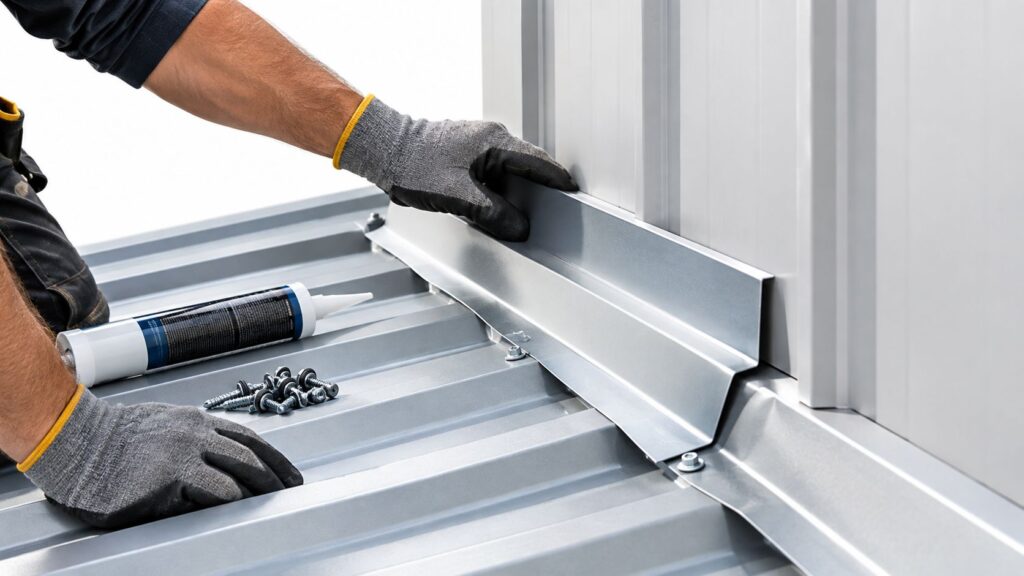
You're halfway through a DFW estimate when the homeowner's architect adds a zinc roof to the finish schedule. The elevation calls for a quiet gray standing-seam surface, the client wants something that won't look dated after the next ownership change, and your usual Galvalume package suddenly isn't the only number on the bid sheet. You need to know whether zinc metal roofing panels fit the roof, the budget, the crew, and the delivery route before you promise anything.
That decision looks different in Fort Worth than it does in a European design catalog. Forest Hill, Arlington, River Oaks, Westworth, Haltom City, and the wider Dallas–Fort Worth metroplex bring different exposure conditions, roof details, access challenges, and scheduling needs. Here's the contractor's read on where zinc works, where it creates trouble, and when its premium earns a place in the takeoff.
Table of Contents
- Why Zinc Is Landing on More DFW Bid Sheets
- How Zinc Patina Works and Why It Protects the Panel
- Profiles, Joints, and Panel Types Contractors Actually Stock
- Installation Decisions That Matter on Texas Jobsites
- Zinc Against Steel, Aluminum, and Copper at a Glance
- Corrosion Reality in the DFW Climate
- When Zinc Is Worth the Premium on Your Next Project
Why Zinc Is Landing on More DFW Bid Sheets
A Fort Worth contractor recently reviewing a modern residential bid may see zinc listed beside familiar options such as Galvalume, aluminum, and copper. The request usually starts with appearance, a matte gray finish that suits contemporary architecture and many HOA environments. It often continues with lifecycle expectations, concealed fasteners, and a roof intended to remain part of the building rather than become a replacement item for the next owner.
That doesn't make zinc an automatic upgrade. Recent pricing guidance places zinc installation around $10 to $25 per square foot, making it a premium roof system rather than a budget substitute for coated steel. The practical question is whether the design, ownership horizon, and roof geometry justify paying more at installation. Modernize's zinc roofing guide also describes zinc as relatively emerging in North America compared with its more established use in Europe, so availability and installer familiarity still affect the estimate.
What has changed at the counter
Zinc now appears more often in architect-led residential work, light-commercial buildings, and European-influenced designs around Fort Worth, Arlington, Plano, Irving, Denton, and the surrounding suburbs. That interest reflects a combination of aesthetic control and long service potential, not merely a desire for an unusual metal. The Dallas–Fort Worth–Arlington metroplex is the most populous metropolitan statistical area in Texas and the Southern United States, with principal cities including Dallas, Fort Worth, Arlington, Plano, Irving, Denton, Richardson, and Grapevine, according to the metroplex overview.
For contractors in Tarrant, Denton, or Collin County, the conversation is often less “zinc or copper” and more “zinc or a high-quality coated steel system.” Zinc can deliver a restrained appearance without copper's distinctive color shift, while standing-seam assemblies offer a cleaner field than exposed-fastener panels.
Bid-sheet rule: Price zinc as a complete system, not as a panel-only upgrade. Clips, seams, trims, substrate preparation, handling, labor, and delivery can change the decision.
A location-specific estimate matters across DFW because the metroplex covers 9,286 square miles, larger than Connecticut and Rhode Island combined, as Visit Dallas Fort Worth explains. A project in Forest Hill isn't planned the same way as one in Denton or a restricted-access site near Plano. Material routing, panel length, crew experience, and protection from jobsite traffic all belong in the first conversation.
How Zinc Patina Works and Why It Protects the Panel
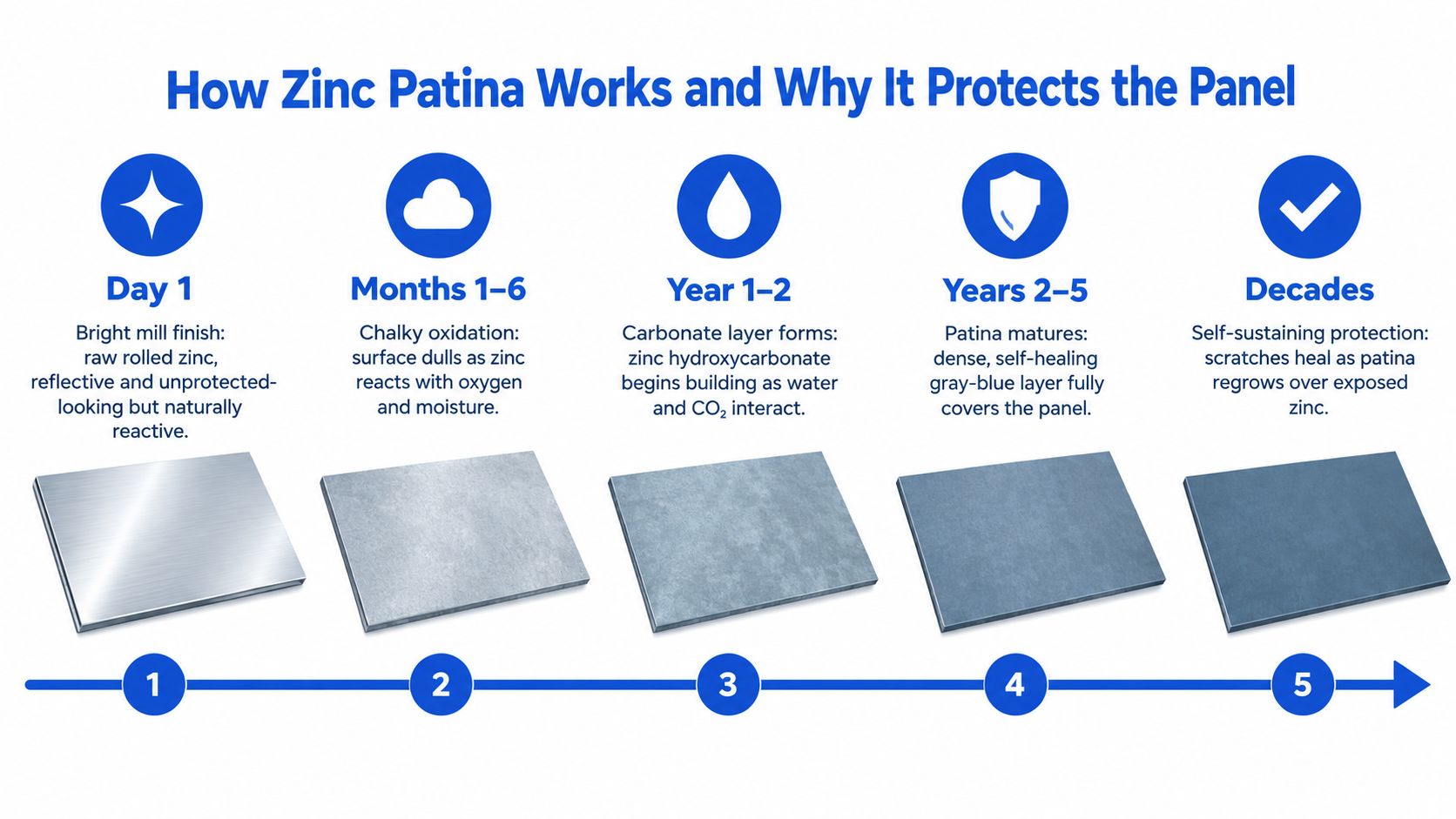
A zinc roof installed in Forest Hill will not keep its bright mill finish for long. Oxygen, moisture, and carbon dioxide react with the exposed surface, forming protective compounds that slow the consumption of the underlying metal. VMZINC's durability information identifies zinc hydroxycarbonate and related surface products as part of that protective process.
The change is gradual. Fresh zinc looks brighter and more reflective, then becomes duller as oxidation begins. A steadier gray or blue-gray appearance develops as the carbonate layer builds. Patina is therefore both a visual change and a working surface layer, not a factory-applied coating that stays unchanged.
What the homeowner will see
Patina rarely develops at exactly the same pace on every roof plane. Shade, moisture, dust, runoff, and orientation all affect the appearance. A north-facing slope under tree cover may weather differently from a sun-exposed south-facing slope, so avoid promising one uniform color transition across the entire building.
DFW's inland position means less direct coastal salt exposure than a marine market, but that does not make every site identical. Traffic corridors, industrial activity, construction dust, and the drier conditions common farther west can influence how the surface looks and how quickly it changes. A Forest Hill delivery within the usual 40-mile service radius may be simple to schedule, but the crew still needs to protect panels from dust, standing water, and uncontrolled runoff before installation.
The patina can reform over minor surface damage because newly exposed zinc reacts with the surrounding environment. That property does not repair deep gouges, poor seams, incompatible metals, or drainage defects. Those problems still require correction at the jobsite.
Set expectations before the first rain
Early runoff can carry fine zinc reaction products away from the panel. On light masonry, unfinished concrete, and other porous materials, the water may leave temporary or persistent staining. Explain that possibility before installation so the first storm is not mistaken for a panel failure.
Use compatible flashings and plan each discharge point. A clean drip edge, controlled drainage, and properly terminated downspouts protect the finished appearance more reliably than trying to force patina development to follow a schedule. The premium makes more sense when the owner values a changing natural finish and long service potential, and less sense when a perfectly uniform color is the main requirement.
Profiles, Joints, and Panel Types Contractors Actually Stock
The zinc profiles a DFW contractor can source depend on the supplier, finish, panel length, and project specification. Standing seam is usually the easiest transition for a crew that already installs Galvalume, but zinc behaves differently under the tools. It's softer, more prone to visible handling marks, and less forgiving when a seamer, clip, or cut edge is used incorrectly.
Mechanically seamed standing seam provides a concealed-joint roof with field-locked ribs. Snap-lock systems can suit residential work where the roof geometry and wind requirements match the product. Flat-lock panels create a more architectural, shingle-like field and can handle details that don't fit long continuous panels, but they demand disciplined substrate and joint work. Batten seam offers another traditional expression, though it's less likely to be an everyday stock item than standing seam.
The commonly cited pitch guidance for architectural zinc places suitable roofs above 1:12, while product-specific installation requirements still control the final specification. BNP Media's architectural zinc article also notes architectural zinc roof service lives of 80 to 100 years, subject to product and local conditions.
| Profile | Typical Application | Joint Style | DFW Stock Status |
|---|---|---|---|
| Mechanically seamed standing seam | Modern residential and light-commercial roofs | Field-locked vertical seam | Most realistic package option through regional suppliers |
| Snap-lock standing seam | Residential roofs with compatible geometry | Snap-together concealed joint | Commoner than specialty architectural profiles |
| Flat lock | Architectural low-slope panel fields and detailed elevations | Folded interlocking seams | More likely to be ordered for a specific project |
| Batten seam | Traditional or shingle-replacement appearance | Raised batten-covered joint | Usually specification-driven rather than routine stock |
What to confirm before ordering
Ask whether the supplier is holding finished panels, compatible coils, or only the accessories. A “zinc package” may still require separate sourcing for clips, trims, closures, sealants, and custom details. Typical panel thickness and coil availability also vary by manufacturer and finish, so don't assume that the profile you use in a Galvalume package can be substituted without checking forming requirements.
For a crew moving from Galvalume standing seam, snap-lock or mechanically seamed standing seam is usually the most familiar starting point. Flat-lock and batten systems require more attention to layout, folding, joint treatment, and visible surface protection. Your standing seam metal roofing supply information is a useful reference point when assembling the broader system, but zinc compatibility still needs confirmation for every component.
Delivery also affects panel selection. A Forest Hill route serving sites within roughly 40 miles can make jobsite-direct delivery practical, but long panels still need a safe loading, transport, staging, and lifting plan. A panel that fits the supplier's route may not fit the driveway, laydown area, or crane plan.
Installation Decisions That Matter on Texas Jobsites
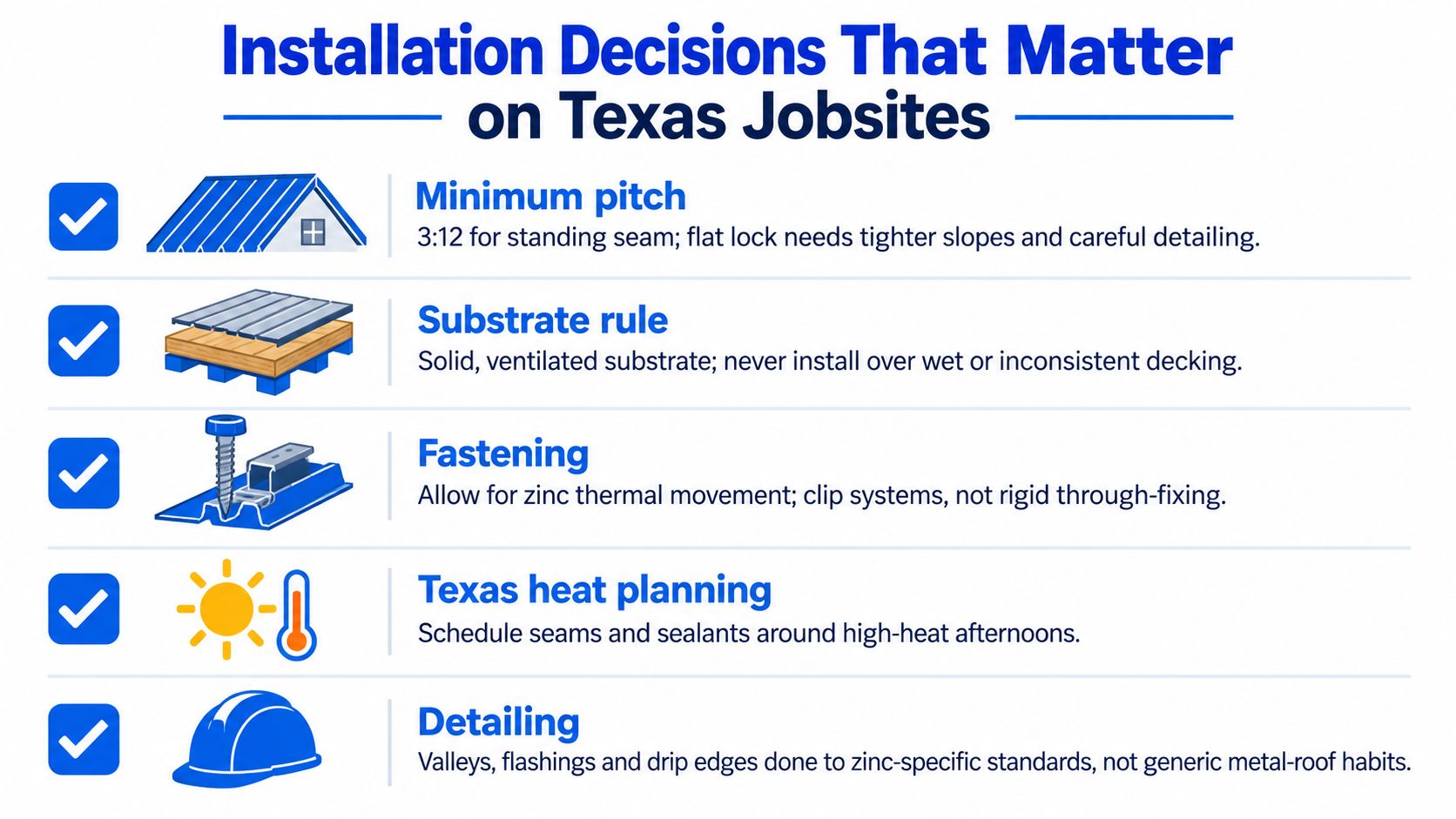
Zinc rewards accurate installation and exposes shortcuts quickly. Start with slope. Standing-seam zinc is commonly specified at a minimum of 3:12 in practical installation guidance, while flat-lock systems need tighter slopes and more deliberate water management. The product manufacturer and approved details govern, but a contractor should reject any roof geometry that depends on sealant alone to defeat slow drainage.
The substrate must be solid, dry, consistent, and compatible. Keep zinc away from direct contact with ACQ-treated lumber and black steel, and use separation layers where the assembly requires them. A high-temperature ice-and-water shield paired with a slip sheet is a stronger Texas strategy than treating standard 30-pound felt as the only defense beneath a dark, heat-loaded roof.
Let the roof move
Zinc expands and contracts with temperature, and North Texas roofs experience substantial heat exposure and seasonal cycling. Use clip systems that permit designed movement instead of rigidly fixing every panel through the face. The exact clip arrangement belongs to the system manufacturer, but the field crew must understand that a concealed fastener is not automatically a movement-friendly fastener.
On snap-lock work, a common planning reference is 24 inches on center for clips. Mechanically locked seams in hail-exposed areas may require closer spacing, often 16 to 18 inches on center, depending on the tested assembly and local requirements. These figures need to be checked against the specified system rather than copied from another metal roof.
Treat valleys and surfaces as failure points
Dead valleys behind second-story walls are a frequent trouble spot because water, leaves, and fine debris can remain trapped. If the design creates standing water, change the drainage strategy before the zinc arrives. A clean valley, positive discharge, and compatible flashing detail matter more than adding sealant after the fact.
Schedule seaming and sealant work around the heat. Wear clean gloves, protect finished faces during staging, and don't cut panels over completed roof surfaces. If a panel gets lightly marked, brush away loose debris and follow the manufacturer's repair guidance. Solvent wiping can spread contamination or change the surface appearance.
For related flashing components, review roof flashing for corrugated roofing while still matching the detail to the zinc system rather than treating corrugated-metal details as interchangeable.
Zinc Against Steel, Aluminum, and Copper at a Glance
A DFW estimate often includes several workable metal choices. Galvanized steel and Galvalume usually appeal to owners focused on familiar procurement and a lower first cost. Aluminum reduces weight and performs well in some corrosion exposures. Copper delivers a distinctive architectural finish, but its material cost can exceed the owner's allowance. Zinc occupies a different position: a premium roof metal with a restrained appearance and a long service horizon.
| Metal | Expected Service Life | Installed Cost ($/sq ft) | DFW Climate Fit |
|---|---|---|---|
| Zinc | About 80 to 100 years in typical service, with severe exposure potentially reducing expected life | About $10 to $25 | Strong fit for architectural roofs with correct slope, separation, detailing, and trained installation |
| Galvanized steel | Varies by coating, thickness, exposure, and maintenance | Get a current project quote | Practical and familiar, but coating damage and incompatible runoff require attention |
| Galvalume | Varies by product, coating, thickness, and exposure | Get a current project quote | Often a strong budget and availability choice for standard DFW work |
| Aluminum | Varies by alloy, thickness, finish, and exposure | Get a current project quote | Useful where low weight or corrosion resistance matters, with attention to denting and movement |
| Copper | Long service potential, with appearance and cost changing over time | Get a current project quote | Visually distinctive but often difficult to justify when the design doesn't require copper |
The zinc service-life range is documented in VMZINC's durability reference. It describes zinc as a long-life roofing material, with a typical initial thickness of 0.7 millimeters and corrosion around 1 micrometer per year in suitable conditions. Those figures do not remove the need to review slope, runoff, industrial exposure, workmanship, and maintenance. In North Texas, a roof near contaminated runoff, heavy traffic, or persistent dampness deserves more scrutiny than a clean suburban installation.
Delivery planning also affects the comparison. Within Blue Lake Roofing Supply's 40-mile Forest Hill delivery radius, zinc's premium material cost can make consolidated deliveries and protected staging more important. A rushed replacement panel or poorly timed shipment adds jobsite friction that a familiar steel order may avoid.
Estimator's view: Steel usually wins when the owner wants predictable procurement and a controlled first cost. Zinc earns consideration when the roof's appearance, service horizon, and architectural value justify paying more for the specified assembly.
Hail exposure requires an assembly-level review. Panel thickness, seam design, substrate, clips, fastening, and tested performance determine whether the roof suits the project. A metal's name alone is not enough to select it for a DFW bid.
Corrosion Reality in the DFW Climate
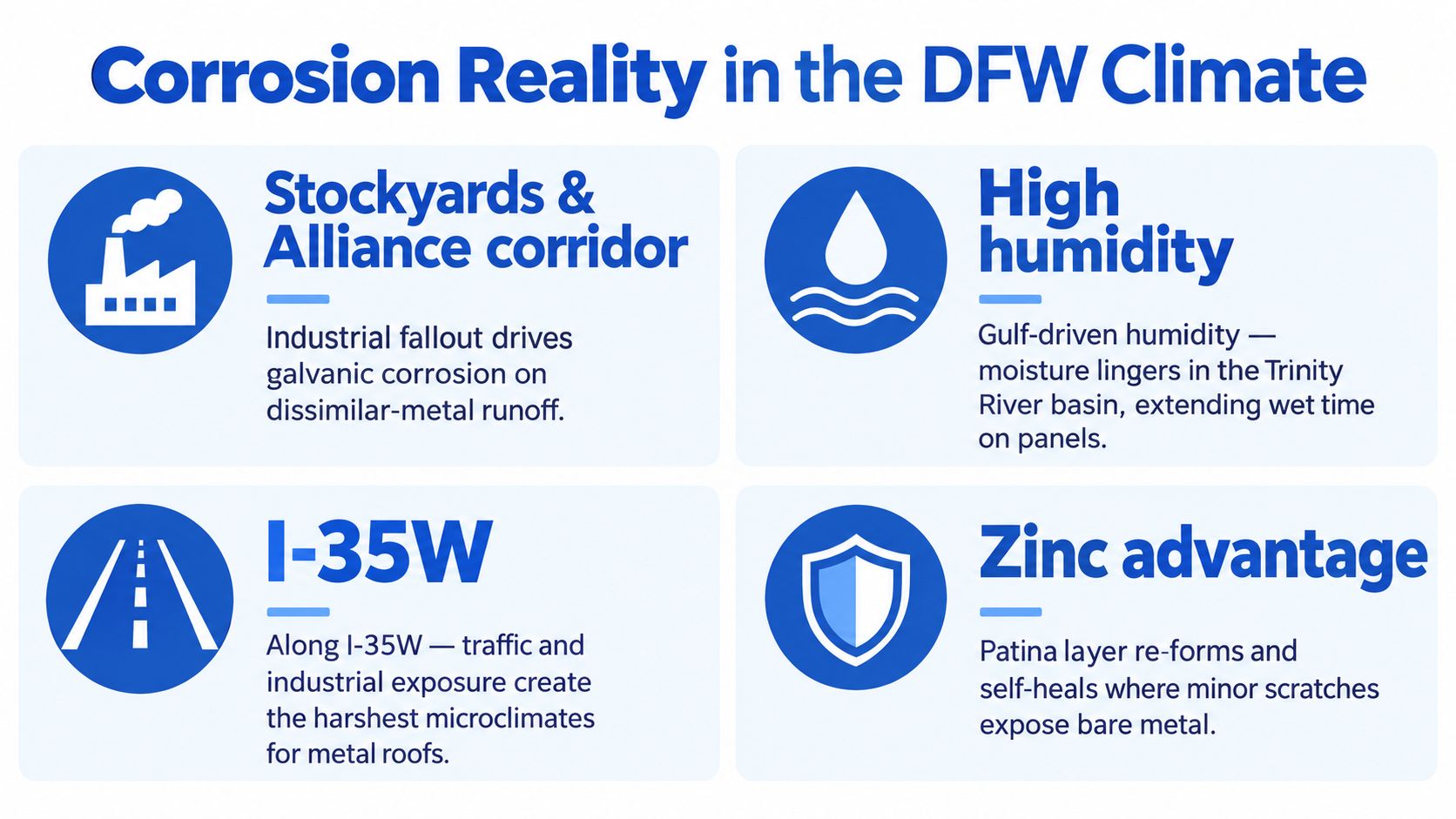
Zinc's general durability claim needs a local qualifier. Independent technical guidance places rolled-zinc corrosion around 1 to 2 microns per year in ordinary exposure, while severe industrial or marine conditions can raise that rate to 5 to 6 microns per year and reduce expected service life to around 60 years. VMZINC's FAQ makes the important point that exposure conditions can change the outcome.
For a contractor, the issue isn't whether every Fort Worth roof belongs in the severe category. It's whether the site has a microclimate that increases wet time, deposits contaminants, or concentrates runoff. Busy corridors, industrial districts, airport-related activity, river-bottom humidity, and sites with incompatible drainage can all deserve a closer review than a generic suburban roof.
Read the exposure, not just the map
A project near the Stockyards or the Alliance corridor may receive more industrial particulate than a roof in a quieter residential pocket. Gulf-influenced humidity can linger in lower areas around the Trinity River system, extending the time that moisture remains on roof surfaces. Traffic and industrial activity along I-35W can create harsher conditions than the broad regional climate label suggests.
The same logic applies near DFW Airport and other high-traffic locations. Chloride and particulate exposure can increase the importance of washing, drainage, separation, and compatible materials, even when the project isn't directly on the coast. These conditions don't automatically rule out zinc. They change the specification and the maintenance conversation.
A corrosion-rate example helps put the severe figure in perspective. At 5 to 6 microns per year, a 30-year period would consume roughly 0.006 inches of material if the rate remained constant, based on the documented rate and period. That arithmetic is not a service-life guarantee, because real roofs weather unevenly and details can fail before the field panel does.
Prevent avoidable galvanic trouble
Keep copper and zinc separated. Copper runoff can create a serious compatibility problem when it reaches zinc surfaces or zinc drainage components. Also watch where downspouts discharge onto masonry, since concentrated wetting and deposits can stain adjacent surfaces and keep the lower edge damp.
ACQ-treated fascia deserves the same caution as ACQ-treated decking. Use the separation and flashing details required by the manufacturer, and don't let a convenient trim shortcut place zinc against a chemically active or dissimilar material.
When Zinc Is Worth the Premium on Your Next Project
Zinc makes sense when its properties solve a specific project problem. A modern home in Fort Worth, Arlington, Plano, or Denton may need a matte gray roof that becomes part of the architecture rather than a colored coating selected from a standard palette. A high-end standing-seam project may justify the material when the owner expects the roof to remain in service across a long ownership period. A design that needs zinc's malleability and patina can also make the premium easier to defend.
The price is harder to justify on a tight-budget tract home, a shallow-pitch shed, or a roof with unresolved ponding. Heavy leaf debris creates a maintenance burden, and poor drainage can undermine any long-life material. If the crew hasn't worked with soft-metal seaming, the labor allowance must include training, slower handling, and inspection of visible joints.
Use a three-question bid check
- Is the client planning to stay? A long ownership horizon makes lifecycle value more relevant than a low first cost.
- Does the roof have proper slope and drainage? If the design depends on standing water not becoming a problem, specify a different solution or redesign the roof.
- Is the architectural statement worth the upgrade? If the owner doesn't value the patina, concealed joints, or long-service intent, coated steel may be the more responsible recommendation.
Logistics can decide whether the specification is practical. Blue Lake Roofing Supply is one DFW option for standing seam roofing brands and system components, including panels, trim, fasteners, and clips for standing-seam applications. A Forest Hill yard with delivery planning across an approximately 40-mile radius can help contractors coordinate drops to nearby jobs, while projects farther out in Arlington, Plano, Denton, or other suburbs need route and lead-time confirmation before the contract is signed.
Zinc earns its place on the takeoff when the client accepts the premium, the roof geometry protects the investment, and the crew can install the system without treating it like ordinary Galvalume. When those conditions aren't present, steel often wins for sound reasons.
Blue Lake Roofing Supply provides contractor-focused roofing materials, including standing-seam panels, trim, fasteners, clips, and jobsite-direct delivery from its Forest Hill yard across the DFW area. Visit Blue Lake Roofing Supply to discuss zinc-compatible system needs, confirm availability, and plan the material drop before your next Fort Worth, Arlington, Plano, or Denton bid.