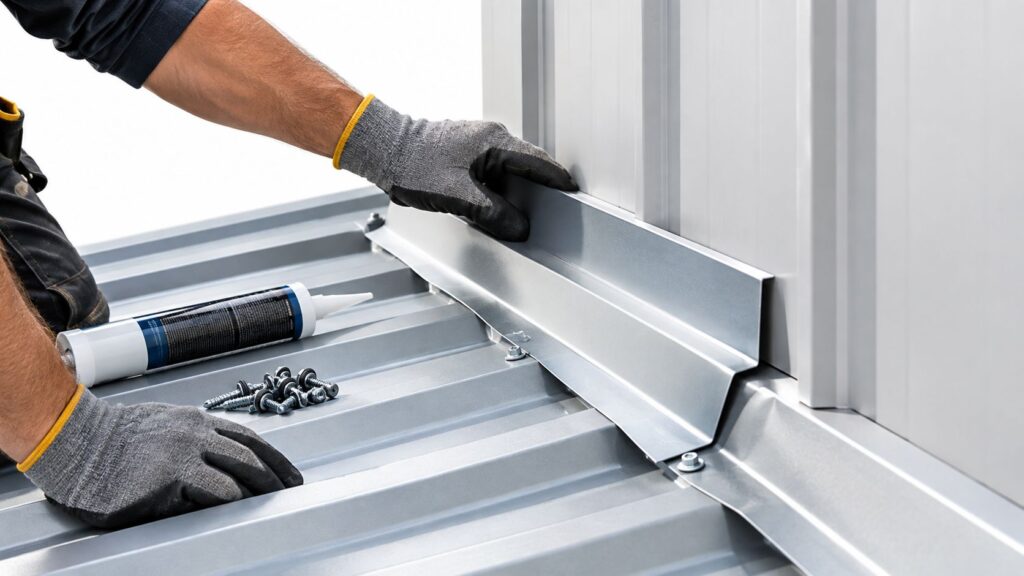
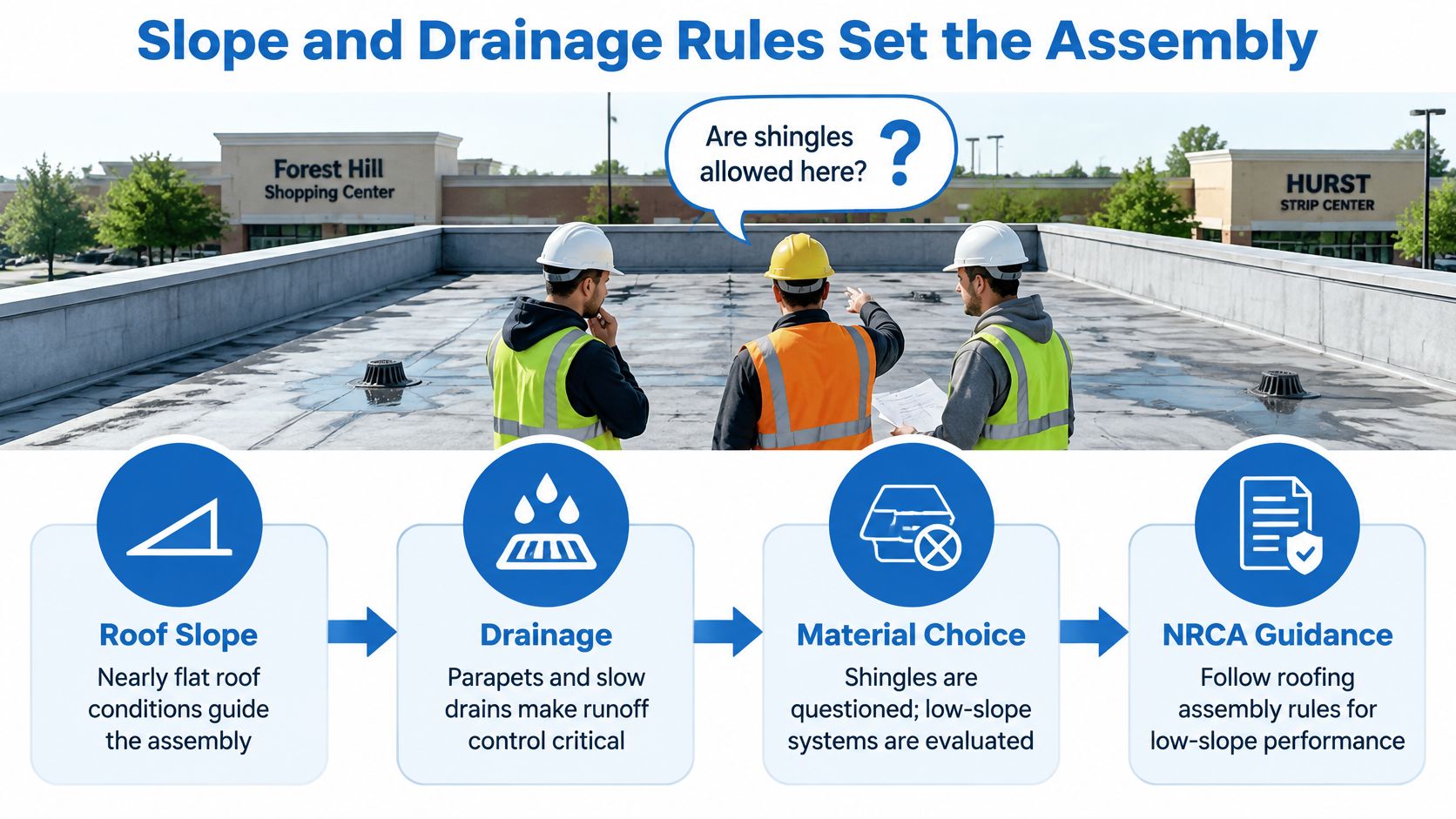
A commercial roofer pricing a Forest Hill retail roof with a slow drain behind a parapet has to settle the assembly before discussing color or cost. Shingles on a nearly flat roof are usually a warranty and code problem: acceptable slope depends on the manufacturer's limits and the adopted code.
Low sloped roofing materials in North Texas should match the roof's exposure, drainage, and repair access. An open warehouse in Dallas faces different conditions from a roof with grease fans in Arlington or hail exposure in Mansfield. Start with the roof conditions, then choose a membrane and assembly that suit them.
Table of Contents
- Slope and Drainage Rules Set the Assembly
- How the Four Membrane Families Compare
- Match the Sheet to the Roof Exposure
- Install the Assembly Not Just the Sheet
- Three Metroplex Roofs and the Material That Fits
- Maintenance and Recoat Planning
- Write the Spec and Stage the Order
Slope and Drainage Rules Set the Assembly
| Rule | Threshold | What it changes |
|---|---|---|
| NRCA low-slope class | 3:12 or less, about 14 degrees | Calls for a membrane system rather than a steep-slope water-shedding roof |
| New membrane design slope | 1/4 inch per foot (1/4:12, about 2%) | May require tapered insulation or a sloped deck |
| Coal-tar built-up exception | 1/8 inch per foot | Lower minimum applies only to this stated exception |
| Ponding-instability check | Slope under 1/4:12 | Requires a structural review because water can deepen as the deck deflects |
| Positive drainage | Water clears within 48 hours after rain | An existing reroof may remain below the new-construction slope if drainage and structural conditions are met |
| NRCA shingle caution | Not recommended below 4:12 | Shingle plans between 2:12 and 4:12 may create warranty risk |
The National Roofing Contractors Association classifies roofs at 3:12 or less, about 14 degrees, as low-slope. That category includes built-up roofing, modified bitumen, single-ply TPO and EPDM, liquid-applied systems, and spray polyurethane foam. At these pitches, membranes rely on sealed seams and flashings to keep water out. Steeper roofs generally shed water, while shingles rely on overlapping courses to direct it downhill.
Why the cutoff shows up on the job
A deck on a parapet roof in Forest Hill or Hurst can look level from the ladder. Some manufacturers and model codes allow asphalt shingles at 2:12, while NRCA does not recommend them below 4:12. Between those pitches, check the shingle manufacturer's slope limit and warranty language before including shingles in the takeoff.
For new membrane construction, the International Building Code, as discussed by IIBEC generally calls for 1/4 inch per foot (1/4:12, about 2%). Coal-tar built-up roofs are the stated exception, at 1/8 inch per foot. A nearly flat plan in Fort Worth, Dallas, or Irving may need tapered insulation or a sloped structural deck to meet that pitch. Confirm the adopted code with the authority having jurisdiction before ordering.
Ponding, overflow, and the permit path
IIBEC's drainage guidance calls for a structural check when slope is under 1/4:12, because water adds load, the deck deflects, and ponding can deepen. Positive drainage means the design accounts for deflection and clears water within 48 hours after rain. An existing roof may remain below the new-construction minimum if it drains positively and the structure is adequate. Crickets can direct water toward drains when the existing deck leaves low spots.
U.S. plumbing practice, as described by IIBEC, generally sizes primary and secondary drains for the 100-year, 60-minute rainfall rate. Where parapets could trap water if the primary path clogs, overflow scuppers are required. Show drain and overflow elevations alongside edge metal and roof-edge guttering options on the drawings, and confirm the local commercial permit sequence with the authority having jurisdiction before finalizing the submittal.
How the Four Membrane Families Compare
On a nearly flat roof, the sheet has to match the exposure, drainage conditions, and access for repairs. TPO offers welded seams and reflective colors; EPDM is a flexible rubber sheet with simpler field seaming; modified bitumen suits roofs with many curbs and penetrations; and coatings can extend the service of a sound, dry roof. The right choice depends on what the roof must handle.
| Material | Where it fits | Common attachment | Typical build | Cool-roof role | Indicative installed cost |
|---|---|---|---|---|---|
| TPO | Sun-heavy roofs needing welded seams | Adhered or mechanically attached | Reinforced 60-mil sheet is a common thickness | White or other reflective colors; DOE lists thermoplastic membranes as a cool-roof option | About $1.50–$3.00 per sq ft for a single-ply cool membrane |
| EPDM | Wide temperature swings and simpler field seaming | Adhered, mechanically attached, or ballasted | 45- to 90-mil cured rubber sheet | Usually black; reflectance requires a later coating | Not listed in the DOE cool-roof cost ranges |
| Modified bitumen | Heavy foot traffic, many penetrations, phased tie-ins | Torch, cold adhesive, or hot asphalt | Commonly two plies over a base | Cap sheet can be granule or reflective | Not listed in the DOE cool-roof cost ranges |
| Roof coating | Sound, dry roof kept in service | Liquid-applied over an approved substrate | Build varies by coating system and warranty | Elastomeric reflective coating; DOE lists coatings as a low-slope option | About $0.75–$1.50 per sq ft |
The cost figures are national planning ranges, not DFW bids. Tear-off, crane access, night work, and detailing can change the installed price.
TPO
TPO is a heat-welded thermoplastic membrane, commonly reinforced and specified in white. The CIB W83 report on TPO membrane history describes the shift from early non-reinforced sheets to fabric-reinforced membranes and the development of ASTM D6878. A 60-mil sheet is a common specification; consider 80 mil where carts, tools, or hail raise puncture concerns. Seams are welded and probed, not taped.
EPDM
EPDM is cured rubber that can be adhered, mechanically attached, or ballasted. Field seams are simpler than welded seams, and the sheet accommodates wide temperature swings. It is usually dark, so a reflective surface requires a later coating.
Modified bitumen
Modified bitumen is a multi-ply asphalt sheet, commonly installed in two plies, using a torch, cold adhesive, or hot asphalt. Its layered construction suits roofs with many penetrations, foot traffic, or phased tie-ins. Modified bitumen roll roofing is an option for complex layouts. Use a cold-process system when an occupied building cannot take an open flame.
Coatings and reflective single-ply
The U.S. Department of Energy cool-roof brief identifies thermoplastic membranes, elastomeric coatings, and reflective metal as low-slope options. Reflectance and thermal emittance drive cooling performance, not color alone. Reflective surfaces can be about 50–60°F (28–33°C) cooler than conventional materials at peak summer.
Indicative installed costs are about $0.75–$1.50 per square foot for low-slope cool-roof coatings and $1.50–$3.00 per square foot for single-ply cool-roof membranes. Prep, access, detailing, and warranty affect actual pricing. Energy savings also depend on insulation, HVAC, rates, and climate; a reflective roof can reduce useful winter heat gain.
Match the Sheet to the Roof Exposure
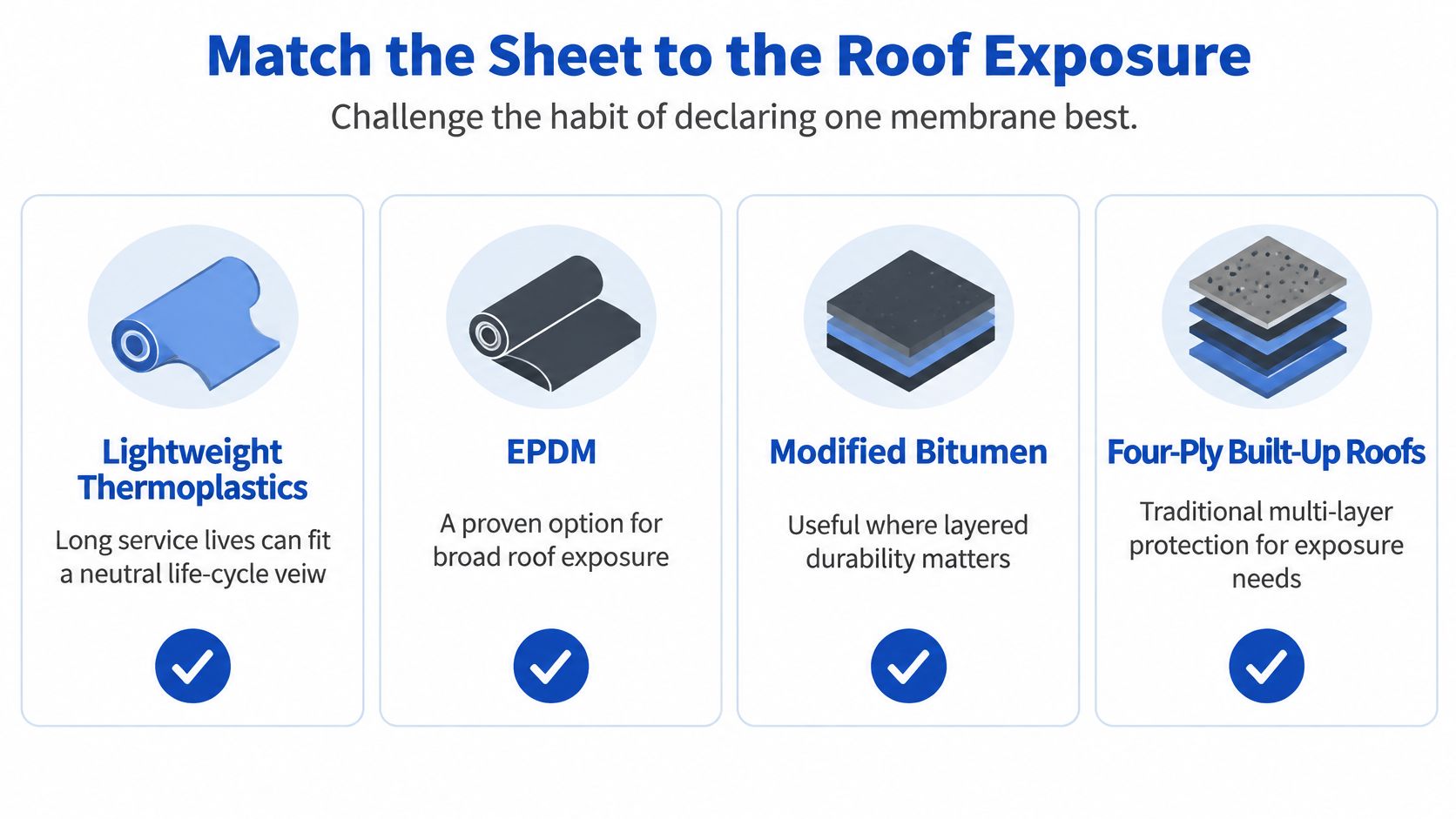
A neutral life-cycle view is not a bid instruction for every building in Tarrant County. The Carbotech life-cycle analysis published by Sika indicates that lightweight thermoplastic systems with long service lives can produce lower global-warming impacts, while EPDM, modified bitumen, and four-ply built-up systems may look worse when shorter life, more material, or more frequent replacement is counted. That finding doesn't make thermoplastic the automatic pick. Grease, chemicals, rooftop traffic, and hard-to-repair penetrations can justify a thicker or more recoverable assembly over the lowest embodied impact.
Four roofs contractors actually walk
Open sun. A white TPO roof on a wide Dallas warehouse fits when summer sun, welded seams, and reflectivity dominate and traffic is light. The sheet is doing one job, staying sealed while it rejects heat.
Grease and chemicals. A restaurant in Arlington with exhaust fans over the membrane needs chemical resistance, a thicker sheet, and walk pads more than the lowest carbon number. Housekeeping and hood techs will be up there weekly.
Hail. Roofs in Mansfield and Fort Worth push thickness, cover board, and puncture resistance ahead of the cheapest square foot. A thin reflective sheet that bruises on the first storm is a callback, not a bargain.
Constant HVAC traffic. Defined walkways and a reinforced or recoverable assembly matter more than color. If the only path to a unit crosses a field seam, that seam will fail first.
Manufacturer life-expectancy language is not field performance. Don't treat a generic 20-to-30-year claim as a guarantee. Ask what was inspected on roofs of similar age, attachment, and hail exposure.
A short walk-through of how crews compare these sheets on a real deck is worth ten minutes before you lock a spec.
The cheapest installed square foot is not the lowest cost once ponding, hail, solar load, and repeat service visits are in the bid.
Install the Assembly Not Just the Sheet
Performance sits in the whole assembly. ASTM's roofing standards catalog points to a dedicated guide for low-slope insulated membrane assemblies, and NRCA wants membrane, liquid-applied, and spray-polyurethane-foam systems designed for positive drainage rather than nominal slope alone. Ponding raises hydrostatic load at seams, penetrations, and edges. Some EPDM and TPO assemblies also carry their own minimum slope, so the manufacturer's tested assembly controls, not the deck pitch by itself.
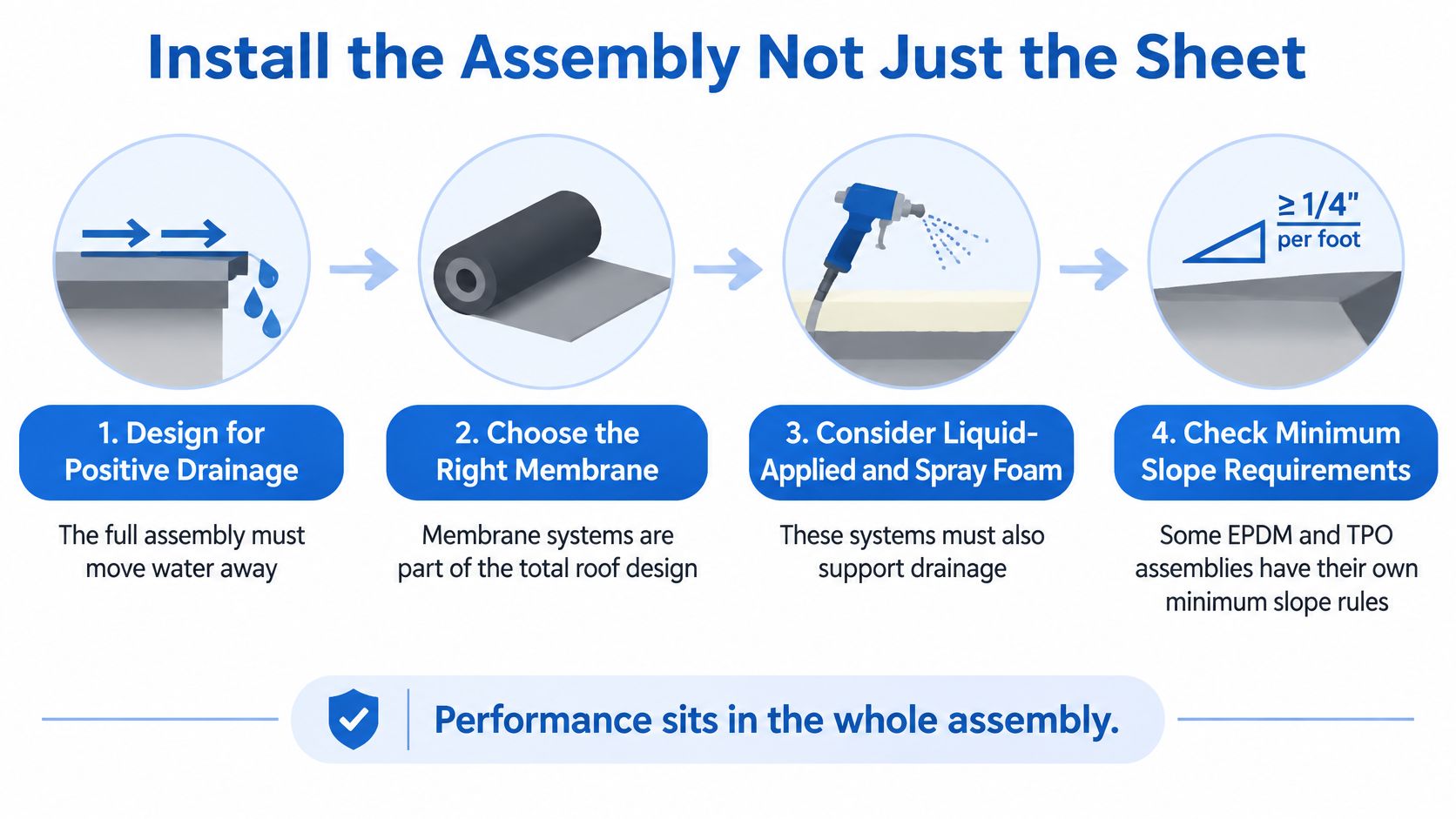
Write the submittal in this order. Each line is a reason an inspector or a warranty desk will ask for later.
- Confirm the deck. It has to be dry, fastened, and able to take the new load. A wet or loose deck makes every layer above it a temporary patch.
- Set insulation and cover board to the attachment and the hail exposure. Polyiso thickness and a high-density cover board are part of the listing, not optional padding. Hail in Tarrant County is why the cover board is on the order.
- Name thickness, reinforcement, and color as one product. A 60-mil reinforced TPO meeting ASTM D6878 is a spec line. "White rubber" is not.
- Name the attachment and stay inside the listing. Adhered, mechanically fastened, or ballasted. Don't mix plates, fasteners, or adhesive rates that the tested assembly never used.
- Detail seams the way that sheet is made. Heat-weld and probe TPO. Use the tape or adhesive system for EPDM. Use torch, cold adhesive, or hot asphalt for modified bitumen, and switch to cold process when an occupied Fort Worth building can't take open flame.
- Flash walls, drains, and penetrations with that manufacturer's details. Wall flashing fails when the field sheet and the flashing come from two systems that were never tested together.
- Add walk pads on the technician path. Pads are cheaper than a puncture at a curb three months after closeout.
A coating is only in play when the existing roof is dry, still adhered, and inside the coating maker's remaining-life rules. If cores come up wet, you're writing a tear-off, not a coating spec.
Three Metroplex Roofs and the Material That Fits
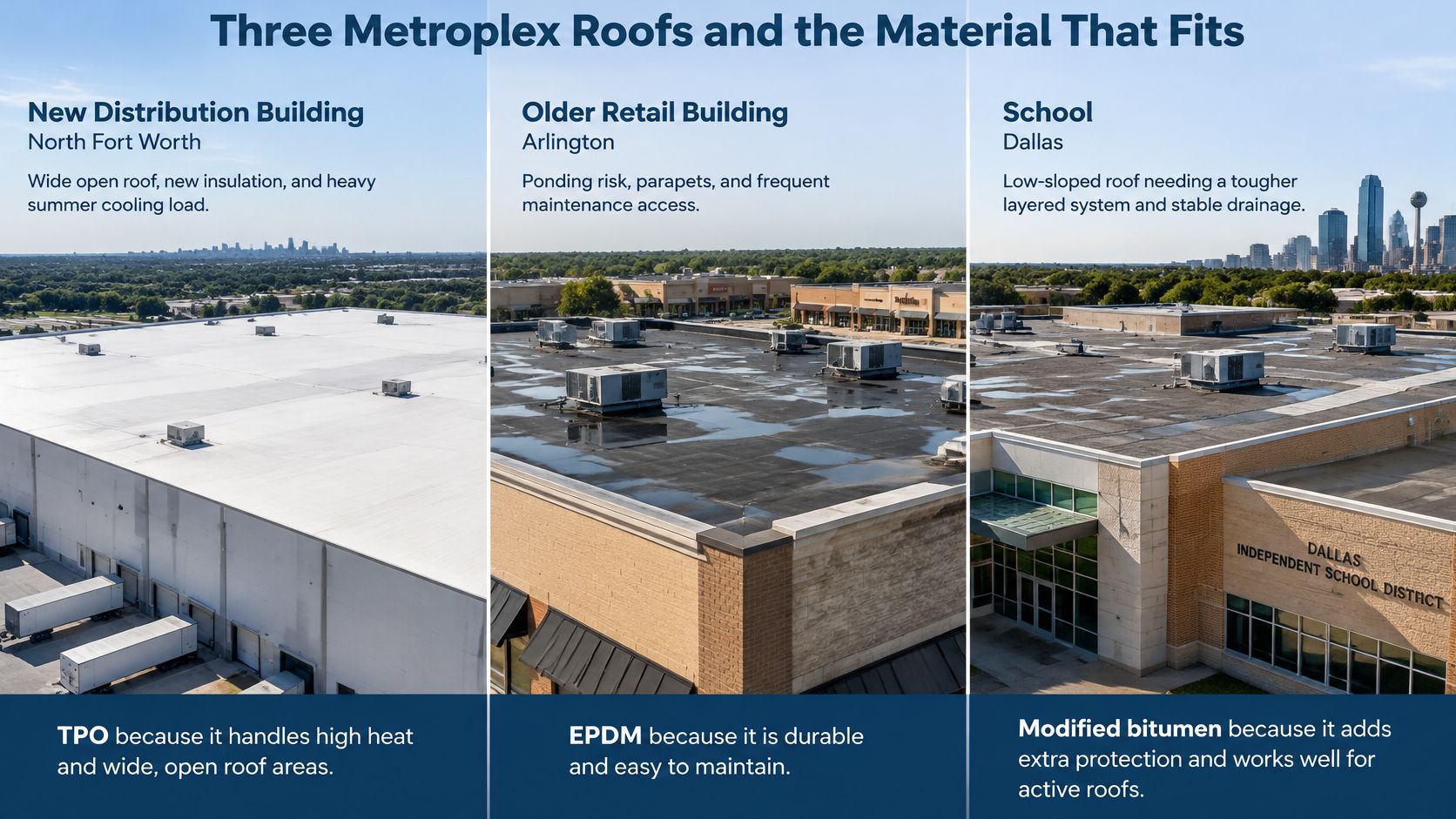
North Fort Worth distribution building
Say the walk is a new distribution roof north of Fort Worth. The deck is wide and open, insulation is new, and the cooling load runs hard from May into September. There is almost no foot traffic except the occasional unit service.
Call: reinforced white 60-mil TPO, mechanically attached or adhered to the wind listing, with tapered insulation built to 1/4:12. Reflectance helps the cooling season. The actual bill still depends on insulation and the HVAC, and any loss of winter heat gain in North Texas is a small trade next to that summer load.
Arlington restaurant
The second roof is a low restaurant in Arlington. Grease fans, a crowd of curbs, and daily foot traffic from the hood company. A thin reflective sheet will get cut by ladders and cleaning crews long before the sun ages it.
Call: a two-ply modified bitumen system, or a thicker protected membrane, with walk pads at every service path. Chemical splash and repair access beat reflectivity on this one.
Dry warehouse in Euless or Hurst
The third roof is a warehouse in Euless or Hurst. The membrane is dry, still stuck down, and water is gone within 48 hours. The owner wants more years without a tear-off.
Call: an elastomeric coating at the lower installed range for coatings, before prep. If cores show wet insulation, or the ponds never leave, the coating only delays the tear-off. Dirt, aging, and the recoating interval belong in the maintenance note, not in the energy claim.
Why the yard can't stock one family
In a 2024 Roofing Contractor distributor industry survey, 48% of commercial roofing contractors named TPO as the type they used most often, and 30% named EPDM. Those three Metroplex roofs don't share a single order. A yard that only stocks the popular sheet leaves the restaurant and the coating job waiting on a second supplier.
Maintenance and Recoat Planning
The roof you installed only holds its warranty if someone walks it after the weather that North Texas gets. Schedule a full inspection after large storms, and at least once each spring and fall. A leak found in October is usually a seam that was already open in May.
What to check on each visit
- Seams: Walk every field seam. Probe TPO welds for cold spots and voids. On EPDM, check adhesive or tape lines for fishmouths and loose edges.
- Flashings: Inspect walls, curbs, pitch pans, and pipe boots. Most callbacks in Fort Worth start at a curb, not in the field of the sheet.
- Drains and scuppers: Clear baskets and overflow openings before the next rain. A clogged primary drain turns a good membrane into a pond.
- Modified bitumen surface: Look for granule loss, blistering, and cracking. After hail in Mansfield or Fort Worth, mark bruises even when the sheet hasn't opened yet.
- Reflective surfaces: Dirt on white TPO or a coated roof cuts reflectance. Put cleaning in the maintenance budget, and assume an aged surface when you talk about energy.
Recoat rules and the roof map
Recoat intervals for elastomeric coatings come from that coating maker's warranty and remaining-life rules. There isn't a generic year count that fits every product. A coating over wet insulation only postpones tear-off, and it can trap moisture that the next contractor has to remove at a higher cost.
Keep a roof map with penetrations, drain locations, and prior repairs so the next crew can find a leak without a full survey. Record every patch, the product used, and the date. The next spec should reflect what failed in the field, not a brochure life number.
Practical rule: If you can't point to the last seam probe and the last drain cleaning on a one-page log, you don't have a maintenance plan. You have a hope.
Write the Spec and Stage the Order
Write the spec as one tested system, not a brand nickname, and attach the warranty to that exact assembly. An inspection in Fort Worth or Dallas fails when the sheet on the roof isn't the sheet on the submittal. Put drain and scupper elevations on the drawings. Mark wet areas as tear-off, not coat.
Price the order before the bid leaves the office
List squares, perimeter metal, boots, walkway pads, and insulation on one order so the crew isn't waiting on a second truck. Lock pricing before the number goes to the owner. IBS Roofing reported that Carlisle SynTec announced increases effective January 15, 2025, of 3% for EPDM membranes and accessories, 4% for TPO membranes and accessories, and 12% for PVC membranes and accessories. Confirm current figures with your supplier before you treat those percentages as today's invoice.
Blue Lake Roofing Supply, at 5609 Wichita St, Forest Hill, TX 76119, stocks installer-grade TPO, EPDM, coatings, insulation, and flashing for trade accounts across Fort Worth, Arlington, Mansfield, Hurst, Euless, Irving, and Dallas. Confirm the current delivery area and hours before you schedule the drop. Other DFW yards can fill a single-family order, but a commercial assembly is easier when membrane, cover board, and flashings ship together.
I would core the wet spots, confirm slope with the authority having jurisdiction, then place the assembly order against that submittal. A generic "low-slope" label on the purchase order is how the wrong mil thickness shows up on the roof.
Blue Lake Roofing Supply stocks TPO, EPDM, coatings, insulation, and flashing for low-slope commercial work, with jobsite delivery for trade accounts around Fort Worth. If you're pricing a nearly flat roof in the Metroplex, match the order to the tested assembly instead of a single membrane nickname. Visit Blue Lake Roofing Supply to check trade pricing and schedule a drop.