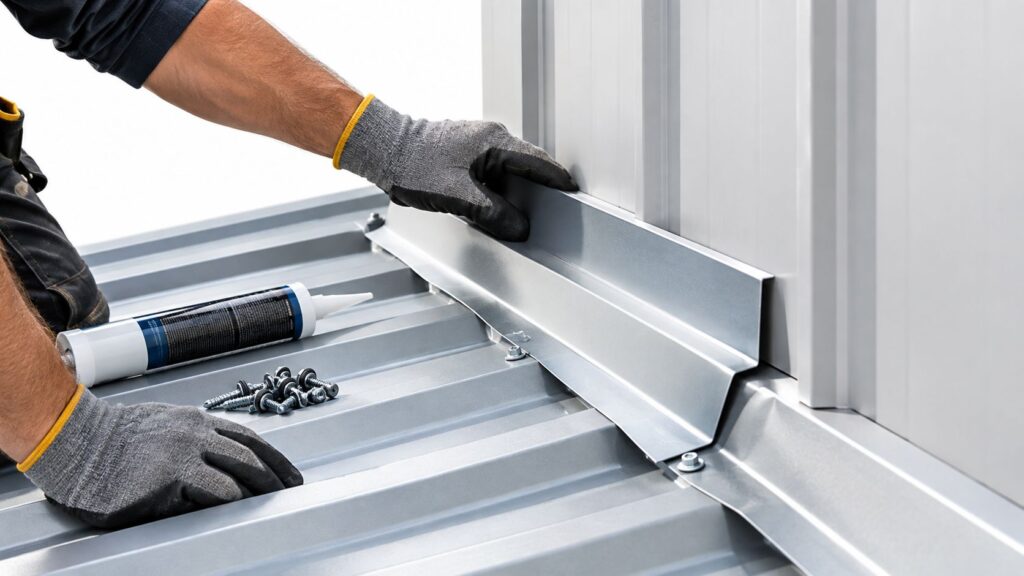
A Fort Worth crew can lose half a day before the first membrane roll is opened. The deck is exposed, the July sun is heating the substrate, and a storm line is building west of Eagle Mountain Lake. The truck carries a torch-grade SBS roll, self-adhered base sheet, and perhaps a leftover TPO roll from another job. Choosing the right stack matters, but so do flame restrictions, deck condition, lap quality, permit timing, and whether the material can reach the site before the crew is standing idle.
That's the daily reality for contractors working from Forest Hill to Arlington, Mansfield, Hurst, Bedford, Grand Prairie, Plano, and Denton. Modified bitumen roll roofing remains a practical option for many DFW low-slope roofs, but it isn't automatically the right answer. The useful question is narrower: when does a two-ply modified bitumen system earn its place over TPO or EPDM on a North Texas job?
Table of Contents
- A Fort Worth Contractor Faces a Low-Slope Decision
- What Modified Bitumen Roll Roofing Actually Is
- SBS and APP Membranes Compared
- How Modified Bitumen Performs in Texas Heat
- Installation Methods From Torch to Self-Adhered
- When Modified Bitumen Beats TPO or EPDM
- Sourcing and Permitting Inside the DFW Metroplex
A Fort Worth Contractor Faces a Low-Slope Decision
The roofer has already opened the deck on a Fort Worth re-roof during the third week of July. By noon, the exposed surface is hot enough to change how adhesive behaves, and every uncovered hour increases the risk of a weather interruption. The crew needs a system that can handle low slope, service penetrations cleanly, and provide a defensible specification for a property owner concerned about hail.
Three choices sit in the staging area. One is a torch-grade SBS cap sheet. Another is a self-adhered base sheet that avoids open flame around an occupied building. The third is leftover TPO, attractive because it's familiar and already on the truck, but not necessarily suitable for the details, substrate, or project documentation.
This isn't an unusual decision in the Metroplex. Contractors in Fort Worth, Benbrook, White Settlement, Saginaw, North Richland Hills, and nearby communities regularly compare cap sheet and base sheet assemblies with single-ply membranes. The tiebreaker often comes from the job rather than the brochure: Texas heat, spring hail, rooftop equipment, foot traffic, flashing complexity, and the crew's actual installation experience.
Modified bitumen has a long commercial track record. It emerged in modern commercial use in the mid-1970s as manufacturers moved beyond older asbestos-felt systems toward glass-fiber-reinforced products meeting ASTM D2178. Industry histories also report that APP membranes were first reported in Italy in 1967 and became available in Holland and Great Britain by the mid-1970s. By the mid-1980s, modified bitumen had captured nearly 90% of the roofing market in Italy and about 60% in France and Norway, according to this history of modified bitumen roofing.
Field rule: Don't select the membrane before you've confirmed the deck, slope, penetrations, fire exposure, and inspection sequence.
The rest of the decision comes down to construction. Modified bitumen gives the contractor layered redundancy and familiar flashing details. TPO offers a large, reflective single-ply surface with hot-air-welded seams. EPDM can be economical on a simple rectangular roof. In a tight DFW re-roof with many penetrations and a crew that knows the system, modified bitumen can still be the more forgiving specification.
What Modified Bitumen Roll Roofing Actually Is
Modified bitumen starts with asphalt, then adds a polymer that changes how the asphalt behaves. Plain asphalt can become brittle when temperatures fall and soften when exposed to sustained heat. The polymer gives the membrane a more useful balance of cold-weather flexibility, elongation, and heat resistance.
A typical assembly uses more than one layer:
- Base sheet: The first membrane layer creates the initial waterproofing plane and helps prepare the roof for the cap sheet.
- Modified cap sheet: This upper layer carries the exposed surfacing and receives the primary ultraviolet and weather exposure.
- Reinforcement carrier: Fiberglass improves dimensional stability, while polyester generally contributes tensile strength, puncture resistance, and movement tolerance.
- Mineral or slate surfacing: Granules protect the asphaltic surface from sunlight and routine service traffic.
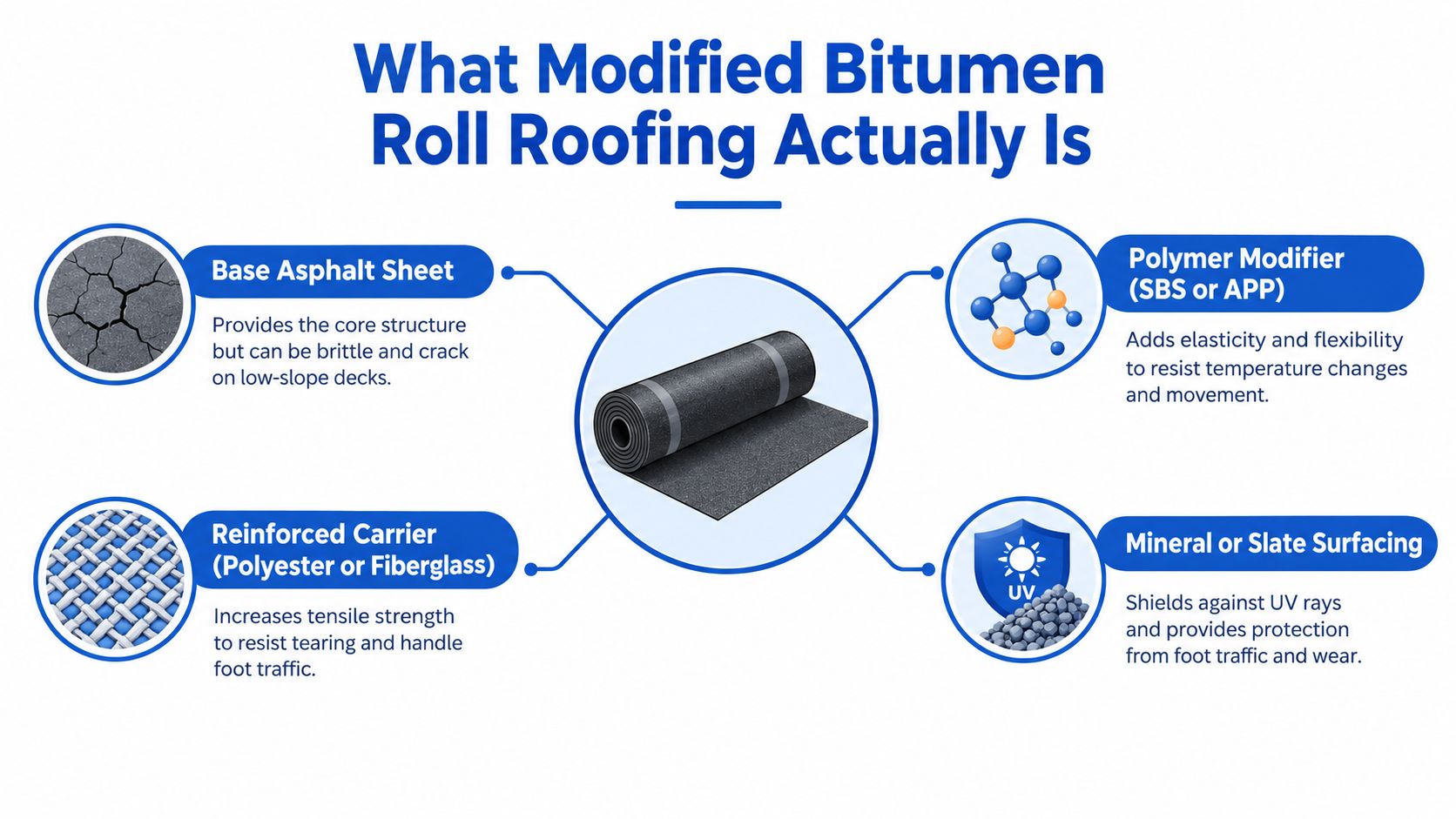
The reinforcement package matters more than the granule color. Project specifications commonly reference ASTM D6162, ASTM D6163, and ASTM D6164 for SBS-modified sheets, and ASTM D6222 and ASTM D6223 for APP-modified sheets. The Durham modified bitumen roofing specification also illustrates why polyester and glass-fiber combinations are selected for tensile performance and dimensional stability.
For a contractor estimating a low-slope roof, the roll is a manageable unit. Products are commonly manufactured around 36 to 39 inches wide, with one roll often covering approximately one roofing square, though exact coverage depends on the manufacturer, laps, and waste. Confirm the technical data before counting pallets for a ten-square deck. A roll that looks interchangeable at the yard may have a different coverage rate, selvage edge, attachment method, or approved adhesive.
The practical distinction from built-up roofing is delivery and assembly. Built-up roofing uses multiple layers of felt and asphalt built on site, while modified bitumen arrives as a factory-manufactured membrane roll. Compared with single-ply, a two-ply modified bitumen system provides a separate base and cap layer. A puncture in the cap sheet doesn't necessarily expose the deck immediately, although it still requires prompt repair.
Contractors specifying low-slope commercial roofing materials should match the membrane, reinforcement, surfacing, and attachment method as one system. Buying a cap sheet by appearance alone is how crews end up with incompatible primers, adhesives, or flashing details.
SBS and APP Membranes Compared
SBS and APP are different polymer approaches, and the distinction shows up on the roof. SBS, or styrene-butadiene-styrene, gives asphalt rubber-like flexibility. APP, or atactic polypropylene, gives asphalt a more plastic character. That doesn't make one universally superior. It changes how the material should be installed and where it fits.
SBS is usually the more comfortable choice where the roof cycles through heat and movement. The sheet can flex with the assembly, which helps on re-roofs where the deck and existing details aren't perfectly static. APP handles ultraviolet exposure and heat aging well, but it's less tolerant of cold-weather flexing. In DFW, that difference matters during a cold morning repair or a winter service call, even though the dominant roof stress comes from summer heat.
| Attribute | SBS | APP |
|---|---|---|
| Polymer behavior | Rubber-like flexibility and elongation | More plastic, heat-oriented behavior |
| Common attachment options | Torch, cold-applied, self-adhered, and hot-mopped systems | Commonly torch-applied |
| Movement tolerance | Strong choice where thermal cycling and deck movement are concerns | Better suited to stable details and warm installation conditions |
| Installation concern | Adhesive and substrate temperature control | Torch technique and cold-weather handling |
| Typical contractor fit | Occupied buildings, complex re-roofs, and movement-prone assemblies | Open, well-controlled jobs where torch application is practical |
SBS systems pair well with cold-applied adhesives and self-adhered backers. They can also be used with hot asphalt or torch application when the product assembly permits it. APP generally wants a torch, which can produce efficient bonding but introduces an open flame around parapets, wall lines, combustible materials, and occupied structures.
The cost comparison must include labor, not just the invoice. The supplied plan for this DFW comparison places self-adhered SBS at roughly 15% to 25% higher in material cost than torch APP, but that figure should be verified against the current product package and local labor conditions before it enters a bid. The trade-off is reduced flame exposure and a simpler safety conversation on an occupied building.
A self-adhered sheet won't rescue a dirty or damp deck. Torch-applied material won't compensate for poor heating, incomplete bleed-out, or careless laps. The right choice is the one the crew can install consistently under the site's safety and weather constraints.
How Modified Bitumen Performs in Texas Heat
Modified bitumen can perform well through DFW summers, but its strengths differ from those of a reflective TPO roof. The membrane formulation, reinforcement, surfacing, and seam workmanship determine whether the roof keeps its waterproofing reserve after repeated expansion and contraction.
A benchmark SBS cap sheet is around 4.0 millimeters, or 160 mils, thick, passes low-temperature flexibility at 8°F, shows dimensional stability around 0.5% in the machine direction and 0.3% in the cross direction, and has a softening point near 310°F, according to this CertainTeed SBS cap sheet specification. Those values help explain why SBS remains attractive for roofs exposed to large temperature swings. The polymer helps the asphalt stay flexible in cold conditions while resisting flow during high-temperature exposure.
Where the roof starts to show stress
Hail doesn't damage every part of a modified bitumen roof equally. A granule-surfaced cap sheet may show scuffing or localized granule displacement after an impact, while a concentrated strike at a seam, edge, flashing, or already-aged area can create a more serious breach. The crew should inspect the surface, laps, perimeter, penetrations, and base flashing instead of treating granule loss as either harmless or conclusive by itself.
Thermal cycling creates a different pattern. Canadian research on modified bituminous low-slope roofs examines temperature-induced stresses and membrane ridging. On a DFW roof, that can translate into ridges along stressed areas, fatigue near seams, blisters at base flashing, or alligatoring and surface degradation where the cap sheet has aged. Industry guidance also identifies seam failure and cap-sheet ultraviolet degradation as common service concerns and places a typical first-claim window at roughly 12 to 18 years, as summarized in this modified bitumen failure guidance.
What to put in the warranty discussion
A realistic warranty conversation should describe the assembly, not promise a generic lifespan. The supplied field range is 15 to 20 years for a two-ply SBS system and 10 to 15 years for APP, but warranty language must follow the manufacturer's approved system, installation requirements, maintenance obligations, and exclusions. Don't present those ranges as guarantees.
For diagnosis, start with the seam and flashing details. The membrane field often looks acceptable while movement concentrates at laps, penetrations, corners, and transitions. A roof that survives Texas heat but has poorly bonded seams still has a predictable failure path.
| Failure Mode | SBS Behavior | APP Behavior | DFW Trigger |
|---|---|---|---|
| Seam movement | Better tolerance for repeated movement when properly detailed | More dependent on stable bonding and correct torch work | Daily heat cycling and deck movement |
| Ridging | Can accommodate movement, but stress can still telegraph through the system | Stiffer sheet can show stress at restrained areas | Temperature changes, substrate movement, and inadequate detailing |
| Blistering | Often linked to trapped moisture or poor adhesion | Often linked to trapped moisture, overheating, or poor bonding | Hot substrate, damp deck, and rushed installation |
| Granule loss | Surface may scuff while the underlying sheet remains intact | Surface may weather or lose protection after impact | Hail, foot traffic, and ultraviolet exposure |
| Cold-weather cracking | Generally more forgiving because of rubber-like flexibility | More vulnerable during cold flexing | Winter repairs, sharp folds, and restrained details |
Installation Methods From Torch to Self-Adhered
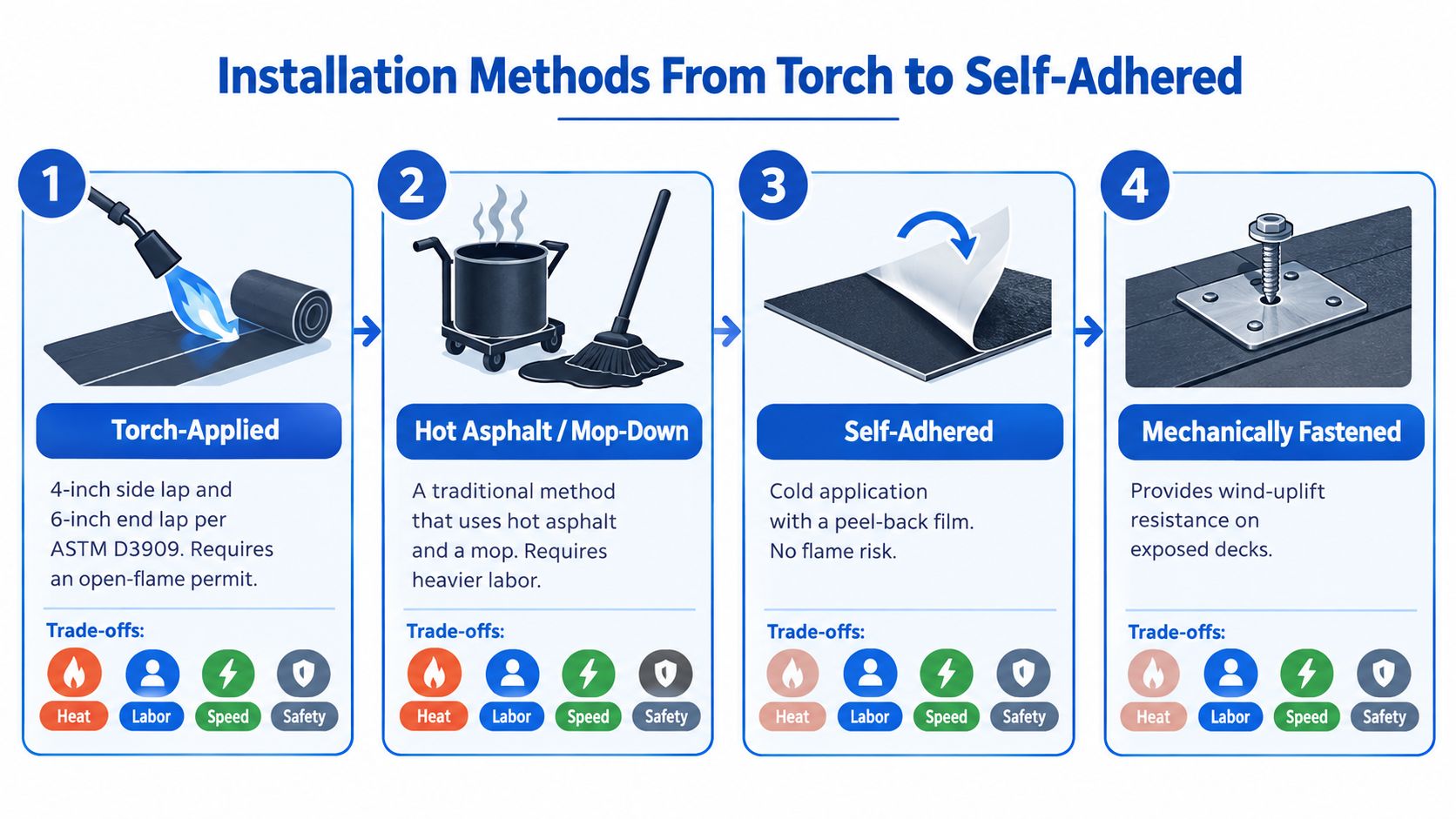
Installation method changes the risk profile of the entire job. A capable torch crew can move quickly on an open, noncombustible deck, while a self-adhered system may be the safer choice over an occupied building or combustible substrate. Industry guidance identifies torch, hot-mop, cold-applied, and self-adhered methods as common options, and notes that self-adhered systems reduce flame risk in sensitive settings. The granule-surfaced roofing seam guidance from IIBEC describes typical shingle-style laps, with side laps of 3 to 4 inches or the selvage-edge width and end laps of 6 inches.
Start with the deck, not the roll
The sequence should be deliberate:
- Prepare the deck. Replace damaged sheathing, remove contaminants, correct sharp projections, and confirm the surface is suitable for the selected primer or adhesive.
- Install the base sheet. Follow the manufacturer's fastening, adhesive, or self-adhered requirements. Stagger joints and avoid creating a continuous weak line.
- Set the cap sheet. Maintain alignment, embed the sheet fully, and roll or broom it as required by the product instructions.
- Build the details. Treat penetrations, drains, parapet corners, curbs, wall transitions, and edge metal as separate waterproofing assemblies.
- Inspect before demobilizing. Look for fishmouths, unbonded edges, loose granules at laps, wrinkles, voids, and exposed reinforcement.
Torch application is productive, but the torch operator must control flame, bleed-out, and substrate exposure. The lap needs enough heat to bond without overheating the membrane or adjacent materials. A project specification may reference ASTM requirements, but the crew still has to produce continuous, visible adhesion in the field.
Hot-mopped systems using Type III or Type IV asphalt can provide a strong bond and good puncture resistance, but the kettle adds equipment, labor, access, and safety demands. Cold-applied adhesive avoids flame and can suit occupied buildings, though cure time, odor, substrate moisture, and weather conditions require planning. Self-adhered sheets simplify flame management, but they're unforgiving of dust, dampness, poor priming, or installation on a substrate that's too cold.
For wall transitions and counterflashing, use a detail sequence rather than improvising at the end. This guide to installing roof flashing against a wall is useful when the roof membrane meets masonry or siding and the flashing has to shed water without trapping it behind the wall finish.
A short installation reference can help a newer crew visualize the order of operations:
When Modified Bitumen Beats TPO or EPDM
Modified bitumen wins when the roof's details matter more than the field area. A small low-slope addition in Fort Worth or Mansfield may not justify bringing specialized single-ply tooling to the site when a familiar crew can install a properly specified modified bitumen assembly with established flashing components.
The advantage becomes clearer on service-heavy roofs. Mechanical contractors working around rooftop units can drop fasteners, tools, or replacement parts. A two-ply assembly gives the roof a second waterproofing layer beneath the cap, so a localized cap-sheet puncture isn't automatically an immediate opening through to the deck. That doesn't excuse poor maintenance, but it gives the assembly useful redundancy.
Hail exposure also changes the conversation. DFW sits in a major hail corridor, and a granule-surfaced cap sheet can absorb and distribute some impacts differently from a smooth single-ply surface. The contractor still needs the assembly documentation and the right impact classification for the specification. A granule surface isn't a guarantee against puncture, and an impact rating shouldn't be assumed from the membrane's appearance.
| Project Condition | Modified Bitumen Advantage | Single-Ply Advantage |
|---|---|---|
| Many penetrations and tight flashing zones | Multiple detail options and layered waterproofing | Fewer field seams across large open areas |
| Frequent rooftop service | Two-ply redundancy and a robust cap surface | Lightweight access and familiar repair patches |
| Small low-slope addition | Practical roll-based installation for an experienced crew | Efficient sheets on larger, unobstructed areas |
| High solar exposure | Granule surfacing and asphaltic protection | TPO can offer a reflective surface |
| Simple rectangular warehouse | Detail flexibility where equipment is dense | Large rolls and welded seams can speed field coverage |
| Cost-sensitive plain deck | Material stack can be tailored to the assembly | EPDM may offer lower material cost in suitable designs |
TPO often makes more sense on a large warehouse where reflectivity and broad field coverage dominate. EPDM can be a sensible choice on a simple rectangular deck with limited penetrations and a contractor experienced in that system. Modified bitumen earns its keep when the roof has curbs, drains, wall lines, rooftop units, and repair traffic that demand careful detail work.
Sourcing and Permitting Inside the DFW Metroplex
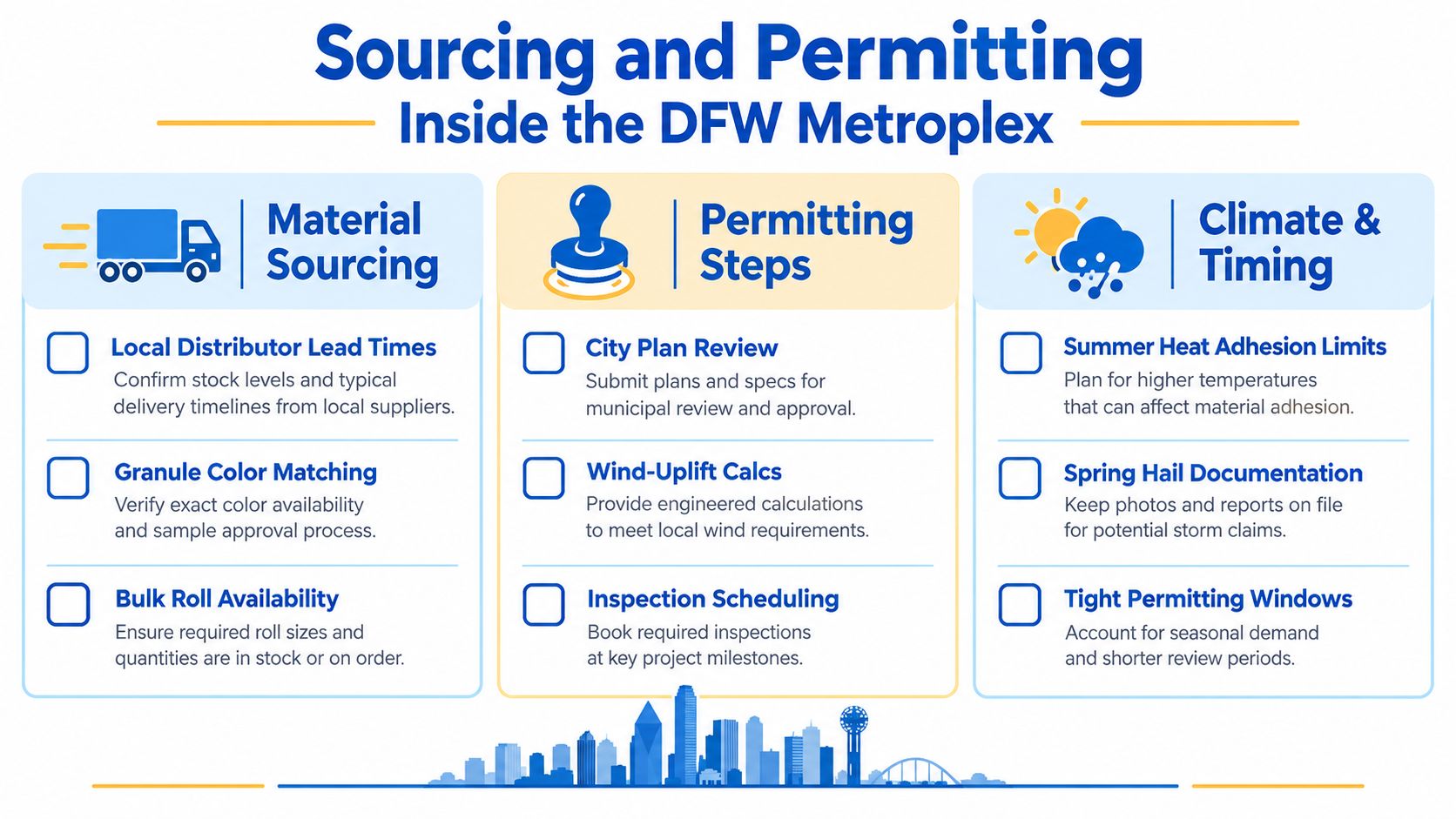
A good membrane choice can still fail the schedule if the permit, inspection, and material drop happen out of sequence. Fort Worth roofing work sits inside a hail-prone region, so contractors should treat documentation and municipal requirements as part of estimating rather than as paperwork after the crew arrives.
Fort Worth Development Services states that a permit is required when roofing work includes replacing decking, lathing boards, sheathing boards, rafters, or ridge boards. Its roofing FAQ also says a permit is required if any decking is replaced, as documented in the city's roofing permit FAQ. Separate Fort Worth residential permit guidance states that the city requires permits for all roof replacements and identifies Fort Worth as part of the DFW hail corridor.
Build the job around the inspection
Before ordering the cap sheet, confirm the local requirements for the property in Fort Worth, Arlington, Plano, Denton, Grapevine, Irving, or the specific surrounding municipality. Requirements can differ by jurisdiction, occupancy, roof assembly, and scope. If the project includes deck replacement, plan for the inspection stage before covering the work.
A practical sequence looks like this:
- Pull the permit: Submit the scope, assembly information, and required supporting documents before scheduling the tear-off.
- Confirm the deck: Open enough of the roof to establish whether the substrate is sound and whether concealed damage changes the scope.
- Schedule the material drop: Match delivery to the crew's dry-in progress, not merely to the planned start date.
- Reserve inspection time: Keep the base sheet and deck work accessible until the required inspection has occurred.
- Release the cap sheet: Install the exposed layer only after the substrate, details, and inspection sequence are ready.
Make delivery part of the specification
A Forest Hill yard with jobsite-direct dispatch can matter when a storm damages a roof in Arlington or a commercial tie-in runs short on rolls in Grand Prairie. Blue Lake Roofing Supply offers low-slope commercial products, including modified bitumen materials, torch-down and self-adhered systems, with will-call pickup at 5609 Wichita St, Forest Hill, TX 76119 and delivery across its stated DFW service area. Contractors can review its low-slope roofing supply service in Fort Worth when coordinating cap sheets, base sheets, flashing, adhesives, and related materials.
For a contractor, the useful question isn't whether a supplier carries modified bitumen. Ask whether the exact SBS or APP roll, reinforcement, surfacing, primer, adhesive, and compatible flashing accessories are available together. Confirm roll counts, lot consistency, delivery access, and whether the drop can arrive before the crew reaches the detail phase.
Blue Lake Roofing Supply stocks low-slope roofing materials, including torch-down and self-adhered modified bitumen systems, and coordinates jobsite-direct delivery from its Forest Hill yard across the DFW Metroplex. Visit Blue Lake Roofing Supply to discuss the membrane assembly, accessory list, permit sequence, and delivery timing for your next Fort Worth, Arlington, Plano, or Denton project.