Ordering a membrane and hoping the rest sorts itself out at the yard is the most popular way to buy commercial roofing supplies, and it's backwards. A low slope roof in North Texas doesn't pass inspection, hold a wind rating, or keep a warranty because one roll was good. It performs because deck, insulation, cover board, sheet, attachment, and flashing were tested together and ordered together. If you're building a takeoff for Fort Worth, Forest Hill, Arlington, or Irving, start with that tested stack, then fill in thicknesses and counts. Anything else puts a lookalike part on the truck and a problem on the roof.
Table of Contents
- Why a Commercial Roof Is Ordered as One Package
- Commercial Roofing Supplies Checklist by Category
- Match the Tested Assembly Before You Order
- Single-Ply Membranes and When Each One Fits
- Insulation Cover Boards and Texas Energy Rules
- Adhesives Fasteners and Flashing That Stay Compatible
- Heat, Hail, and Traffic Choices for North Texas Roofs
- Confirm the Takeoff and Place the DFW Order
Why a Commercial Roof Is Ordered as One Package
Stop buying the sheet first. A commercial roof in Fort Worth, Arlington, or Irving is a tested stack, not a catalog pick. Deck attachment, insulation, cover board, membrane, adhesive or fasteners, and flashing share one approval, and swapping one layer changes how the whole roof handles wind, fire, hail, and heat.
The scale explains why yards stock it that way. The Freedonia Group U.S. commercial roofing study put the market at approximately 83.2 million roofing squares in 2024, where one roofing square equals 100 square feet, representing about 8.32 billion square feet, with demand projected to reach 85.2 million squares by 2029.
That steady volume shows up locally as reroofs, not just new builds. Warehouses along I-20 and I-35W, schools, and retail pads in Mansfield and Grand Prairie burn through full packages fast because crews can't install membrane without tapered board, plates, boots, and edge metal arriving in the same drop.
The Rule for Every Ticket
Single-ply work drives most of that ordering. The Roofing Contractor 2024 Commercial Roofing Trends Report found 88% of surveyed commercial roofing contractors offered single-ply roofing in 2024, representing an average of 43% of their sales revenue.
- Membrane alone isn't a system: Seams, primers, and flashing have to belong to the same family.
- Insulation alone isn't R-value: Thickness, facer, and cover board affect uplift and traffic resistance too.
- Fasteners alone aren't attachment: Count and pattern change by field, perimeter, and corner.
Practical rule: If a substitute isn't on the approved assembly, it doesn't go on the takeoff.
That rule sounds strict because it is. It's also how you avoid a crew in Benbrook or Haltom City standing on a roof with the right roll and the wrong plates.
Commercial Roofing Supplies Checklist by Category
Copy the rows below onto your ticket in install order, not catalog order. Leave thickness and count blank until you know the assembly number, then fill each line from that listing. That sequence stops the most common yard mistake, a complete-looking load that's missing the one compatible part.
| Category | Job on the roof | Spec to write | Common order description |
|---|---|---|---|
| Membrane | Weatherproof sheet | Product and mil from assembly listing, 45, 60, or 80 mil | 60-mil white TPO, 10-ft roll |
| Insulation | R-value and taper to drains | Thickness, taper layout, and psi from data sheet | 4×8 polyiso, 2 in, plus tapered |
| Cover board | Hail, foot traffic, smooth surface | 1/2 in HD polyiso or 1/4 to 1/2 in gypsum | HD cover board, 4×8 |
| Adhesive | Bond membrane or insulation | Product named on the TDS, with temperature window | Bonding adhesive, 5 gal, or LRF cartridge |
| Fasteners and plates | Mechanical attachment | #14 or #15 screws and 3 in plates by field, perimeter, and corner | #14 fastener with 3 in plate |
| Flashing and edge metal | Penetrations and perimeter | Same membrane family, height above finished roof | Pipe boot kit and clad drip edge |
| Walk pads and coatings | Traffic paths and maintenance | Walkway roll or coating rated for that sheet | Walk pad roll or coating pail |
How to Mark Up Each Row
Membrane is the weather sheet. A 60-mil white TPO in a 10-foot roll is the order crews in Forest Hill and Fort Worth write most often, with 45, 60, and 80 mil as the usual menu. EPDM and PVC are alternates, not interchangeable rolls, because seams and flashing change with each one.
Insulation is flat and tapered polyiso, commonly ordered as 4-by-8 boards around 2 inches thick. I use about R-5.6 to R-5.7 per inch as a working range and check 20 or 25 psi against the data sheet, since compressive strength matters under traffic and equipment.
Cover board is the hail and traffic layer. Write 1/2-inch high-density polyiso or 1/4- to 1/2-inch gypsum, not just cover board. Without that line, a bright membrane sits directly over soft insulation and takes every boot heel and hail hit.
Our low-slope commercial roofing materials page groups these categories the same way crews order them, which helps when you're checking a takeoff against stock before dispatch.
Attachment and Finishing Lines
Adhesive means a 5-gallon bonding pail or low-rise foam cartridge named for that membrane, never a generic glue. Write the temperature window next to it, because adhesion fails without warning when the crew works outside it.
Fasteners are #14 or #15 screws with 3-inch plates, counted separately for field, perimeter, and corner. Don't write a single total. Zones don't use the same pattern, and a blended count guarantees a short corner.
Flashing means same-family pipe boots, T-joint patches, and membrane-clad edge metal. Walk pads and coating pails close the list as maintenance items. They protect a sound sheet, they don't replace it.
Match the Tested Assembly Before You Order
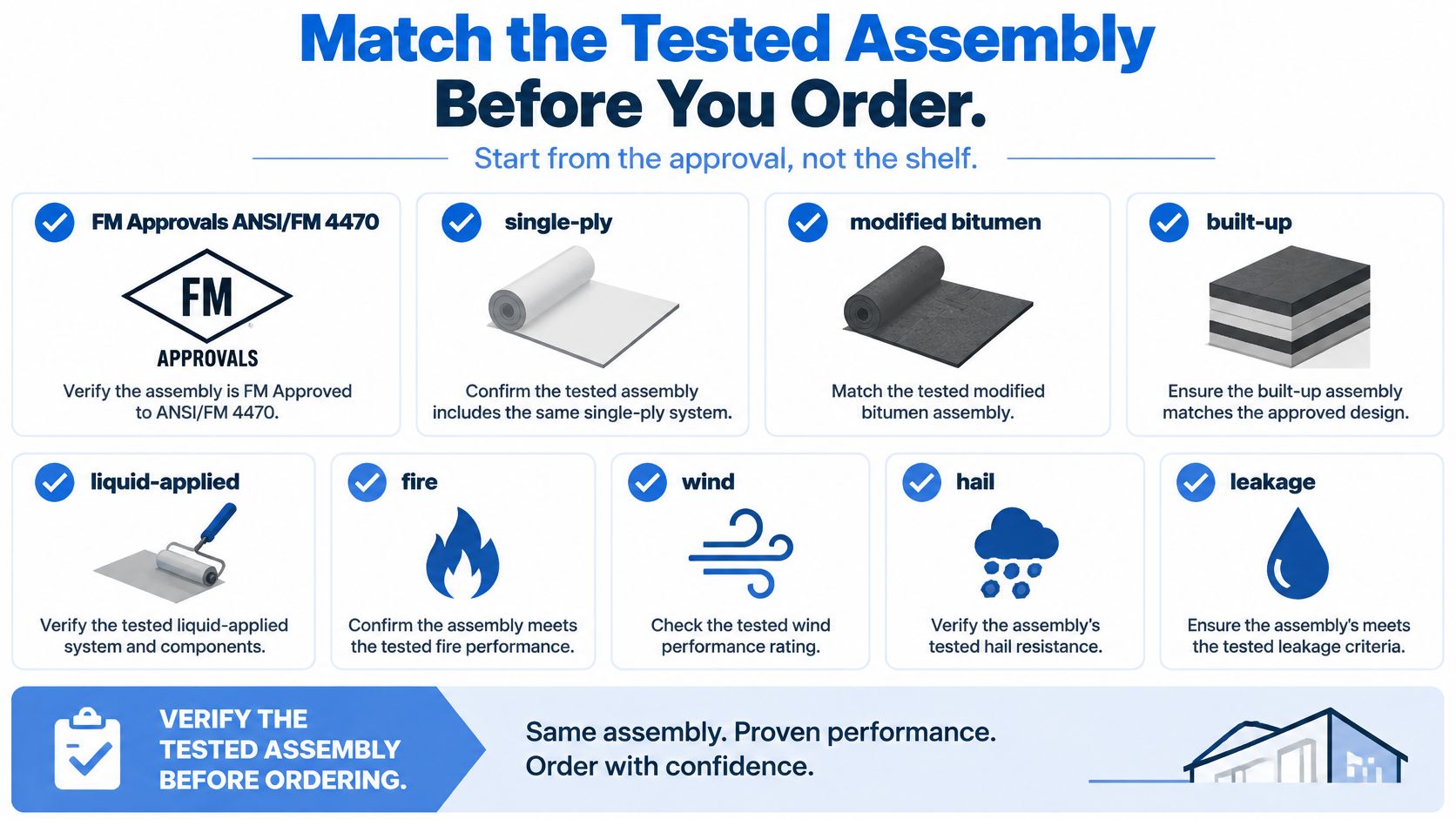
Start from the approval, not the shelf. The FM Approvals roof testing guidance describes ANSI/FM 4470 evaluating single-ply, modified-bitumen, built-up, and liquid-applied systems for fire exposure, wind uplift, hail, water leakage, weathering, foot traffic, and metal corrosion, with wind resistance evaluated under ANSI/FM 4474 using pull tests or 5 × 9 ft or 12 × 24 ft simulated-pressure tests, and certified ratings beginning at Class 1-60 and extending to Class 1-990.
That Class 1-60 number means the assembly sustains 60 psf for one minute without failure. It's a property of the whole stack, deck included. A thicker sheet on the wrong insulation doesn't raise it, and a stronger fastener from another listing doesn't preserve it.
The Five-Line Ticket Check
Run this check before anyone in Fort Worth, Arlington, or Grand Prairie releases rolls.
- Record the assembly number: Write the exact system number, not just the brand family.
- Match deck type: Steel, wood, and concrete don't share fastener or adhesive patterns.
- Match the insulation stack: Type, thickness, facer, and cover board must read as tested.
- Match membrane and attachment: Product, mil, and adhered or fastened method stay together.
- Add zone enhancements: Perimeters and corners get their extra fasteners or adhesive.
The engineer of record or the project's calculated design pressures supply your wind pressures. Cite that calculation next to the system number on the ticket. Don't infer zone fastening from membrane color or mil, because neither one sets pressure.
| Lock this | What matching means | If it is wrong |
|---|---|---|
| System number | Exact approved assembly, not a brand family | Rating does not apply |
| Deck | Steel, wood, or concrete as tested | Fastener or adhesive pattern fails |
| Insulation stack | Type, thickness, facer, and cover board | Uplift and R-value both drift |
| Membrane | Product, thickness, and attachment in the listing | Seams and warranty miss |
| Zones | More fasteners or adhesive at edges and corners | Perimeter blow-off risk |
A component approved on its own doesn't create an approved roof when you combine it with others. That's the warning crews miss when a plate looks identical in the bin. Similar mil thickness isn't a match, and similar color isn't either.
A lookalike part breaks the tested assembly even when it installs without a fight.
For DFW procurement, match the approved assembly, deck, attachment, insulation configuration, membrane, and perimeter and corner enhancements to calculated pressures and the governing code. If one field on the takeoff can't be traced to the listing, hold the order.
Single-Ply Membranes and When Each One Fits
Three sheets cover most commercial orders, and each one fits a different roof. Pick by exposure and existing surface, then let the assembly lock color and mil.
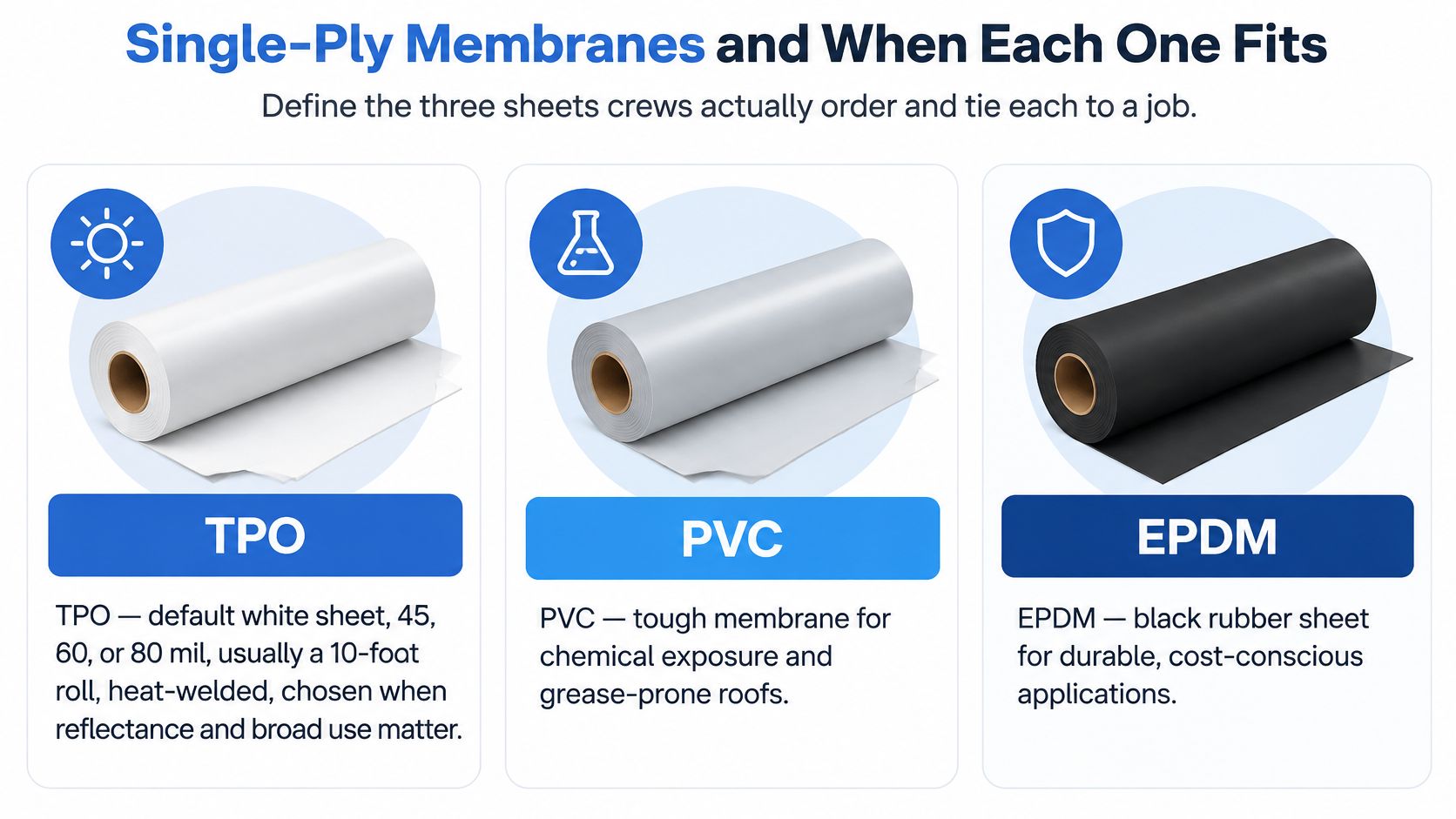
TPO is the default white sheet at 45, 60, or 80 mil, usually a 10-foot roll, with heat-welded seams. Choose it when reflectance and broad availability matter, say a 60-mil white TPO recover over polyiso on a Fort Worth warehouse or an Irving office park.
EPDM comes in 45, 60, or 90 mil, usually black, with tape or adhesive seams. It suits older black roofs and simple seams, for example a 60-mil EPDM patch and extend scope where the crew is tying into a sound black field instead of changing systems mid-roof.
PVC comes in 50, 60, or 80 mil and is heat-welded. It's the usual call near grease exhausts, for example a 60-mil PVC cap at a kitchen curb on an Arlington restaurant roof where TPO flashing would be the wrong family.
What the Historical Split Shows
A technical history of single-ply roofing estimated the total U.S. single-ply commercial roofing market at 3–4 billion square feet by 2017, with approximate single-ply shares excluding bituminous built-up roofing at 60% for TPO, 23% for EPDM, and 17% for PVC.
Treat those shares as a labeled historical split, not a current forecast. They explain why TPO rolls, welders, and boots are easiest to source across DFW, and why EPDM tape and PVC details still need deliberate ordering.
| Membrane | Cited share | Usual attachment | Pick it when |
|---|---|---|---|
| TPO | About 60% | Heat-welded seams, adhered or fastened | White low-slope, broad DFW stock |
| EPDM | About 23% | Tape or adhesive | Existing black roofs and simple seams |
| PVC | About 17% | Heat-welded | Grease, chemicals, or kitchen curbs |
Crews comparing sheet goods with bituminous options can check modified bitumen roll roofing as a separate system family, not as a substitute layer in a single-ply assembly.
Coatings aren't a fourth membrane. They're a maintenance layer on a sound, compatible sheet. If the field is split, wet, or badly patched, a coating pail doesn't turn that roof into a new system for a school in Mansfield or a retail center in Grapevine.
Insulation Cover Boards and Texas Energy Rules
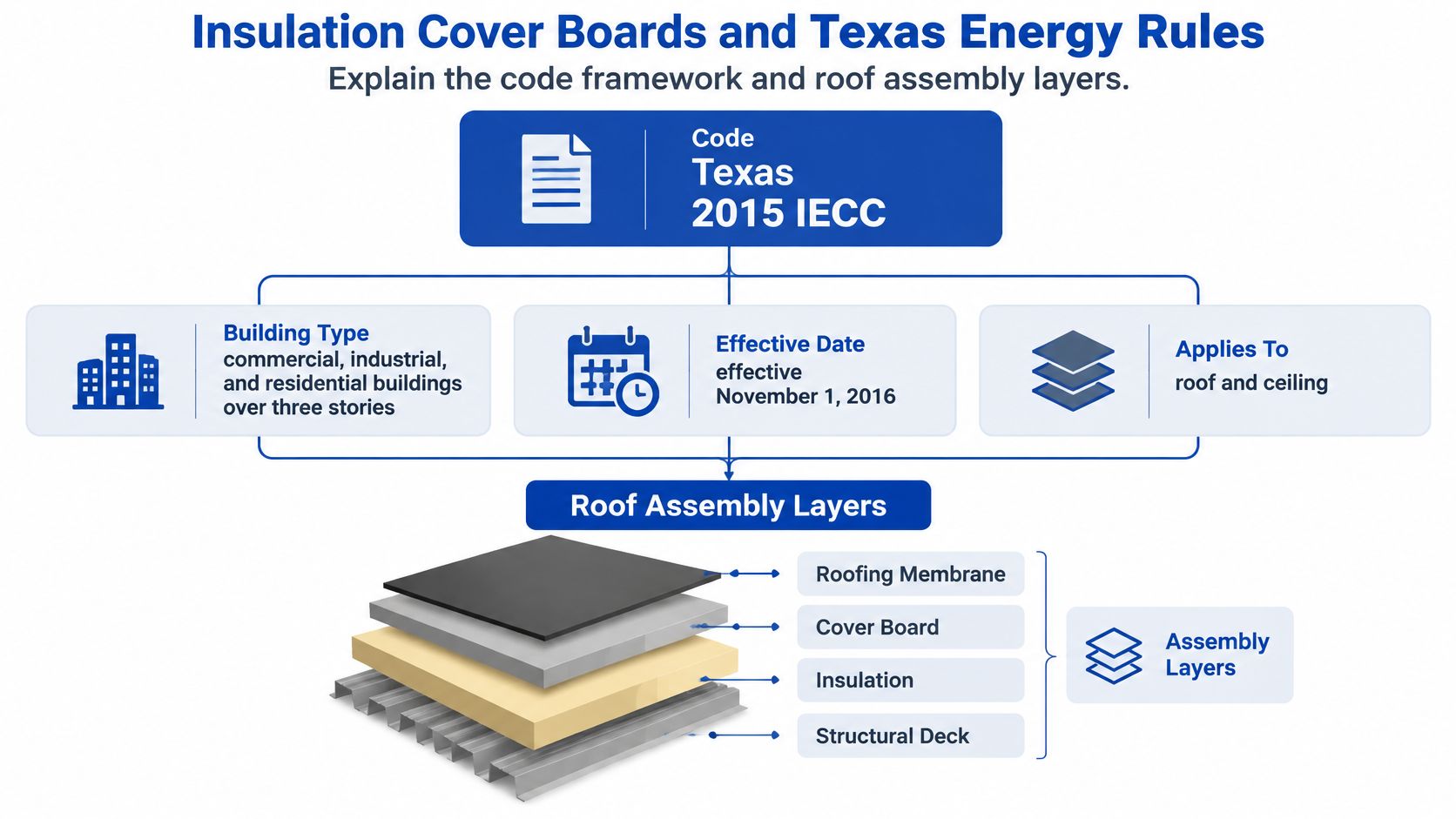
Texas energy compliance affects the roof assembly before the membrane is selected. The Texas State Energy Conservation Office commercial code page says Texas continues to use the 2015 International Energy Conservation Code for commercial, industrial, and certain multifamily construction. The 2015 IECC became effective November 1, 2016, for commercial, industrial, and residential buildings taller than three stories.
That framework addresses roof and ceiling insulation values, continuous insulation, installation, and low-slope roof solar reflectance and thermal emittance. For crews in Arlington, Grapevine, Irving, or Mansfield, insulation is part of the specified assembly, not filler beneath a white sheet. Type, placement, thickness, and surface all affect the finished roof.
Fort Worth applies its currently adopted local codes. Crews in Fort Worth, Benbrook, White Settlement, and Haltom City should check the applicable city edition and amendments before relying on a brochure's R-value.
Build the Stack in Order
- Verify the deck first: Confirm whether it is steel, wood, or concrete, and check the existing substrate condition.
- Set positive drainage: Tapered polyiso and saddles at drains can create slope, often near 1/4 inch per foot.
- Check flashing height last: Curbs, pipes, and parapets must clear the completed roof elevation.
For planning, polyiso commonly provides about R-5.6 to R-5.7 per inch. Typical compressive-strength options include 20 psi for ordinary field areas and 25 psi where traffic or pavers concentrate loads. Confirm the selected board's R-value and psi rating against its data sheet and the tested assembly. A cover board above the insulation can add protection from hail and foot traffic, but its type and attachment must also match the assembly.
A dead-level Arlington warehouse needing two inches of flat board plus a tapered sump at each drain illustrates the height trade-off. The added thickness raises the finished roof, so a curb that had adequate flashing height may no longer clear it. Set the taper layout and check curb height on paper before ordering.
Keep lot labels and packaging information for inspection. Confirm reflectance when the assembly surface is part of the energy submittal, and retain the documentation with the system paperwork for the inspector.
Adhesives Fasteners and Flashing That Stay Compatible
A 60-mil TPO sheet fastened with plates from another listing and flashed with an EPDM boot looks finished on day one. It's still three incompatible decisions on one roof. Compatibility is a receiving check, not a second shopping list.
Bonding adhesive or low-rise foam must be the product named for that TPO, EPDM, or PVC. Keep the technical data sheet temperature and coverage rate in the truck, because a hot afternoon in Forest Hill or south Fort Worth can sit outside that window and weaken the bond.
Primers belong on EPDM tape seams and on some self-adhered details, with open time respected. Rushing tape onto wet primer, or skipping primer to save ten minutes, creates the seam failure that shows up after the first hard rain in Arlington.
| Item | Must match | Field check | Leave it off if |
|---|---|---|---|
| Bonding adhesive or low-rise foam | Membrane on the TDS | Temperature and coverage rate | It is a generic construction adhesive |
| Primer | EPDM seams or listed self-adhered | Open time before the tape | The seam is EPDM and primer was skipped |
| #14 or #15 fastener | Deck and assembly length | Engagement and pull-out | Length stops in the insulation |
| 3 in plate | Listed plate for that system | Field, perimeter, and corner counts | Corners use the field pattern |
| Pipe boot | Same membrane family | Height above finished surface | It is a universal boot on PVC |
| Edge metal | Clad or listed metal | Cleat and fastener pattern | Bare metal contacts PVC |
Deck-Specific Attachment
Fasteners are deck-specific. Order #14 or #15 screws long enough to engage steel or wood through the full insulation stack, with pull-out values from the system, and pair them with 3-inch plates. A screw that stops in the insulation holds nothing, no matter how tight it feels.
Plates and screws increase in perimeter and corner zones already locked by the assembly. Don't let a yard substitution shrink that count. If you're checking detail products, our roof flashing tape belongs only where the membrane system lists a taped detail, not as a universal seam fix.
Flashing That Gets Rejected
Pipe boots, pitch pockets, and T-joint covers must be the same membrane family as the field sheet. A universal boot is a common reject on PVC, and bare metal against PVC can create a chemical problem at the edge.
Use membrane-clad edge metal or metal otherwise accepted by that manufacturer, with the listed cleat and fastener pattern. The good version of the earlier example is simple, same-brand TPO boots, clad edge metal, and the listed plate count in every zone.
Yard note: Stage boots and edge metal in the same drop as the rolls so crews in Mansfield or Irving don't improvise details while the field sheet goes down.
Heat, Hail, and Traffic Choices for North Texas Roofs
North Texas forces three decisions at once. Heat pushes you toward a light TPO or PVC surface when the energy submittal cares about reflectance. Hail and foot traffic push you toward a cover board under that sheet. Wind pushes the corner and perimeter counts up whether the sheet is bright or not.
A bright membrane with no cover board is a weak hail package. The sheet may reflect heat well, but it still sits over insulation that dents, and every service visit concentrates boots and toolboxes on the same soft spots between rooftop units.
What a Reflectance Label Does Not Answer
A high-reflectance label doesn't answer puncture resistance, thermal movement, or whether the insurer accepts the assembly. It doesn't tell you if the crew can repair the sheet easily, if the flashing family matches, or if maintenance traffic will cut it within a season.
- Cover board under the field: Gypsum or high-density board spreads hail impact and foot loads.
- Walk pads on service paths: Pads belong on the route to rooftop units so maintenance doesn't become the puncture source.
- Coatings in the maintenance column: Use them only when the sheet is sound and compatible.
Say you're ordering for a Mansfield or Grapevine retail roof. A workable combined package is a white 60-mil TPO, polyiso at the specified psi, a gypsum or high-density cover board under the hail-exposed field, extra corner attachment from the assembly, and same-family boots at every penetration.
Flip grease-exposed areas on that same roof to PVC, with PVC details at the kitchen curbs. Don't mix a PVC cap with TPO boots to save a line item. The exposure changed, so the membrane family and its flashing change together.
Keep three records with the delivery paperwork, the system number, lot labels, and a note of the cover board used under the hail-exposed field. That note matters when an owner in Fort Worth or Irving asks why one area dented and another didn't after the same storm.
Confirm the Takeoff and Place the DFW Order
Confirm the permit status before releasing materials. The Fort Worth commercial permits page explains that new commercial construction, commercial accessory buildings, remodels, and additions require applicable building, electrical, mechanical, and plumbing permits. The building permit must be issued before a trade permit can be applied for.
A delivery to Forest Hill, Arlington, or Mansfield cannot make up for a permit delay. Check permit status against material planning, inspections, and the installation schedule, then confirm the release list.
The Release List
- Assembly number: Exact listing cited on the ticket.
- Membrane and mil: Product, thickness, and roll width.
- Insulation and taper: Flat thickness, tapered layout, and saddles.
- Cover board: Type and thickness across the field.
- Attachment by zone: Adhesive or fastener pattern for field, perimeter, and corner.
- Flashing and walk pads: Compatible boots, clad metal, and service-path pads.
Keep packaging and lot marks intact for inspection. The records can help the inspector, manufacturer, and crew trace a detail if questions arise.
Blue Lake Roofing Supply supplies TPO, EPDM, coatings, and low-slope systems for commercial buildings. Its Forest Hill yard dispatches materials for DFW contractors, and Arlington residential and commercial corridors receive same-day delivery. Opening a trade account takes minutes and includes contractor pricing, a dedicated representative, and flexible terms. Before dispatch, match the assembly number and each takeoff line to the specified system.
Bring the assembly number, zone counts, and taper layout to Blue Lake Roofing Supply to confirm the membranes, insulation, cover boards, flashing, and coatings as one coordinated package. Set the delivery window around the job schedule so the crew has the materials needed for the planned installation.