Class 4 impact resistance and Class A fire ratings describe tested laboratory assemblies, not permanent guarantees. DFW contractors must verify the exact listed assembly before specifying synthetic shake roofing shingles on hail- and wind-exposed projects across the Dallas–Fort Worth Metroplex.
You're standing on a Fort Worth roof with a homeowner who wants the cedar look, but doesn't want recurring wood maintenance, moisture problems, or a difficult insurance conversation after the next hailstorm. Synthetic shake roofing shingles may be the right answer, but only if the product's documented assembly matches the roof you're building.
That distinction separates a defensible specification from a sales brochure. A synthetic product can carry strong fire and impact classifications, yet still have limitations involving underlayment, fastening, roof slope, weathering, warranty coverage, and end-of-life disposal. The practical question isn't whether synthetic shake looks like cedar. It's whether the exact system has evidence behind its performance in Fort Worth, Arlington, Keller, Grapevine, Mansfield, and the rest of North Texas.
Table of Contents
- Why DFW Contractors Are Evaluating Synthetic Shake Roofing Shingles
- What Synthetic Shake Roofing Shingles Are Made Of
- How Synthetic Shake Compares With Natural Wood Shake Roofs
- How to Read Synthetic Shake Installation and Assembly Documentation
- Hail Performance and Weathered Durability in North Texas
- Sustainability, Recycled Content, and End-of-Life Disposal
- When to Specify Synthetic Shake Roofing Shingles in DFW Projects
Why DFW Contractors Are Evaluating Synthetic Shake Roofing Shingles
A homeowner in Arlington wants cedar shake character without recurring wood maintenance. You are responsible for a roof that must withstand severe thunderstorms, hail exposure, inspection requirements, installation variables, and warranty conditions. Synthetic shake roofing shingles can fit that project, but only when the documented assembly matches the roof being built.
Synthetic shake developed as an alternative to natural cedar. Manufacturers mold polymer and rubber-based composites to reproduce shake texture and profile. Depending on the formulation, the material can avoid several wood-related vulnerabilities, including insects, mold, and mildew, as described in a 2009 industry review of synthetic roofing products.
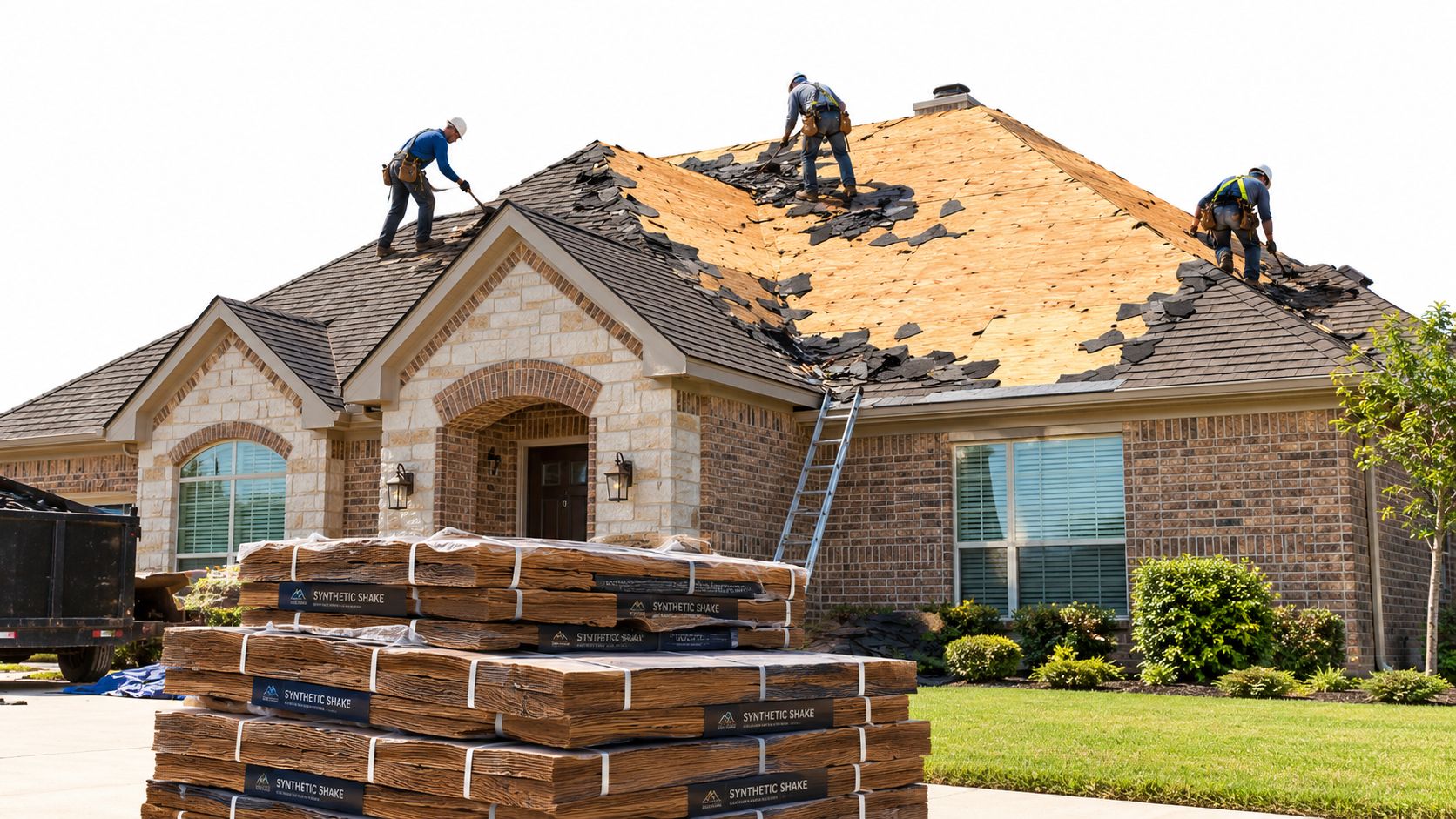
A roof replacement in Forest Hill, Benbrook, or White Settlement is not a simple shingle swap. Synthetic shake is an assembly. The product profile, roof deck, underlayment, exposure, fasteners, perimeter details, and installation method all affect performance. Compare the manufacturer's tested assembly with the project conditions, then confirm product availability through a reliable residential roofing materials supplier.
Treat a Class 4 impact rating as a starting point, not proof of North Texas hail performance. The rating applies to a tested assembly. It does not establish how the installed roof will perform after repeated storms, aging, altered fastening, different underlayment, or field conditions outside the listed configuration. Demand the assembly report, installation instructions, approved components, and warranty terms before promising hail results.
The contractor's first comparison
| Decision factor | Synthetic shake | Natural wood shake |
|---|---|---|
| Appearance | Reproduces cedar or slate character through engineered profiles | Genuine wood texture and aging |
| Fire performance | Varies by product and assembly, with some products achieving Class A and others Class C ratings | Requires project-specific evaluation and treatment |
| Impact documentation | Some products carry Class 4 certification, but the listed assembly and limitations require verification | Must be evaluated separately |
| Moisture and biological concerns | Some formulations avoid several wood-related vulnerabilities | Wood remains vulnerable to moisture, insects, mold, and mildew |
| End of life | Composite construction can make sorting and recycling difficult, as indicated by sector EPD data | Disposal and reuse depend on wood condition and treatment |
Field position: Specify the documented assembly, not the marketing category. Ask how the composite will be handled after removal, because durability does not solve end-of-life disposal.
For detached homes, multifamily replacements, and exterior renovations near Southlake or Euless, that discipline protects both contractor and owner. A roof that looks right but lacks matching documentation can cause inspection delays, warranty disputes, and difficult storm-damage decisions later.
What Synthetic Shake Roofing Shingles Are Made Of
A synthetic shake roof can pass a showroom inspection and still require closer specification review. The word synthetic covers molded products made from different polymers, rubber-based composites, fillers, UV inhibitors, and impact modifiers. Formulations may also include recycled rubber, recycled plastic, mineral dust, or cellulose fibers, as described in this industry review of synthetic roofing materials.
Composition affects more than appearance. It influences flexibility, weight, fire behavior, impact response, ultraviolet aging, and how the material can be handled after removal. Two products with similar cedar profiles may rely on very different feedstocks and require different documentation. Ask for the product's actual composition, evaluation reports, installation requirements, and tested assembly. Do not infer performance from the molded profile.
Composition changes the specification
| Composition element | Performance influence and documentation question |
|---|---|
| Polymers | Form the base structure and molded profile and commonly rely on petroleum-derived feedstocks. Ask which resin system the manufacturer uses and whether the evaluation report covers the ordered profile. |
| Rubber or elastomers | Can add flexibility and affect impact behavior. The complete formulation and assembly still control the usable rating, not the presence of rubber alone. |
| Mineral fillers | Can change stiffness, weight, fire behavior, and processing. Composite construction may also make separation at disposal more difficult, a concern reflected in the sector data on shingle materials and end-of-life handling. |
| UV inhibitors | Help address ultraviolet exposure. They do not replace evidence from weathered specimens or the limitations stated in the UL evaluation report for the tested product. |
| Impact modifiers | May improve impact resistance, but a Class 4 label remains an assembly-specific test result. Require the tested deck, underlayment, fastening pattern, and product configuration before treating it as North Texas hail evidence. |
| Recycled content | Can reduce virgin feedstock use, but the amount and source vary by product. Require written recycled-content documentation rather than accepting a general sustainability claim. |
A published synthetic cedar-shake specification reports up to 80% post-industrial recycled materials and lists UL 790 Class A or Class C fire resistance, UL 2218 Class 4 hail impact resistance, and ASTM D3161 Class F wind resistance at 110 mph. These are separate test results. They do not create one universal durability score, and a Class 4 result does not prove equivalent performance after years of North Texas heat, ultraviolet exposure, and hail cycles. Review the published shake-tile specification as one product example, not as a standard for every synthetic shake line.
For Fort Worth and nearby projects, request the resin and filler composition, recycled-content records, evaluation reports, weathering evidence, and complete installation manual. Confirm that the documents match the ordered color, profile, deck, underlayment, and fastening method.
End-of-life deserves the same direct review. Synthetic products may reduce demand for timber or quarried slate in some applications, but they generally use petroleum-derived materials, and composite construction can complicate sorting. Specify the tested assembly, then ask how the removed material will be handled.
How Synthetic Shake Compares With Natural Wood Shake Roofs
A DFW owner who wants cedar character without rot and insect exposure should start with synthetic shake. A restoration project that demands authentic material may still justify natural wood, but replacement work calls for a tighter comparison than appearance alone.
Synthetic shake also requires disciplined installation. A representative specification calls for a weather-tight roof envelope, wind-uplift attachment suited to the selected configuration, a 1/4- to 3/8-inch gap between shakes for expansion, and two or three nails per shake based on size. Review the CeDUR three-part installation specification before treating those details as interchangeable with another product's instructions. The spacing and fastening affect movement, drainage, uplift resistance, and warranty compliance.
Compare the controls separately
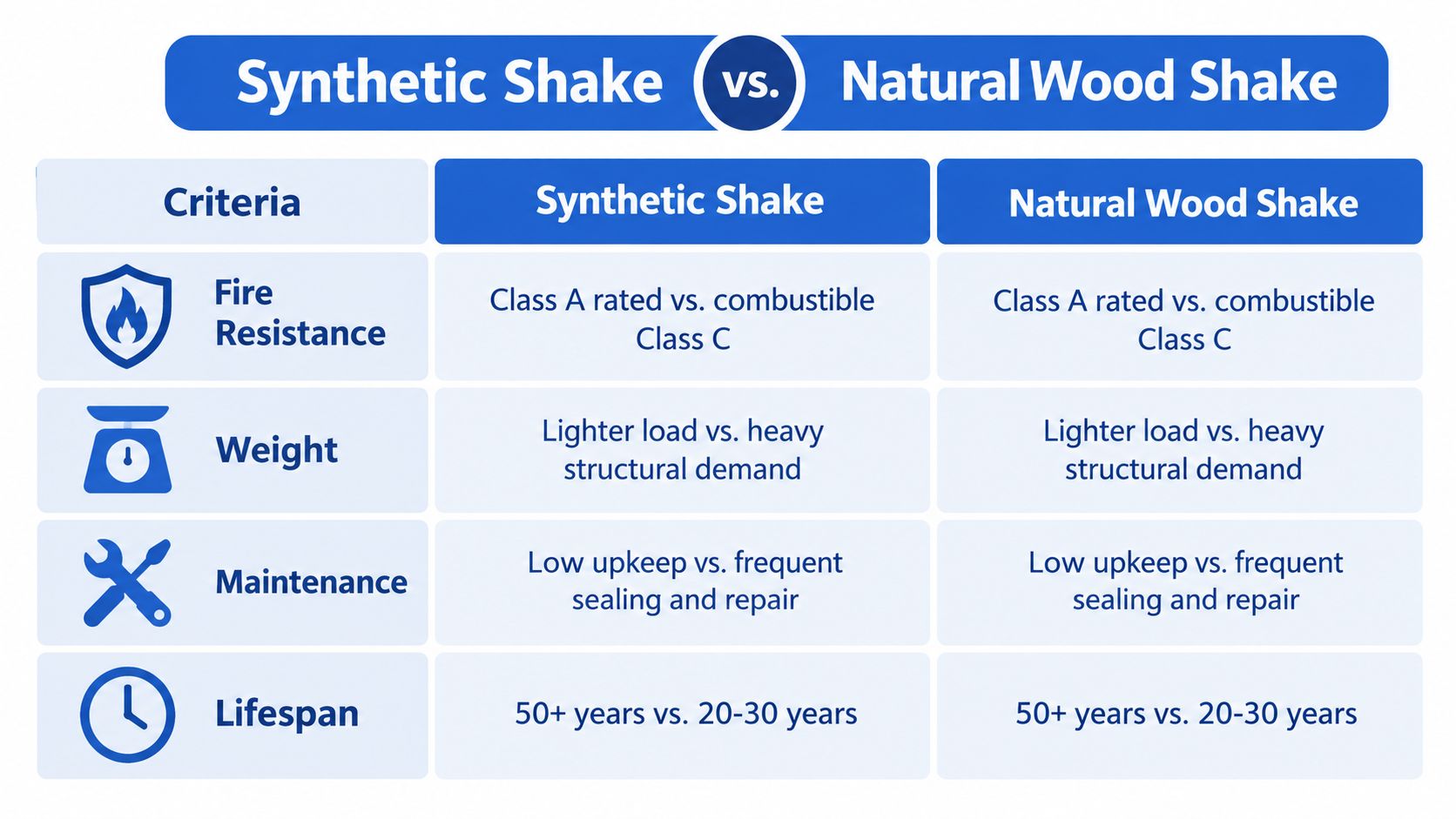
| Control | Synthetic shake | Natural wood shake | Contractor's decision |
|---|---|---|---|
| Fire | Some synthetic assemblies achieve Class A, while other products or assemblies carry different classifications | Performance depends on the wood product, treatment, assembly, and adopted requirements | Verify the listed assembly, not the material name |
| Wind | One published guide identifies a standard application rating of 115 mph at a 10-inch exposure, while the related warranty limits that application to 90 mph. Review the synthetic shake installation guide | The profile and project conditions determine design and installation requirements | Separate test results from allowable design and warranty coverage |
| Impact | Many synthetic products carry Class 4 certification, but that classification belongs to the tested product and assembly. A synthetic roofing product review is background, not approval for another brand | Natural wood needs its own documented performance basis | Do not transfer a synthetic rating to wood or between synthetic brands |
| Movement | Expansion spacing and fastening follow the selected product system | Wood movement and installation practice differ from composite systems | Follow the manufacturer's details for the ordered product |
| Maintenance | Some formulations reduce exposure to rot, insects, mold, and mildew vulnerabilities | Wood requires closer attention to moisture, insects, weathering, and damaged pieces | Match the material to the owner's maintenance expectations |
The wind figures demand careful reading in Fort Worth, Keller, Grapevine, Arlington, and Mansfield. A 115 mph laboratory or system rating does not approve every roof configuration for that wind demand. A 90 mph warranty limit does not increase because the test rating is higher. The guide also calls for ASTM D226 No. 30 base sheet across the roof deck or an approved synthetic underlayment, plus a 36-inch-wide ASTM D226 Type II No. 30 strip at the eave line. Put those requirements in the job file.
Class 4 deserves the same discipline. It confirms performance under a defined impact test. It does not prove equal resistance after years of North Texas heat, ultraviolet exposure, and repeated hail. Require assembly-specific documentation, including the product, deck, underlayment, fastening pattern, and approved installation method.
Natural cedar remains defensible for preservation work where material authenticity outweighs maintenance and storm-performance concerns. Synthetic shake is the better replacement platform when the contractor can document the complete tested assembly. Ask about end-of-life handling too. Lower maintenance does not answer how a composite roofing product will be sorted or disposed of after removal.
How to Read Synthetic Shake Installation and Assembly Documentation
A product page tells you what the manufacturer wants you to notice. An evaluation report tells you what the tested system included. Use the second document to make the specification.
One Florida Building Commission compliance report documents Class A fire classification on combustible decks when the system uses ASTM D226 Type II underlayment. The same report identifies ASTM D7158 Class H, ASTM D3161 Class F, and Class 4 impact resistance under ANSI/FM 4473 and UL 2218. Those classifications apply to the documented system, not automatically to every roof using the same brand name.
Read the report in this order
Identify the roof assembly. Confirm deck type, roof slope, exposure, profile, color, and the exact product designation. A rating for one configuration may not cover another.
Check underlayment requirements. Record the required material and placement. If the tested system requires ASTM D226 Type II, an unapproved substitute can change the compliance basis.
Review fastening details. Note nail type, length, quantity, spacing, fastening pattern, and perimeter requirements. Crews in Forest Hill, Southlake, Euless, and nearby cities should have these details in the installation packet, not only in a sales email.
Confirm wind limitations. Look for allowable design wind speed, exposure assumptions, uplift test method, and any high-wind exceptions. Don't confuse a classification with permission to install the product on any roof.
Match fire and impact evidence. Verify whether the rating applies to the complete assembly, including underlayment and deck. Class 4 is the highest commonly used UL 2218 impact category, but it doesn't make a roof immune to cosmetic damage, debris, or installation failure.
Build the job file around evidence
For detached homes, multifamily replacements, and repair work, retain the evaluation report, current installation instructions, selected underlayment documentation, product identification, and crew fastening notes. If an inspector asks what was installed, the answer should be traceable to a published assembly.
Documentation rule: If the report doesn't identify the deck, underlayment, fasteners, exposure, and edge details, you don't yet have enough information to promise code compliance or storm performance.
That standard also applies when ordering asphalt shingle underlayment for a project that uses synthetic shake in part of the roof system. Confirm compatibility before material arrives at the jobsite.
Hail Performance and Weathered Durability in North Texas
A DFW homeowner calls after a second hailstorm, and the synthetic shake roof still sheds water. The exposed faces show dents, the edges are brittle, and no one can confirm whether the original impact rating covered the installed assembly. That is the North Texas performance question contractors need to answer before specifying the product.
A Class 4 label records performance in a defined impact test. It does not establish how ultraviolet exposure, thermal movement, repeated storms, or installation conditions affect the roof years later. The Insurance Institute for Business & Home Safety identified this evidence gap in its 2025 research agenda, which plans field aging of a synthetic composite roofing cover followed by hail testing. The material had shown resilience against unaged 2-inch hail, while post-aging performance remained largely unknown, according to the IBHS research agenda. Contractors in Fort Worth, Dallas, Arlington, and Grand Prairie should require manufacturers to address that gap directly.
Separate protection from appearance
Water-shedding performance and visible appearance are separate questions. A roof can keep out water while showing cosmetic damage. Hidden cracking, loose fasteners, or broken pieces can also reduce serviceability before a homeowner sees an active leak. Class 4 is not a complete answer for either condition.
Use this screening list when reviewing product evidence:
- Pre- and post-weathering data: Confirm whether specimens were tested as manufactured and after Xenon-Arc exposure.
- Tensile retention: Review evidence of resistance to rupture and cracking after exposure.
- Flexural retention: Check for changes that could signal brittleness or breakage during handling and thermal movement.
- Temperature cycling: Confirm evaluation through repeated expansion and contraction.
- Wind uplift: Verify the relevant uplift procedures and the installation conditions used in testing.
A UL evaluation report for synthetic composite roofing tiles references tensile testing under ASTM D638, flexural testing under ASTM D790, temperature cycling under AC07, and wind-uplift testing under ANSI/UL 580 and ANSI/UL 1897. Those categories provide a stronger procurement basis than a generic “lifetime” or “50-year” claim.
For successive hail events, demand written guidance for inspection, repair, replacement, warranty decisions, and end-of-life handling. If the documentation covers only a new product sample, the evidence is incomplete. Contractors comparing impact options can also review zinc metal roofing panels as a documented alternative assembly. Specify synthetic shake for hail-exposed DFW work only when the manufacturer can support the complete roof system, not just a marketing label.
Sustainability, Recycled Content, and End-of-Life Disposal
At tear-off, the sustainability case becomes concrete. Synthetic shake can reduce demand for solid wood or quarried slate, but contractors still need to account for polymer feedstock, manufacturing, transportation, installation waste, tear-off handling, and disposal. A Class 4 impact label addresses one performance category. It does not prove lower environmental impact or a workable recovery route.
The recycled-content figure cited earlier describes input material, not output recovery. A composite that reduces virgin feedstock use may still be landfill-bound after removal because conventional sorting cannot easily separate polymer, rubber, and mineral filler. Use the product specification for the manufacturer's stated material information, then request current documentation for the specific product and assembly.
Recycled content needs a precise definition
Ask whether the content is post-industrial or post-consumer. Request the resin, rubber, and mineral-filler breakdown, along with evidence showing how much installation waste can re-enter production. A high recycled-content claim does not establish low carbon impact, local recyclability, or a manufacturer take-back program.
Environmental reporting shows why generic labels fail. A sector EPD dataset for pitched-roof shingles reports global-warming impacts ranging from approximately 45% below to 93% above its average. Treat that range as a warning to request product-specific evidence. “Synthetic” is not a sustainability analysis.
The tear-off plan belongs in the bid
Composite shingles containing polymers, rubber, and mineral fillers can be difficult to process through conventional recycling systems. Roofing waste commonly goes to landfills, so a contractor bidding work in Fort Worth, Benbrook, Mansfield, or another North Texas market should establish the disposal pathway before installation.
Use this procurement checklist:
- Material disclosure: Obtain resin, rubber, filler, and recycled-content information.
- Take-back options: Ask whether the manufacturer accepts returned installation waste or tear-off material.
- Recycler acceptance: Confirm that a local facility accepts the specific composite, not just “plastic roofing.”
- Sorting requirements: Determine whether shakes, underlayment, fasteners, and other materials must be separated.
- Disposal cost: Include handling and disposal requirements in the project scope.
- Lifecycle evidence: Check whether claims cover manufacturing, transport, installation, maintenance, and disposal.
A durable roof may require fewer replacements, but durability does not prove recyclability or lower carbon impact. Give the owner a documented answer for the roof's full service life and its removal.
When to Specify Synthetic Shake Roofing Shingles in DFW Projects
Specify synthetic shake roofing shingles when the project needs cedar or slate character, the owner wants less wood-related maintenance, and the manufacturer can provide a tested assembly that matches the roof. That combination makes sense for replacement work on detached homes in Fort Worth, Grapevine, Keller, Arlington, Mansfield, and nearby communities where hail and severe thunderstorms influence material selection.
I'd favor synthetic shake in these situations:
- Appearance-driven replacements: The owner wants a cedar-style roof but doesn't want the maintenance exposure associated with natural wood.
- Hail-conscious projects: The selected product has independently documented impact performance, and the contractor explains that the rating isn't a permanent guarantee against cosmetic or weathered damage.
- Inspection-sensitive work: The file includes the assembly report, underlayment, fastening pattern, roof slope, edge details, and applicable wind limitations.
- Multifamily and managed properties: The owner needs repeatable installation details and clear documentation across multiple roof areas.
- New construction: The design team can select the roof deck, underlayment, profile, and edge conditions around the tested system from the beginning.
I'd reject it when the project requires genuine historical wood, when the owner's sustainability goals depend on a verified closed-loop recycling route that the product doesn't have, or when the available report doesn't match the roof configuration. The same applies to a high-wind application where the warranty limit, tested rating, and project design requirement don't align.
Commercial and low-slope exterior coordination also demands restraint. Synthetic shake belongs on the roof areas for which the manufacturer documents an approved assembly. Don't use it as a visual substitution across incompatible slopes, transitions, or flashing conditions without written system guidance.
My recommendation: Approve the product only after the documentation survives a three-part check: exact assembly, weathered-performance evidence, and a realistic tear-off plan.
For contractors serving Dallas–Fort Worth, that approach is more valuable than a generic durability promise. Specify the tested system, train the crew on the details, document the installation, and explain both the benefits and the unresolved hail-aging question to the owner. Synthetic shake is a strong option, but only when the evidence supports the roof you're building.
Blue Lake Roofing Supply helps DFW contractors source installer-grade roofing systems, underlayments, accessories, and related exterior materials with jobsite-direct delivery from its Forest Hill yard and contractor-focused support. Visit Blue Lake Roofing Supply to discuss material availability, documentation, trade accounts, and delivery coordination for your next synthetic shake roofing project.