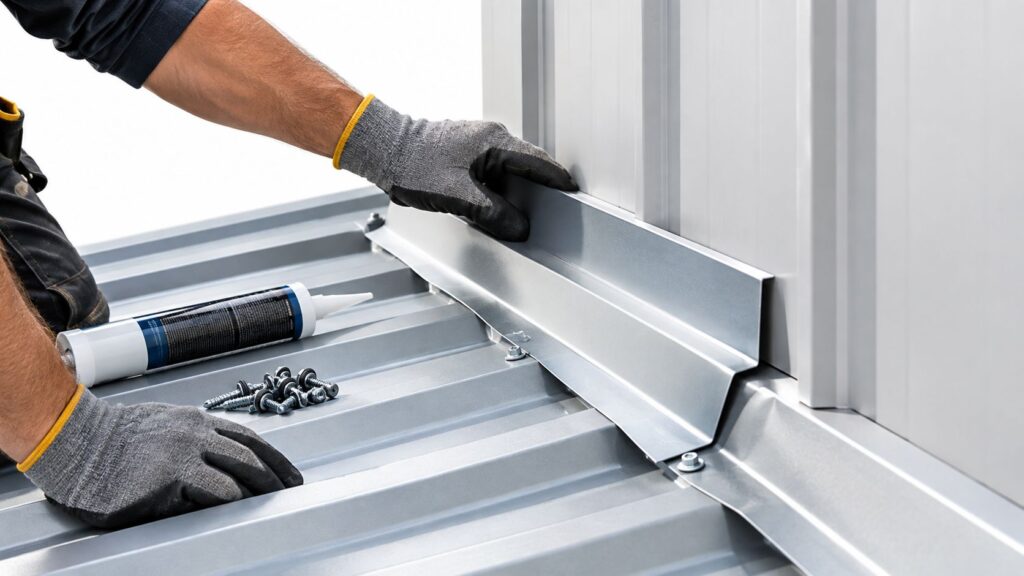
You're on a roof quote in Fort Worth, Arlington, or Benbrook, the shingles are picked, the crew is lined up, and the roll under the pallet still has to be called in. That's where the job gets decided more often than most homeowners ever realize. The best roof underlayment isn't the loudest label on the rack, it's the layer that fits the roof covering, the slope, the wind exposure, and the code enforced on that address.
| Underlayment family | What it's good at | Where it usually wins | Where it can disappoint |
|---|---|---|---|
| Asphalt-saturated felt | Familiar handling, code acceptance, predictable basics | Straightforward re-roofs and budget-conscious work | Tears easier and gives you less margin on rough scheduling |
| Synthetic sheet | Stronger tear resistance, easier walkability, cleaner install | Most pitched residential roofs in DFW | Needs the right standard and fastening details, not just a marketing label |
| Self-adhered membrane | Fastener sealing, edge and detail protection, low-perm control | Eaves, valleys, penetrations, ice-dam or high-detail zones | Usually too much membrane for the whole roof if you don't need that level |
Table of Contents
- Why DFW Contractors Are Rethinking the Best Roof Underlayment
- The Three Underlayment Families Every Contractor Should Know
- Comparing Performance Where It Actually Counts
- DFW Conditions That Change the Equation
- Matching Underlayment to Roof Type Across the Metroplex
- A Pre-Order Checklist for Calling In the Right Roll
Why DFW Contractors Are Rethinking the Best Roof Underlayment
A Tuesday morning in Fort Worth can turn into a Saturday install in Benbrook before the coffee cools. The shingles get attention first, because that's what the homeowner sees, but the underlayment is what keeps the job from coming back with stains, soft decking, or an inspector asking why the spec didn't match the roof.
That hidden layer matters more in the Dallas-Fort Worth Metroplex than a lot of generic comparison posts admit. Local roofs deal with wind, heat, mixed slope conditions, and attic assemblies that don't always dry the same way. A product that looks great on a sales sheet can still be the wrong answer on a roof in Forest Hill, Arlington, or Keller if it doesn't match the roof covering and the code edition in force.
Start with the assembly, not the roll
Roofing materials are generally vapor-impermeable, so the rest of the assembly has to be thought through as a system, not as isolated products. Building guidance for cold-weather roof assemblies points out that ventilation beneath the decking is the main drying route in many cases, and higher-permeability underlayments can help if the assembly gets wet from penetrations, storm damage, or ice dams. That's why “best” is never a universal label, it's a fit test.
Practical rule: if the underlayment choice doesn't make sense when you explain the deck, attic, ventilation, and roof covering together, it's probably the wrong call.
That's also why a contractor should be able to defend the choice to three different people without changing the story. The homeowner wants a simple answer. The inspector wants code and documentation. The crew leader wants a product that installs cleanly and seals where it should.
If you need a field-ready reference for asphalt-shingle jobs, Blue Lake Roofing Supply publishes a local asphalt shingle underlayment guide that fits the kind of pitched-roof work crews are doing around DFW.
The Three Underlayment Families Every Contractor Should Know
The trade keeps trying to simplify underlayment into “felt versus synthetic,” but that skips the part that matters on the jobsite. The actual categories you need to sort are asphalt-saturated felt, synthetic sheet underlayment, and self-adhered polymer-modified bitumen. Those are the families that show up on labels, in code references, and in manufacturer listings.
What the label is really telling you
The code and standard matter more than the sales language. ASTM D226, ASTM D4869, ASTM D8257, and ASTM D1970 are the kinds of designations that tell you what the product is meant to do, not just how it's marketed. “Premium,” “high-performance,” and “30-year underlayment” are shop talk at best, not a compliance plan.
A felt product tied to ASTM D4869 is not the same conversation as a synthetic sheet evaluated to ASTM D8257. A self-adhered membrane built around ASTM D1970 is doing a different job again, especially around fasteners and leak-prone details. The right move is to verify the printed standard against the roof covering and the adopted IRC edition before anyone starts loading the truck.
Practical sourcing for DFW crews
That's where installer-grade stocking matters. A crew in Forest Hill or Arlington doesn't have time to wonder whether the roll at will-call fits the job, especially when the next stop is a reroof in Mansfield or Grand Prairie. Blue Lake Roofing Supply stocks pitched-roof underlayments and related accessories for that kind of same-day pick-up and jobsite delivery flow, which keeps the spec tied to the actual roof instead of to a generic catalog page.
Field takeaway: the best roof underlayment is the one whose printed standard, fastening method, and code listing match the covering, not the one with the loudest packaging.
Comparing Performance Where It Actually Counts
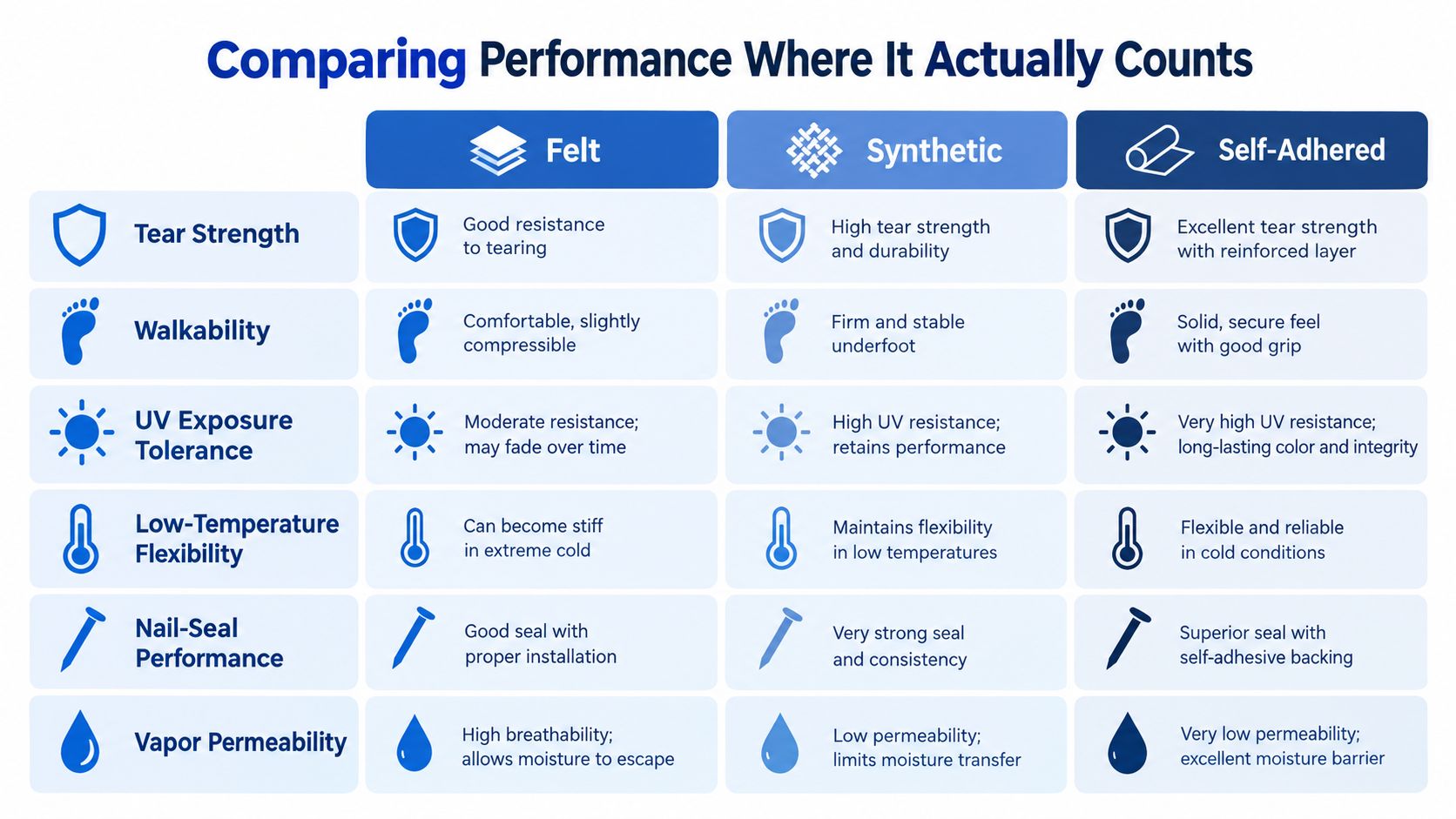
The comparison that saves callbacks is the one built around failure modes, not brochure copy. Tear resistance, walkability, UV tolerance, low-temperature flexibility, nail-seal performance, and vapor permeance are the metrics that tell you whether a roll belongs on a specific roof in Fort Worth or should stay on the pallet.
| Underlayment Family Performance Snapshot | Key ASTM Standard | Tear Strength Trend | Nail-Seal | Typical Vapor Permeance | Best-Fit DFW Use |
|---|---|---|---|---|---|
| Asphalt-saturated felt | ASTM D226, ASTM D4869 | Lower than synthetics in typical handling | Limited by design, depends on detailing | Generally higher, so it's more vapor-open | Basic pitched-roof work where code and budget drive the call |
| Synthetic sheet | ASTM D8257 where specified | Stronger than felt in typical field use | Depends on product and fastening system | Varies by product, check the label and test method | Most asphalt-shingle reroofs and many general residential jobs |
| Self-adhered membrane | ASTM D1970 / D1970M | Not the main selling point, sealing is | Strong at fastener penetration and details | Often low-perm, detail-oriented behavior | Eaves, valleys, penetrations, high-detail or high-risk zones |
What the data actually says
A representative self-adhered membrane data sheet reports 40 mil thickness, 250 psi tensile strength, flexibility unaffected at −20°F, and maximum permeance of 0.05 perms. Those numbers are useful because they show the profile of a low-permeance, detail-driven membrane, but they are not a universal benchmark for every roof. A different roof assembly may need more drying potential and less vapor control.
Felt and synthetic products need a different kind of judgment. Building Science reporting has shown wet-cup permeance values of 5.6 perms for 15-pound asphalt felt, 18.2 perms for 15-pound tar felt, and as high as 28 perms for some fiberglass-reinforced products, while also documenting an underlayment example at 0.56 perms by dry-cup testing (Building Science technical paper). That spread tells you why the cup method matters and why you can't compare vapor claims casually.
The same section of the job often wants different answers. An asphalt-shingle reroof over a vented attic in Tarrant County does not need the same underlayment strategy as a metal retrofit over an unvented cathedral ceiling. If the assembly can dry, a more open underlayment can make sense. If the details are the weak point, a self-adhered layer at the vulnerable areas is the smarter buy.
Shop-floor rule: don't let a membrane's thickness fool you into thinking it's the right answer everywhere. Match the product to the failure risk.
For crews adding flashing reinforcement and detail sealing, a product line like roof flashing tape can be a better supporting choice than trying to make one underlayment do everything. If you're comparing those details against a standard residential package, roof flashing tape options are worth lining up with the underlayment spec before material day.
DFW Conditions That Change the Equation
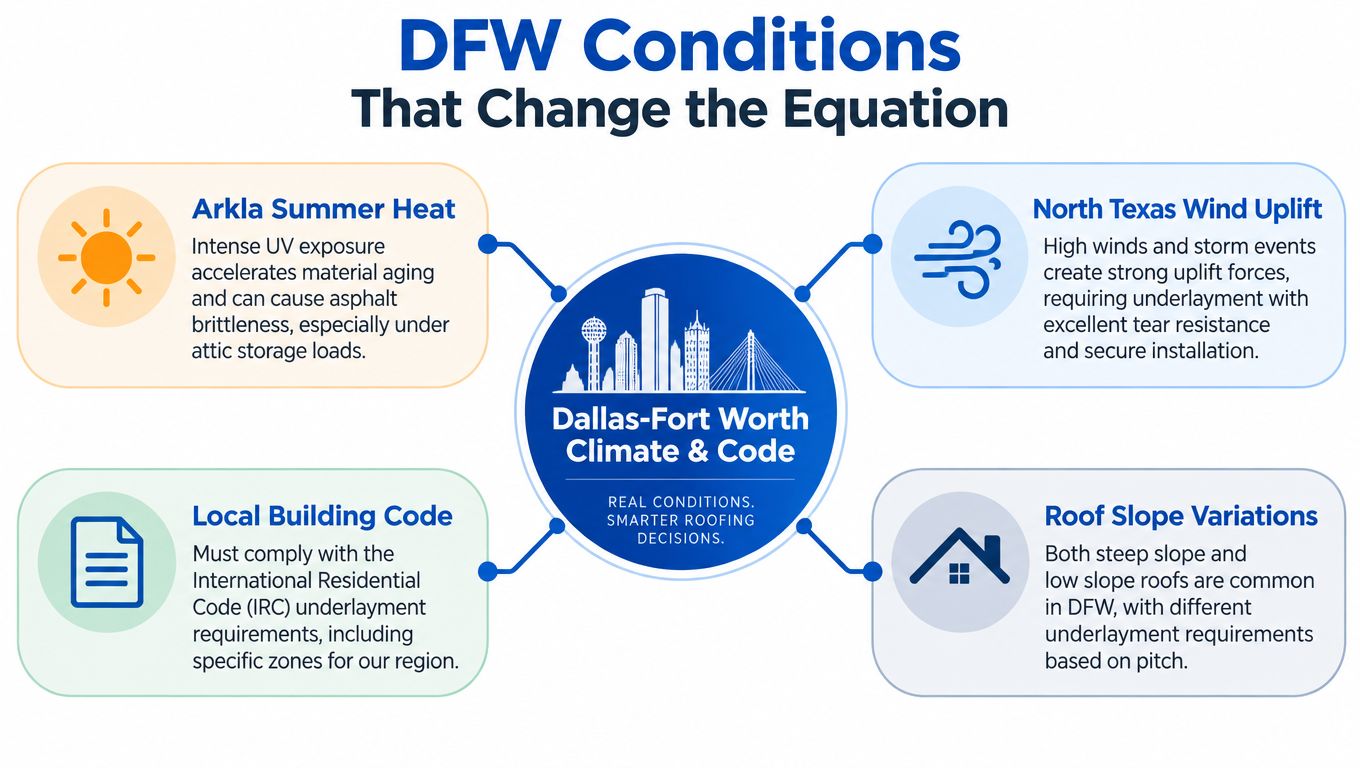
The Dallas-Fort Worth area doesn't reward a one-size-fits-all underlayment decision. Heat, wind, slope, and local code all push the job in different directions, and Fort Worth's own guidance makes that plain. The city's roofing FAQ says an ice-barrier underlayment is not required under local amendments because the area doesn't have a history of ice damming, and it says roof work must follow either the manufacturer's recommendations or Section R905 of the 2021 IRC, whichever is more restrictive (Fort Worth roofing FAQ).
Slope changes the install math
Under the 2021 IBC and IRC, asphalt-shingle roofs with slopes from 2:12 through 4:12 require a two-layer underlayment application. That's not a marketing preference, it's a response to how low-slope shingles shed water differently from steeper roofs. The same roof type can demand a completely different detail package once the pitch changes.
Wind matters too. One major International Code update moved the enhanced-wind threshold from a velocity pressure of 120 mph to an ultimate wind speed of 140 mph to align terminology with the IRC, and it allowed ASTM D1970 self-adhered membranes as an alternative in specified high-wind applications (NRCA roofing guideline summary). That means the right answer on a windy address is not always “more felt,” it may be a sealed detail strategy tied to the code.
Moisture management is the real test
The roof deck, attic ventilation, insulation, and covering all affect whether the underlayment should breathe more or seal harder. Underlays improved weather-penetration performance on concrete tile roofs in assembly testing, slightly improved metal-tile performance, and didn't help long-run galvanized or prefinished steel assemblies the same way in the cited study. That's a reminder that compatibility matters as much as product class.
North Texas contractors know the practical side of this. A job in Mansfield or Grand Prairie can get an inspector comment that changes the underlayment call, and the crew still needs to keep moving. Same-day dispatch from a local supply yard helps, but only if the replacement roll fits the code and the assembly already on the roof.
The better question is never “what's the strongest product.” It's “what does this roof need to shed water, dry out, and pass inspection on this address?”
Matching Underlayment to Roof Type Across the Metroplex
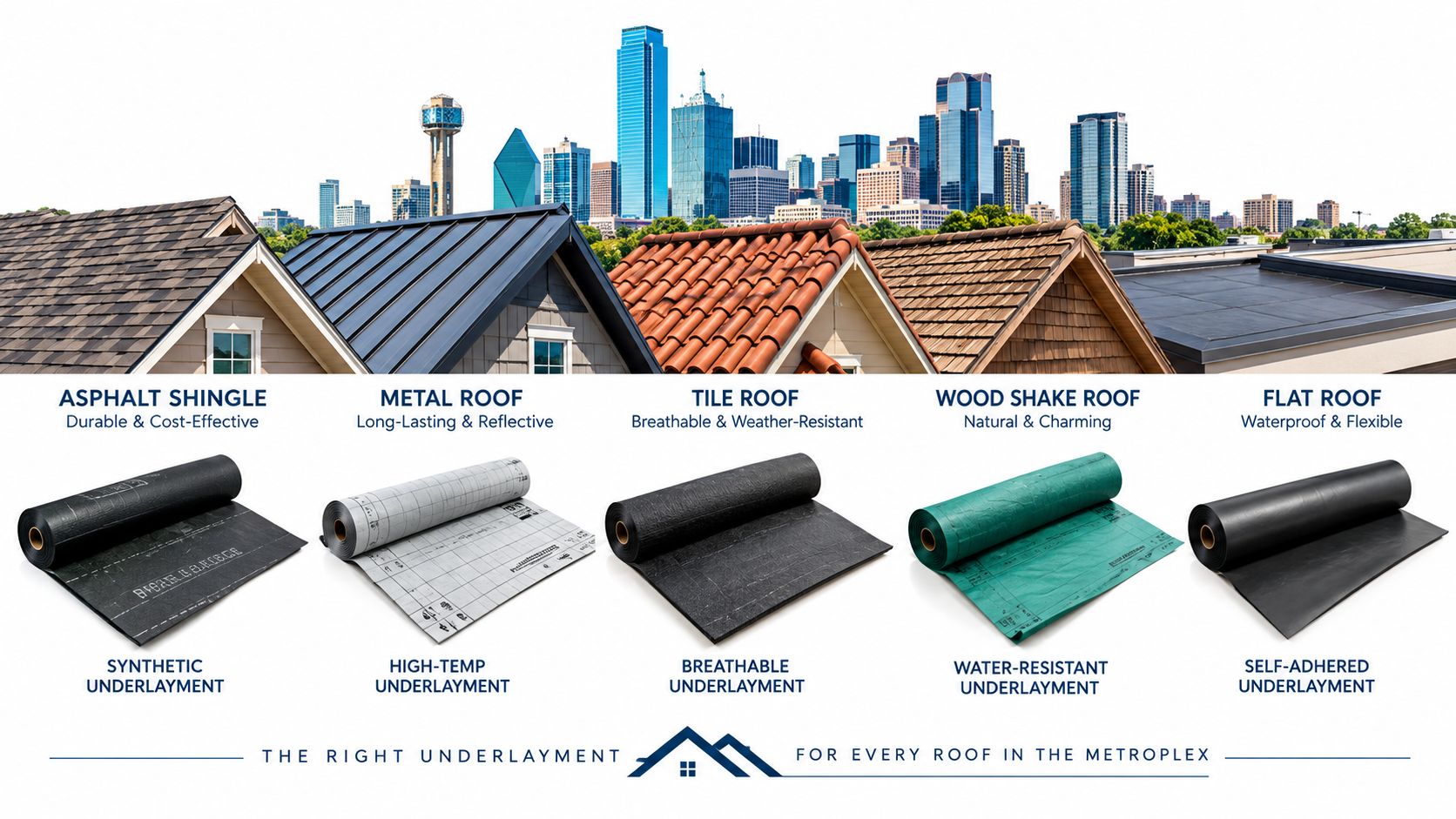
An asphalt shingle reroof on a vented attic in Fort Worth usually wants a synthetic underlayment with peel-and-stick detailing at valleys, eaves, and penetrations. That gives crews a stronger walking surface and better tear resistance without overbuilding the entire roof. For the homeowner, the verdict is simple, use synthetic on the field and self-adhered membrane where leaks start.
Metal panels on a barndominium, shop, or commercial-style shed call for a different read. Darker finishes and higher heat loads push you toward a high-temperature self-adhered membrane or a product expressly approved for the metal system, because the underlayment has to deal with heat, movement, and fasteners without turning into a headache later. If you're ordering a mixed-use package, modified bitumen roll roofing belongs in the same conversation when low-slope transitions are part of the build.
Concrete tile is another case where the underlayment can't be guessed. The code path already supports a two-layer underlayment approach, and a self-adhered upgrade makes sense where slope and exposure justify it. The verdict is to let the roof geometry and exposure decide whether the tile gets a standard layered system or a more durable sealed detail package.
For low-slope transitions tied into residential additions, TPO or modified bitumen sections need commercial-grade logic, not shingle logic. That's where contractors often mix roof families on the same project and need the underlayment package to match the transition, not just the main roof field. The homeowner verdict is that the transition detail should be treated as its own roof condition, not as an afterthought.
A Pre-Order Checklist for Calling In the Right Roll
Before anyone calls in the order to Forest Hill or loads a will-call pickup, verify the address, the adopted code edition, and the roof-covering listing. Check the design wind speed, deck condition, sealed-roof-deck or secondary water barrier requirements, valley and eave details, manufacturer exposure limits, and the paperwork the inspector or insurance file will expect.
- Confirm the jurisdiction: Fort Worth, Arlington, Keller, Mansfield, Grand Prairie, or another Tarrant County address may follow a different amendment set.
- Match the covering: asphalt shingles, tile, metal, slate, wood, or a low-slope transition all change the underlayment call.
- Check the standard: look for the ASTM designation on the label, not just a marketing term.
- Verify the details: eaves, valleys, penetrations, and transitions should be selected before the truck leaves the yard.
- Keep documentation ready: product data sheets and install instructions matter when the job gets inspected.
Blue Lake Roofing Supply keeps a trade-account setup, a dedicated rep, and same-day dispatch on orders placed by noon, which helps crews get the right underlayment on the truck without wasting a half day chasing material. The point isn't to buy more membrane, it's to buy the right membrane for the roof you're standing on.
Bottom line: the best roof underlayment is the one that fits the roof covering, the slope, the drying strategy, and the local code on that exact address, not the one with the biggest promise on the wrap.
If you're comparing underlayment for a job in Fort Worth, Arlington, Forest Hill, or anywhere in Tarrant County, Blue Lake Roofing Supply can help you match the roll to the roof instead of guessing from a spec sheet. Visit Blue Lake Roofing Supply to line up the right underlayment, flashing accessories, and jobsite delivery for your next reroof.