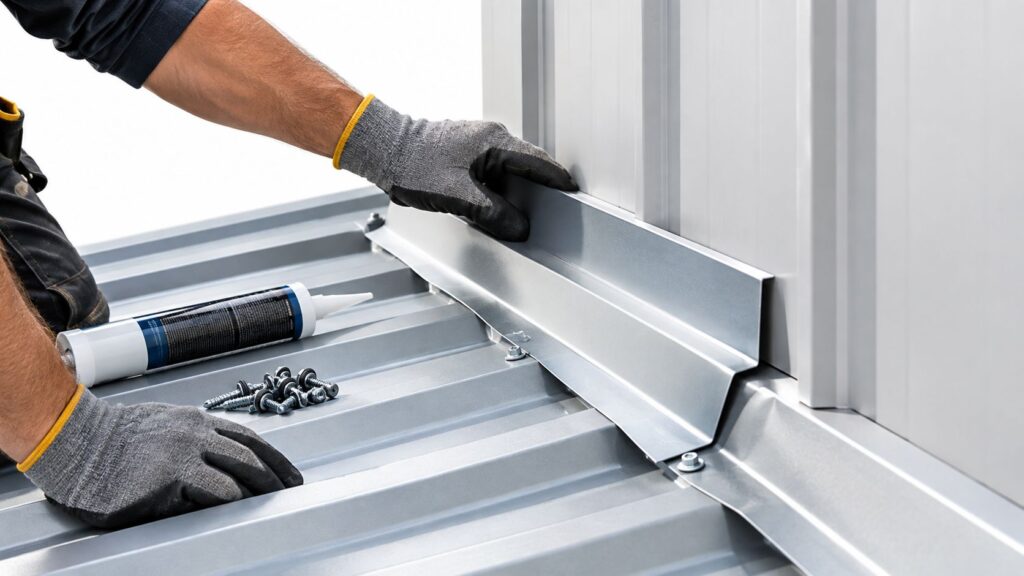
The most popular advice on tile roof underlayment replacement cost is also the least dependable: multiply the roof size by a national per-square-foot average. That shortcut works poorly on tile because the membrane is only one part of the job. Crews must remove, sort, protect, and reset the existing tile, then deal with the deck, flashing, penetrations, access, and breakage that become visible after the covering is lifted.
For contractors in Fort Worth, Arlington, Forest Hill, Mansfield, Benbrook, North Richland Hills, and the wider Dallas–Fort Worth Metroplex, a defensible bid starts with scope normalization. The roof area matters, but tile condition, pitch, staging, code-required coverage, and labor access usually matter more than the price of a roll of underlayment.
Table of Contents
- Why National Averages Fail DFW Tile Roofing Bids
- Breaking Down the True Labor and Material Expenses
- Navigating Fort Worth and Metroplex Code Requirements
- Evaluating Membrane Upgrades and Lifecycle Value
- Building a Defensible Bid Normalization Checklist
- Securing Reliable Material Dispatch for DFW Jobsites
Why National Averages Fail DFW Tile Roofing Bids
A national average treats underlayment replacement as though every roof were an exposed deck waiting for a new membrane. A tile roof isn't that job. The existing covering has value, and the crew must handle it without turning reusable tile into a pile of replacement material.
On a shingle roof, tear-off generally means removing a disposable covering. On a tile roof, installers lift courses, sort pieces, stage them safely, protect them from traffic and weather, and later relay them over the new waterproofing layer. Valleys, hips, penetrations, parapets, and complicated flashing interfaces slow the process further.
Estimator's rule: A low membrane price doesn't make a low-cost tile project. The bid follows the labor required to access, preserve, and restore the roof assembly.
Published benchmarks show why a generic rate can mislead. One national reference places average roof-underlayment replacement near $1.60 per square foot overall, while tile-roof work is identified as a higher-cost category, with typical cases around $3,600 to $4,200 and labor commonly accounting for 80% to 90% of the total. Those figures come from Fixr's roof underlayment replacement benchmark, and they should be treated as a starting point rather than a DFW bid.
The roof size is only the first measurement
A measured roof surface is more useful than conditioned floor area, but it still doesn't describe the job. Two roofs with similar areas can require very different production time if one has simple access and reusable concrete tile while the other has multiple roof planes, tight staging, brittle clay tile, and extensive flashing.
A contractor should separate at least these variables before applying a unit rate:
- Measured roof surface: Price the actual roof area, not the home's interior footprint.
- Tile handling: Account for lifting, sorting, stacking, protection, relay, and expected breakage.
- Access and pitch: Note stories, ladders, staging areas, roof slope, and difficult transitions.
- Assembly condition: Allow for deck, battens where applicable, flashing, penetrations, and concealed water damage.
- Specification: Confirm whether the project calls for one-ply, two-ply, modified-bitumen, or self-adhered material.
Tile and concrete roofs carry higher labor rates because crews work around breakable, reusable material and often face more complex geometry. A published benchmark places tile and concrete roof labor at approximately $2.75 to $3.50 per square foot, as detailed in the Fixr tile-roof repair cost guide.
What a headline number leaves out
The most dangerous quote is one that looks precise while hiding its exclusions. A headline price may omit tile replacement, disposal, deck repair, flashing work, permit or inspection costs, or the extra coverage required on low-slope tile sections.
For DFW estimators, the practical question isn't “What's the average cost per square foot?” It's “What work is included once the tiles come off, and what conditions trigger a change order?” That distinction protects margin and gives the property owner a quote they can compare fairly.
Breaking Down the True Labor and Material Expenses
In DFW, the membrane rarely drives the number. Tile handling does. For a 2,000-square-foot existing tile roof, a full lift-and-relay job with underlayment replacement is commonly benchmarked at about $6,000 to $10,000, or roughly $3 to $5 per square foot, based on Fixr's replacement cost data. That benchmark is useful for orientation, but on a real bid, Fort Worth area labor conditions and scope definitions will move the total faster than the felt or peel-and-stick line item.
That is why I separate tile work from membrane work before I trust any budget number. The crew has to mobilize, protect grade and hardscape, set staging, pull tile by hand, stack reusable pieces, haul debris, inspect the deck, install the specified assembly, and then reset everything without creating breakage claims.
A practical cost breakdown
| Cost Category | Estimated Range | What Usually Pushes It Up |
|---|---|---|
| Tile lift, sorting, stacking, and relay | $3,600–$4,200 | Fragile tile, limited staging, higher stories, complex cuts, valleys, hips, and penetrations |
| Broad tile-roof underlayment labor and materials | $0.75–$4.00 per square foot | Roof size, access, substrate condition, repair scope, and whether the work is localized or part of a larger relay operation |
| Tile underlayment labor | $2–$5 per square foot | Tear-off method, relay pace, slope changes, crew access, and protection of salvageable tile |
| Additional disposal, repairs, and permits | Approximately $500–$2,000 | Dump fees, damaged tile replacement, permit costs, flashing corrections, and incidental carpentry |
The broader $0.75 to $4.00 per-square-foot benchmark comes from the Fixr tile roof repair cost reference. It helps with early budgeting, especially when an owner wants a quick range before you have a full takeoff. It does not replace a measured DFW scope. A localized repair, a partial slope reset, and a complete lift-and-relay are different jobs with different labor risk.
Why labor dominates the invoice
Published guidance on tile systems often shows labor taking the larger share of the bill, and that tracks with what estimators see in the field. RoofVista tile roofing guide also notes that lift-and-relay pricing can spread widely once the affected area grows. The spread is not just estimator error. It usually reflects scope differences, reuse assumptions, and how much detail work is included.
One contractor may include detach and reset at walls, valleys, vents, and edge metal. Another may carry underlayment only and leave flashing, disposal, and replacement tile as separate lines. On paper those bids can look close for a minute. Once the roof is open, they are not close at all.
The labor sequence is what should appear in the estimate. Remove tile in controlled sections. Sort and protect reusable pieces. Strip the old underlayment. Check the substrate. Install the replacement system. Reset and fasten the tile. Every transition adds hand work, and hand work is where margin disappears if the bid is thin.
Where small allowances become large costs
DFW bids get exposed here. Tile breaks during removal. Old flashing around walls, vents, chimneys, and valleys may not survive reset. Deck damage often stays hidden until the underlayment is off, especially on older roofs with past leak history.
A defensible quote states exactly what the base price covers and what sits in allowance or unit-price form. Carry separate lines for replacement tile, deck repair, flashing correction, disposal, and permit-related costs. That format may look less tidy than a single lump sum, but it gives the owner a cleaner comparison and gives the contractor a cleaner path for change-order support.
Navigating Fort Worth and Metroplex Code Requirements
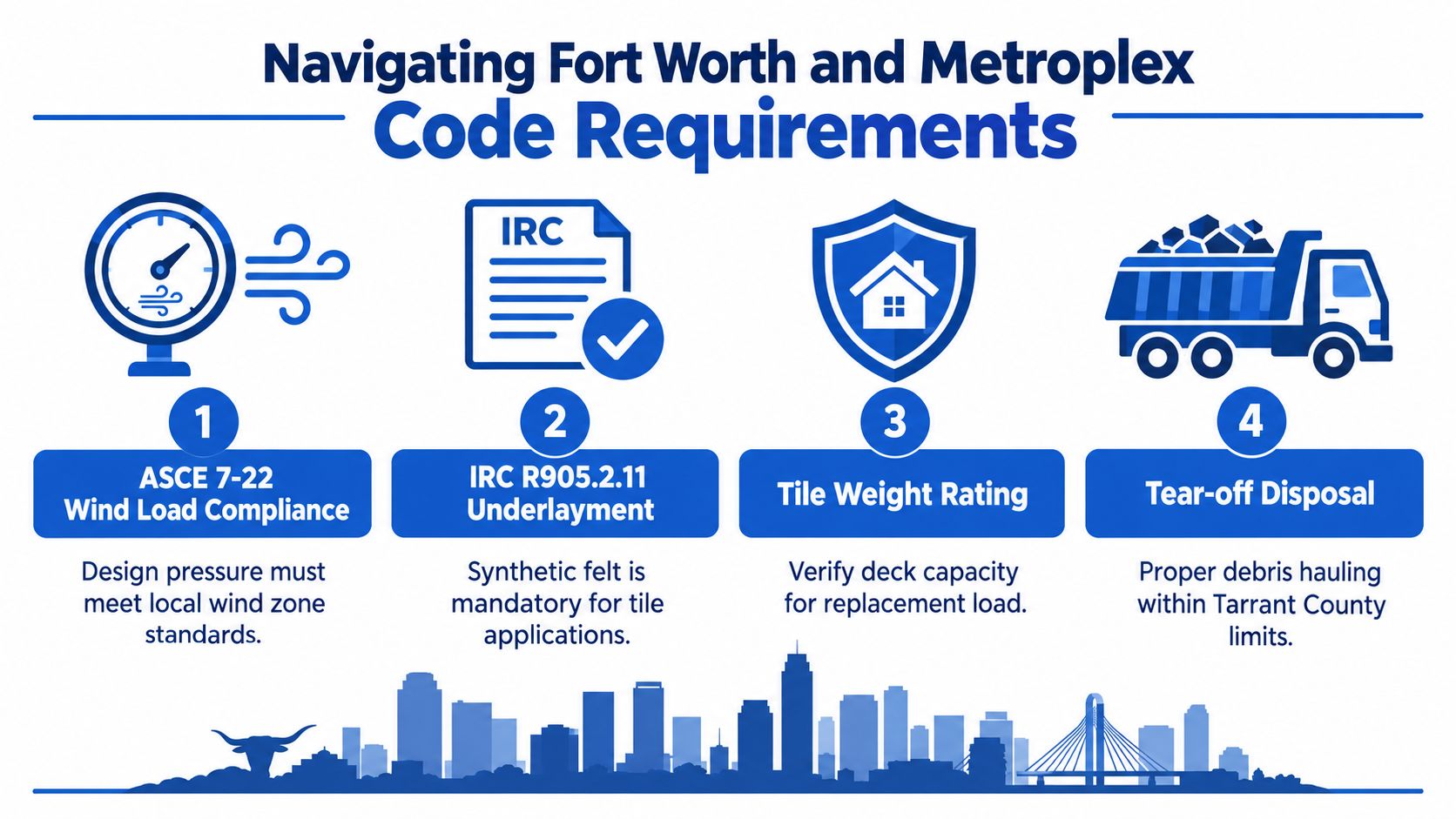
Fort Worth's residential roofing rules can change the material takeoff before the first tile is lifted. The city requires roof-covering work to comply with either the manufacturer's installation instructions or Section R905 of the 2021 International Residential Code, whichever is more restrictive, as stated in the City of Fort Worth roofing FAQ.
That requirement matters for contractors working in Fort Worth and nearby locations such as Arlington, Forest Hill, Mansfield, Benbrook, and North Richland Hills. Don't assume that a specification used on one Metroplex project automatically satisfies another jurisdiction or the applicable manufacturer instructions.
Confirm the roof slope before ordering material
Fort Worth's adopted roof-assembly rules permit concrete and clay tile only on roof slopes of at least 2.5 units vertical in 12 units horizontal, equivalent to a 25% slope. For sections from 2.5:12 up to 4:12, the code requires a double underlayment application under Section R905.3.3, as shown in the Fort Worth IRC roof-assembly reference.
That rule makes a single roof-wide underlayment rate unreliable. A low-slope section can require twice the underlayment coverage, additional laps and fastening, and more detail work at eaves, valleys, penetrations, and transitions.
Measure and separate the roof planes. Don't apply the double-coverage assumption to every square foot if only part of the roof falls within that slope range. Conversely, don't miss the requirement by averaging the entire roof into one blended number.
Treat the deck as part of the tile assembly
Concrete and clay tile must be installed over solid sheathing. Before promising tile reuse, inspect the deck for solid-sheathing compliance and condition. If the deck won't support the specified assembly or contains deteriorated areas, the estimate needs a repair allowance and a clear explanation of how that work will be priced.
Fort Worth also confirms that its local amendments don't require an ice-barrier underlayment because the area doesn't have a history of ice damming. That doesn't mean contractors should skip product or code verification. It means an ice barrier shouldn't be added automatically to every Fort Worth estimate without checking the adopted requirements, manufacturer instructions, and project conditions.
For broader underlayment specifications, contractors can compare installation considerations in asphalt shingle underlayment resources, while still using the tile-specific code and manufacturer requirements for the actual project.
Build the code check into the takeoff
Before finalizing the bid, record the roof slope, solid-sheathing condition, required coverage, lap details, fastening approach, material standard, and manufacturer instructions. Model-code provisions identify applicable standards such as ASTM D226, D1970, D4869, or D6757, while lap and fastening details vary by slope, material, jurisdiction, and adopted code edition, as explained in the underlayment code reference.
The estimate should show where additional material comes from. Laps, offsetting, waste, penetrations, valleys, parapets, and self-adhered membrane detailing all affect installed quantity and production time.
Evaluating Membrane Upgrades and Lifecycle Value
Tile roofs in DFW rarely fail because the field tile suddenly gives up. The usual trigger is the layer below it. Published service-life benchmarks put concrete and clay tile roofs at roughly 40 to 50 years or more, while underlayment commonly lands around 20 to 30 years, according to RoofPredict's roof-life guidance. That split is why a lift-and-relay can be the right scope when the tile is still usable.
Compare systems by the next intervention
Roll price is only part of the bid. What matters more is when that roof will need to be opened up again, how much tile handling that next cycle will require, and whether the owner wants to pay for another relay sooner than necessary.
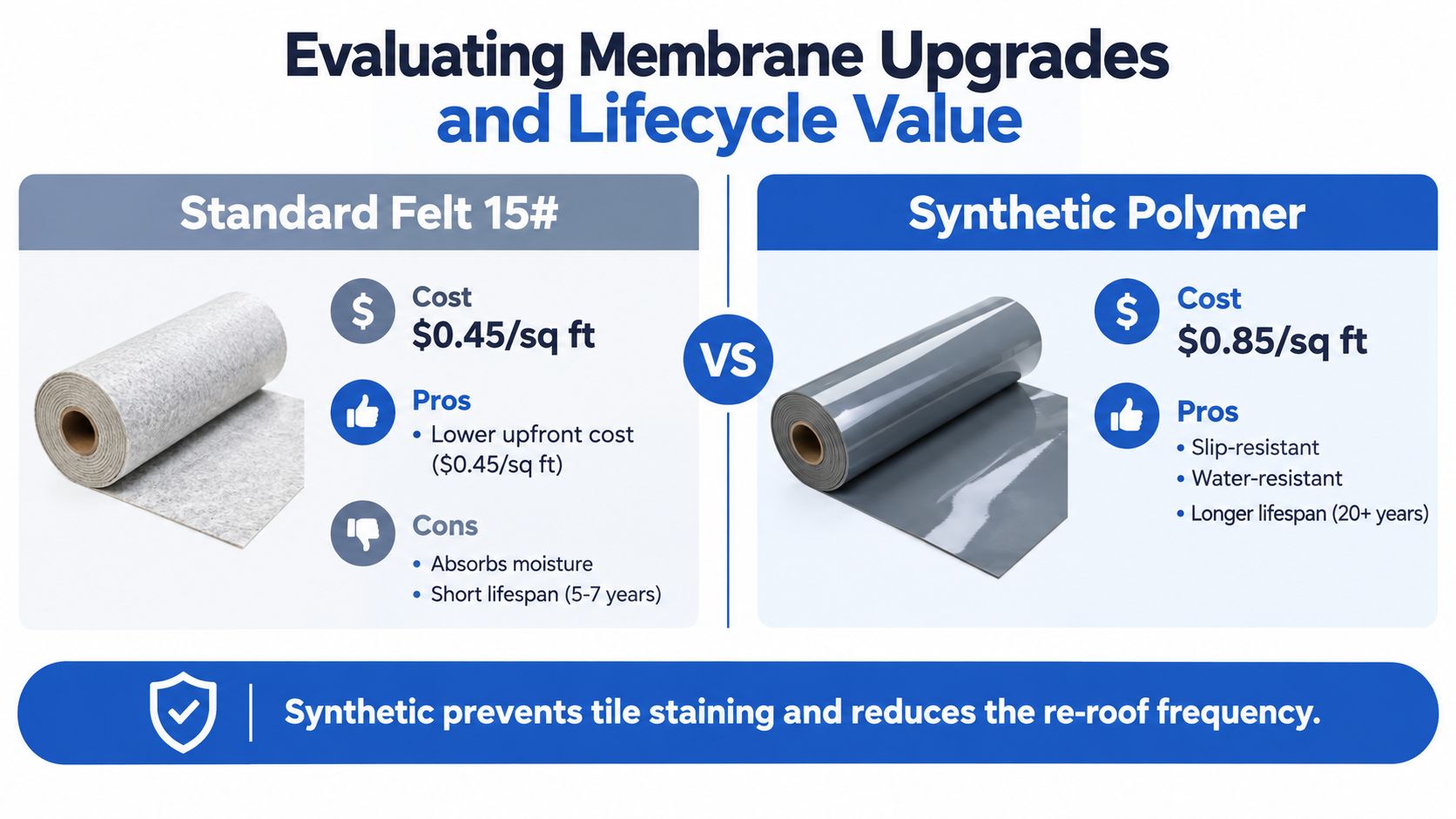
Older felt systems may fail around 18 to 25 years, while modern modified-bitumen or high-temperature self-adhered systems can be rated around 30 years or more, as discussed in the IBHS building-code progress material. The same material notes that harsh heat, humidity, salt, and storm exposure can shorten service life. In North Texas, that means a national life-range should be treated as a planning tool, not as a promise you put in writing.
A practical comparison for estimating looks like this:
- Traditional felt: Lower initial material cost. Best fit when the budget is tight and the owner accepts a shorter interval before the next major tear-up.
- Modified bitumen: More durable on many tile assemblies and often easier to justify when the roof has enough remaining life to benefit from a longer service cycle.
- High-temperature self-adhered membrane: Useful where heat loading and detail work are harder on the assembly, but only if the deck is prepared correctly and the product is approved for the full roof system.
The DFW angle is simple. A membrane upgrade is often less about saving a few squares of material and more about avoiding another expensive round of tile removal, sorting, breakage, staging, and relay labor.
Match the upgrade to the tile's remaining value
This decision should follow a rule, not a sales script. If the tile is largely sound and the profile is still available, spending more on a better membrane can make sense because the assembly has a realistic path to another full service interval. If the profile is discontinued or the roof already carries heavy breakage, budget for replacement tile exposure first and keep the membrane specification aligned with the project's actual remaining roof value. For profile and replacement matching questions, check this concrete roof tile reference before you write a premium membrane into the scope.
That keeps the conversation honest. The owner needs to see tile condition, expected hold period, replacement availability, and membrane type on the same page.
Upgraded underlayment can reduce the odds of repeating the full lift-and-relay cycle too soon. It does not eliminate future maintenance. Flashings still age, penetrations still move, and storm damage still creates repair work.
Document compliance instead of selling a label
Use the product that fits the slope, exposure, manufacturer instructions, and adopted code. Product names do not make a bid defensible. Documentation does.
For a clean file, keep the product data sheet, installation instructions, coverage calculation, slope notes, and inspection requirements with the estimate. Then spell out what is being reused, what is being replaced, and what the membrane is expected to do. That is how you support the number if the owner compares proposals later or questions a change order after dry-in.
Building a Defensible Bid Normalization Checklist
A bid becomes comparable when every contractor prices the same scope. Without normalization, one proposal can include tile relay and disposal while another includes only membrane installation. The lower number may just be missing the work that will eventually appear as a change order.
Start with the measured roof surface and divide the assembly into line items. Keep reusable tile, replacement tile, underlayment, flashing, fasteners, deck repairs, delivery, disposal, and labor visible instead of blending them into a single unexplained figure.
Separate the material takeoff from the labor plan
The material takeoff should reflect actual roof geometry. Add laps, offsets, waste, penetrations, valleys, parapets, and any double-underlayment sections required by slope. Then identify whether the specification uses one-ply, two-ply, modified-bitumen, or high-temperature self-adhered material.
A contractor-facing checklist should include:
- Roof measurement: Record actual roof surface area by plane and distinguish it from conditioned floor area.
- Tile inventory: Mark reusable tile, expected replacement tile, discontinued profiles, and matching or salvage requirements.
- Underlayment coverage: Calculate base coverage, laps, waste, and any code-driven double coverage.
- Flashing interfaces: List wall flashing, valley work, penetrations, vents, chimneys, parapets, and transitions separately.
- Deck condition: State the inspection method and the unit or allowance used for concealed sheathing repairs.
- Fasteners and accessories: Include corrosion-resistant fasteners, compatible primers, sealants, tapes, and detail components where specified.
- Disposal and logistics: Price old underlayment, broken tile, packaging, hauling, staging, and delivery.
Use allowances that can survive tear-off
No estimator can fully verify concealed deck conditions before the covering is removed. The answer isn't to hide the uncertainty. State the allowance, define the trigger, and explain how the owner approves additional work.
The same principle applies to tile breakage. A crew should photograph damaged pieces, separate pre-existing cracks from removal damage where practical, and confirm replacement profiles before ordering. That record protects the customer and gives the contractor a defensible basis for billing.
Field practice: A change-order allowance should describe the condition that activates it. “Wood as needed” is weak. “Deck replacement where concealed deterioration is exposed after tile removal, priced by the agreed unit or allowance” is usable.
Normalize competing bids before comparing totals
Ask every bidder whether the price includes tile removal and reset, underlayment disposal, flashing adjustments, deck repair, broken tile, permits or inspections, delivery, and cleanup. Confirm whether the roof area includes only the field or also accessory slopes and detail zones.
Published figures can differ substantially because the scopes differ. One national benchmark places complete tile underlayment replacement for a 2,000-square-foot roof at $6,000 to $10,000, while other tile lift-and-relay estimates can be much higher when a meaningful portion of the field is affected or extensive repair categories are included, as described in RoofVista's scope discussion.
The contractor who itemizes the scope may not have the lowest headline price. That contractor is more likely to have priced the actual work.
Securing Reliable Material Dispatch for DFW Jobsites
A normalized tile bid still falls apart fast if the material plan is loose. In DFW, the miss usually is not the main rolls. It is the accessory box, the flashing package, or the second drop that shows up after the crew has already opened the roof.
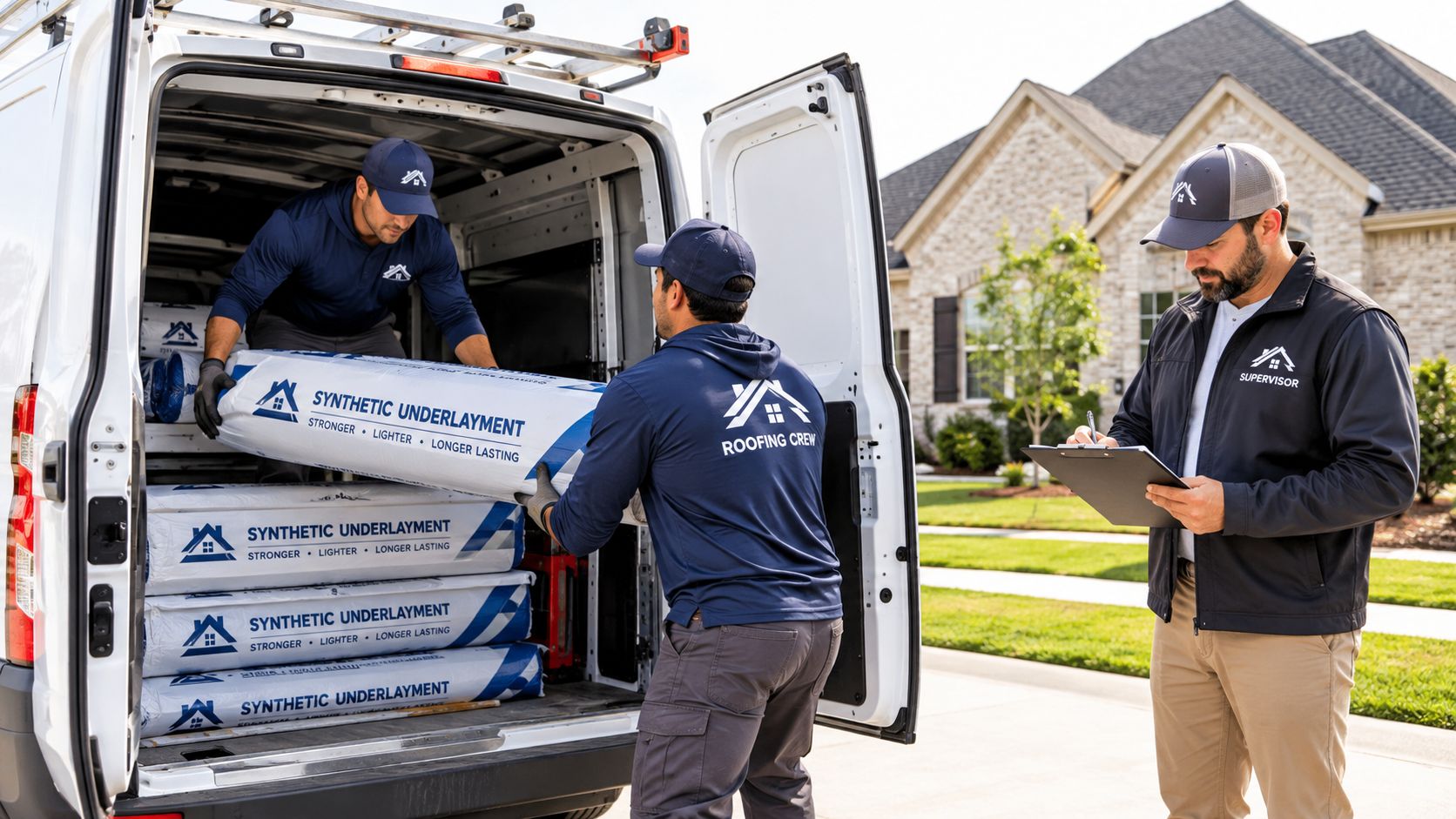
That matters more on tile than on many steep-slope systems because the sequence is less forgiving. Once the field tile is off, every delay hits labor twice. The crew loses time waiting, then loses time protecting exposed areas, re-handling stacked tile, and resetting the work area when product finally lands. A bid that looked tight on paper can get soft in a hurry.
For Fort Worth, Forest Hill, Arlington, Mansfield, Benbrook, North Richland Hills, and nearby DFW jobs, dispatch needs to be built from the same takeoff that priced the work. Send the supplier the actual scope, not a shortened shopping list. That means membrane type, roll counts, laps, metal profiles, fastener package, sealants, primers, and phase notes for relay work. If Fort Worth detailing or inspection calls for a specific assembly, put that in the order before the first pallet is loaded.
Keep the delivery aligned with the scope
Good delivery follows installation sequence. Get the dry-in package to the site when the deck is ready. Get replacement tile, metal, and specialty accessories there before the crew reaches those transitions. Direct-to-jobsite delivery helps because it cuts extra handling and lets the foreman compare the drop against the approved scope at the driveway, not after half the roof is opened.
One late accessory drop can push a profitable tile underlayment job past its production window. I would rather hold tile removal for a few hours than start without the tape, metal, and fastening package that closes the details correctly.
Verify the accessories, not only the rolls
Underlayment is only part of the assembly. Valleys, walls, penetrations, and tie-ins are where a rushed order shows up in the punch list. Review the needed roof flashing tape options with the same care you give the membrane spec, and keep those items on the original purchase order instead of treating them as field pickups.
A solid delivery check is simple. Confirm product names, quantities, compatibility, visible damage, and which phase each item belongs to. Mark shortages before the driver leaves.
The following video provides another visual reference for roofing material handling and jobsite coordination.
Trade accounts can help match purchases to multi-phase billing, but the bigger win is production control. Blue Lake Roofing Supply supports DFW contractors with installer-grade underlayments, tile and roofing accessories, trade accounts, and jobsite-direct delivery from its Forest Hill yard. Visit Blue Lake Roofing Supply to coordinate the material takeoff and delivery plan for your next tile underlayment replacement project.