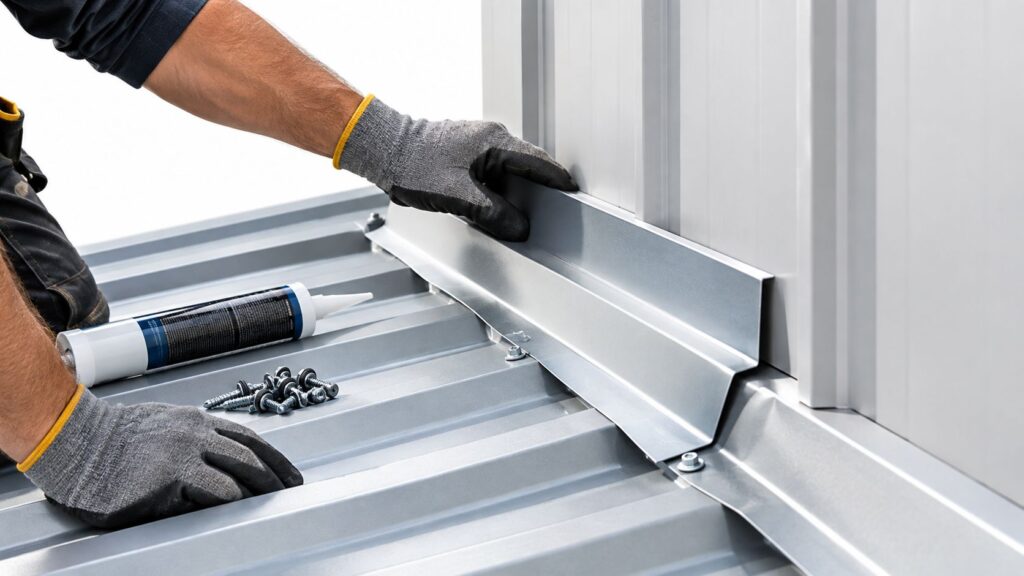
Texas standing-seam metal roofing is commonly estimated at about $9–$16 per square foot installed, or roughly $18,000–$32,000 on a 2,000-square-foot roof before unusual repairs. Dallas, Fort Worth, Plano, Frisco, McKinney, and Arlington projects often run about 5–10% above statewide averages.
Those budgeting figures come from Texas metal-roof pricing estimates, which attribute the local premium to hail exposure, competitive labor markets, and demand. For a contractor, the important question isn't whether the published range sounds reasonable. It's whether the scope behind that range matches the roof your crew will install.
Table of Contents
- What Standing Seam Metal Roof Cost Means in DFW
- Installed Cost Benchmarks Across the Metroplex
- Breaking Down Panels Labor and Accessories
- Comparing Metal Types and System Choices
- How Geometry Code and Access Change the Bid
- Sample Estimates for Common DFW Roof Jobs
- How to Price the Next Standing Seam Job
What Standing Seam Metal Roof Cost Means in DFW
An installed benchmark is a budgeting tool, not a proposal. A Fort Worth estimator needs a number that can survive field measurement, material ordering, tear-off, and inspection. An owner searching for standing seam metal roof cost usually sees a single rate without that chain of assumptions.
The Texas benchmark above is useful for deciding whether standing seam belongs in the initial budget. It doesn't establish the right price for a particular Arlington house, Forest Hill renovation, Benbrook addition, or White Settlement reroof. Metal type, gauge, insulation, trim, penetrations, access, and existing roof conditions still need to be defined before the contractor commits.
Separate the budget conversation from the bid
For an early conversation with a builder or property manager, explain what the benchmark represents and what remains unresolved. Don't describe an uninspected roof as a standard installation because its floor plan looks straightforward.
- Budget basis: Identify the intended standing-seam system and the measured roof area, rather than leaving the owner to assume the number covers any metal roof.
- Included scope: State whether the preliminary allowance anticipates removal, substrate preparation, accessories, and installation.
- Unresolved conditions: Name the items that require field verification before you'll issue a firm proposal.
- Alternate scope: Keep optional metals, insulation changes, and assembly changes separate from the base bid.
This distinction matters when the owner compares your proposal with an online calculator. A calculator may be useful for screening affordability, while your estimate has to describe who supplies, installs, and pays for each required component.
Estimating rule: Don't defend a higher bid until you've established whether the lower number buys the same roof.
My recommendation is to give the customer a clear baseline and a written list of exceptions. That's more useful than a narrow number that looks competitive but leaves the crew responsible for unpriced details. The contractor should be able to explain the price without relying on assumptions the builder never saw.
Installed Cost Benchmarks Across the Metroplex
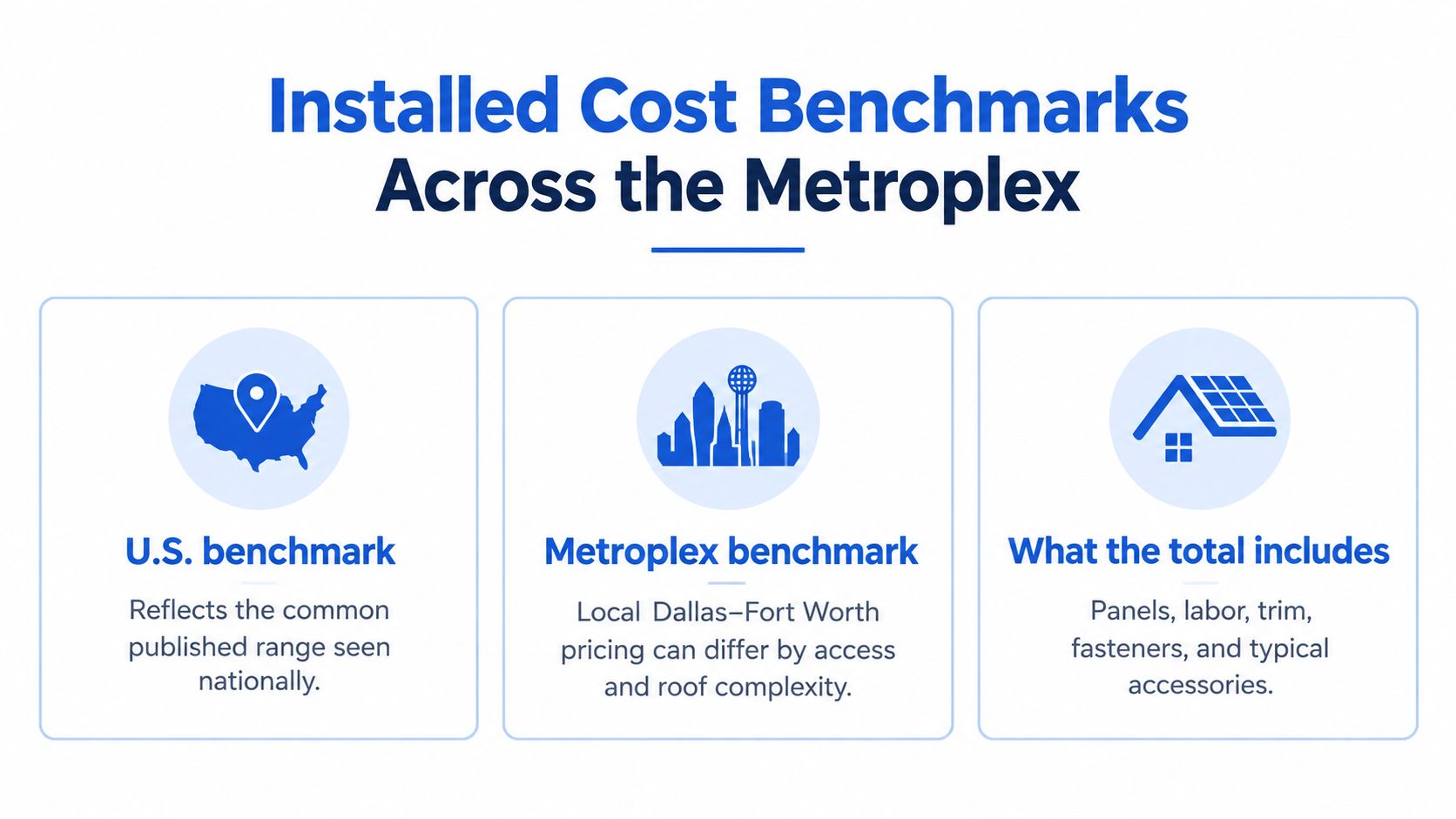
Published ranges differ enough that the cheapest headline shouldn't become your estimating target. Modernize's standing-seam cost guide places a typical 2,000-square-foot roof at approximately $16,000–$28,000, averaging near $22,000, equivalent to roughly $8–$14 per square foot across that project range; it also identifies broader mainstream steel or aluminum estimates around $10–$18 per square foot installed.
| Benchmark | Published budgeting frame | Best use |
|---|---|---|
| Common national project | $16,000–$28,000 for the cited roof size | Initial owner budget |
| Broader steel or aluminum estimate | $10–$18 per square foot installed | Checking how scope and market assumptions differ |
| Texas and Metroplex context | Statewide baseline with the local premium described above | Early DFW qualification, not a fixed bid |
The table compares the national estimates cited immediately above with the Texas estimates introduced earlier. It doesn't imply that the ranges include identical materials, roof conditions, or installation work.
Compare the contents before the totals
Modernize identifies regional labor, roof complexity, substrate preparation, and metal selection as price drivers. Its estimates may include different combinations of tear-off, underlayment, flashing, trim, clips, fasteners, disposal, and labor. That's why apparently conflicting ranges can both be useful without either being a reliable bid for your job.
For a Lake Worth, Hurst, Arlington, or Fort Worth house, start by asking what area the calculator used. Then ask whether its accessory allowance reflects the actual roof details. A panel supplier's material quote and a consumer calculator's installed total answer different questions.
A useful comparison sheet should show measured area, specified assembly, included accessories, existing-roof work, and installation scope side by side. If those fields aren't aligned, the price difference isn't yet evidence that a contractor or supplier costs more.
The practical conclusion is straightforward: use national ranges to start a conversation, then replace their assumptions with project quantities. Don't average incompatible estimates and call the result a local price.
Breaking Down Panels Labor and Accessories
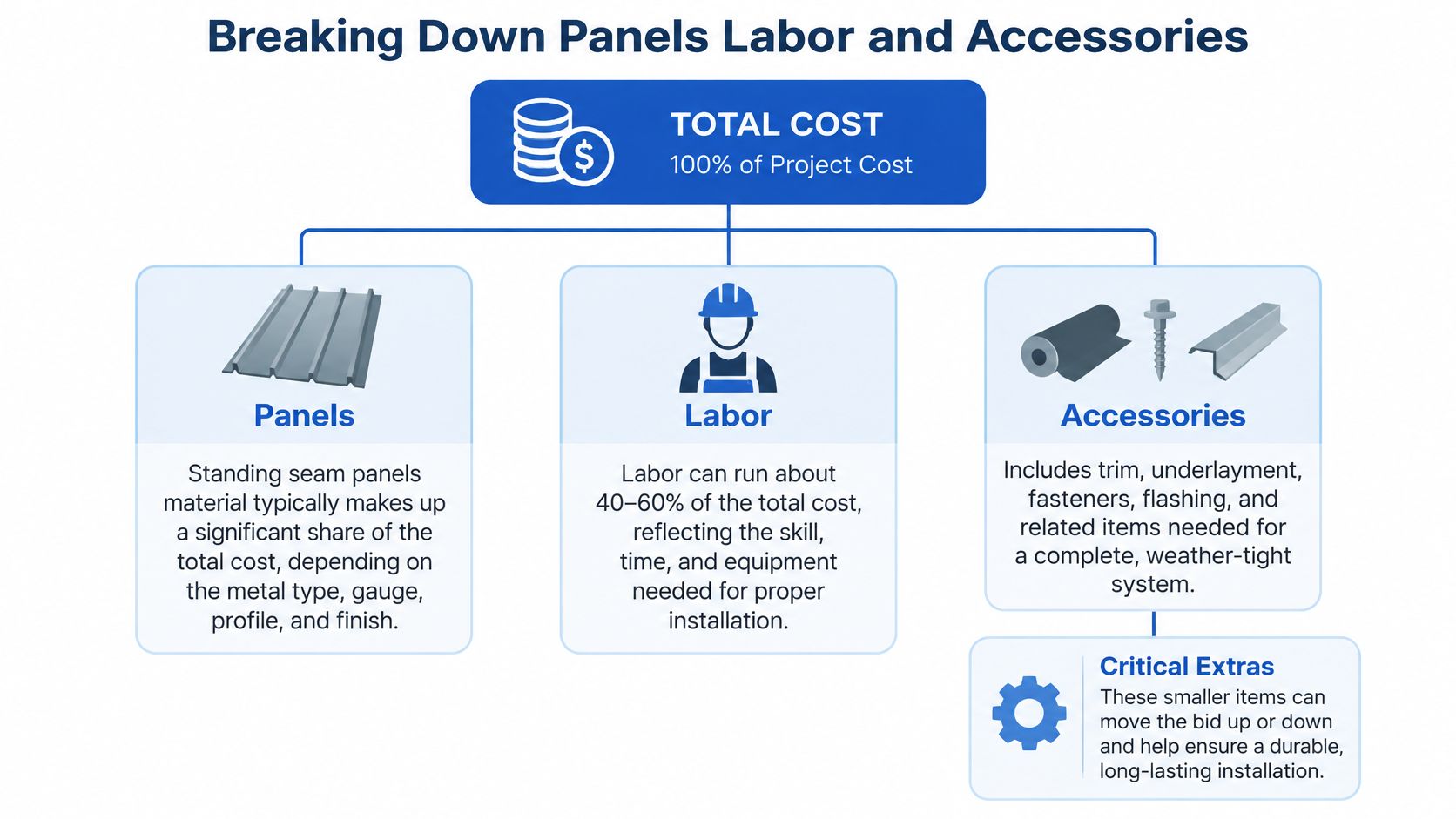
Labor can account for 40–60% of total metal-roof cost, according to this Dallas–Fort Worth roofing-supply market guide. It gives a production reference of about 1.5–2 hours per roofing square for tear-off and reinstallation, and broad installed bands of $250–$400 per square for basic metal roofs and $450–$600 for more complex concealed-fastener systems with thermal breaks.
These figures are benchmarks, not a standing-seam bid. Use the production rate to test the crew-hour allowance against the roof's layout and specified assembly. The installed bands describe broad system categories, so they cannot establish profitability without measured quantities and a defined scope.
Build a cost stack the foreman can recognize
Keep each major cost visible instead of burying unmeasured work in a panel markup:
- Panels and clips: Count panels and specify the metal, coating, concealed clips, and compatible fasteners.
- Trim and closures: Measure eaves, rakes, transitions, closures, and valley metal separately.
- Underlayment and membranes: Identify the specified underlayment and any required high-temperature membrane.
- Tear-off and disposal: Define what comes off and how removed material will leave the property.
- Deck work: Separate confirmed repairs from concealed conditions that need authorization.
- Field labor and seaming: Estimate hours against the assembly, roof geometry, and panel layout.
- Penetration flashing: Price details around vents, curbs, skylights, and other interruptions.
- Delivery and schedule exposure: Account for unloading, staging, remobilization, and phased material needs.
Tie flashing quantities and details to the selected standing-seam system. The guide to roof flashing for corrugated roofing can help identify accessory categories, but corrugated-roof details are not a substitute for the standing-seam manufacturer's specifications.
Measure quantities before applying rates
HomeGuide's metal-roof estimating guide uses approximately 8% waste as an estimating reference and places standing-seam labor around $5–$8 per square foot. It also calls out measured roof area, accessories, removal, disposal, delivery, and access as separate estimating considerations.
Apply a project-specific waste allowance based on panel nesting and cut planning. Floor area does not establish roof area, and a panel rate alone misses trim, flashing, and labor tied to roof details. Profit depends on pricing those quantities and conditions separately, not expecting panel margin to absorb uncounted work.
Comparing Metal Types and System Choices
Published per-square-foot figures are starting benchmarks, not interchangeable bid rates. Material-only prices exclude installation and system components, while an installed example reflects a defined roof and scope. Keep those categories separate when comparing specifications.
Standing Seam Metal Price Benchmarks
| Metal or system | Cited figure | What the figure covers |
|---|---|---|
| Galvanized or Galvalume steel | Approximately $3.00–$5.50 per square foot | Materials alone |
| Aluminum | No figure retained | Materials alone |
| Zinc | No figure retained | Materials alone |
| Copper | No figure retained | Materials alone |
| Steel standing seam | Approximately $12.75 per square foot | Installed example described below |
| Copper standing seam | Approximately $34.00 per square foot | Installed example described below |
The original material-only figures for aluminum, zinc, and copper are omitted because they are not dependable benchmarks for comparing these metals. Obtain current, project-specific material pricing for each specification. For a zinc alternate, zinc metal roofing panels information can support the material discussion, but the panel cost alone does not establish the installed bid.
The installed figures come from Roof Observations' standing-seam cost guide. For a 1,700-square-foot roof with a pitch of 6/12 or less, its estimates are roughly $22,000 for steel and $58,000 for copper. The stated scope includes panels, clips, fasteners, underlayment, and basic flashing. The guide estimates steel standing-seam service life at around 40–60 years and says steep or complicated geometry can raise costs by as much as 50%.
Use those figures to frame a duration discussion, not to promise an owner a specific annual cost. Dividing an invoice by an assumed lifespan leaves out maintenance, actual service conditions, and eventual replacement. For a contractor, metal choice changes more than panel cost: confirm the specified clips, trim, and other system components before treating an alternate as comparable.
A cheaper system isn't automatically an equivalent alternate
Standing seam uses concealed clips, accurate layout, and, where specified, seam formation and integrated penetration details. Those items belong in the system comparison because a panel price is not an installed bid.
An exposed-fastener alternate can be appropriate when the owner accepts a different assembly. Document how it handles movement, its maintenance expectations and warranty scope, and the service-life assumptions used in the comparison. Label the change clearly rather than presenting a lower assembly price as an equivalent standing-seam option.
Blue Lake Roofing Supply's Forest Hill operation stocks standing-seam panels, trim, fasteners, and clips. It offers trade pricing and jobsite delivery within approximately a 40-mile DFW radius, including same-day drops for orders placed by noon, according to its contractor supply and delivery information.
Compare complete packages. A panel quote without the specified clips and trim cannot be compared directly with an installed-system proposal.
How Geometry Code and Access Change the Bid
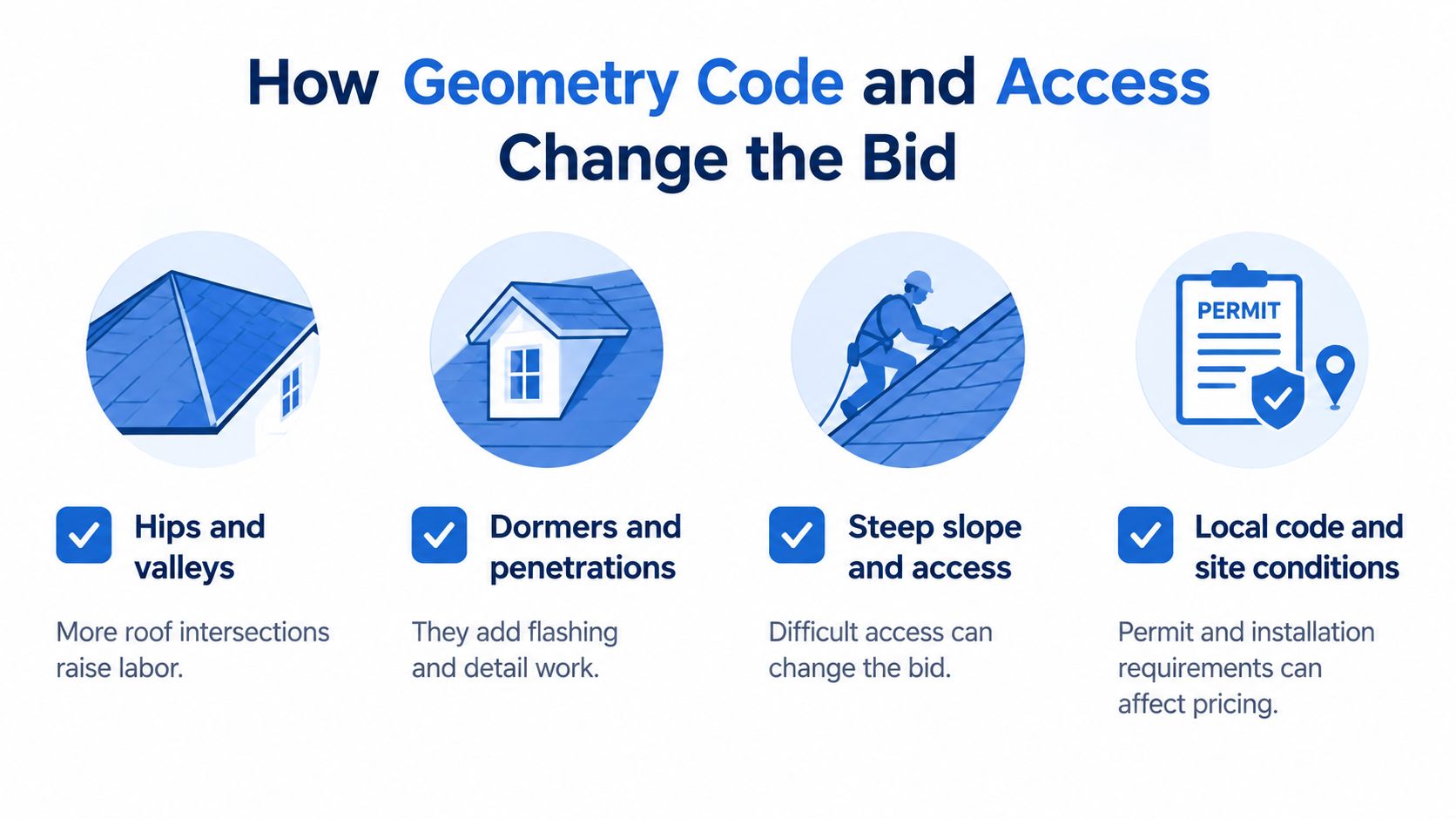
The published installed-cost range is a starting benchmark, not a margin guarantee. Hips, valleys, dormers, penetrations, steep slopes, and difficult eave or rake details add measurement, fabrication, and installation work. A roof with the same panel specification can therefore require a different bid once its geometry and access are accounted for.
The earlier per-square-foot example translates to approximately $15,300–$27,200 for a 1,700-square-foot roof, before unusual complexity or major substrate repairs. Treat that figure as a baseline illustration. Carry difficult details as identified line items rather than assuming the upper end of a broad range will cover them.
Confirm which slope rule applies
Fort Worth's adopted residential roof provisions state that lapped, nonsoldered-seam metal roofs require at least 3:12 without applied lap sealant, or 1/2:12 with approved applied lap sealant. Metal roof shingles may not be installed below 3:12. These provisions apply to specified assemblies, not every standing-seam product.
Fort Worth's official roofing guidance requires compliance with manufacturer recommendations or Section R905 of the 2021 International Residential Code, whichever is more restrictive. Include the specified clips, fasteners, underlayment, flashing, and seam treatment in the estimate.
For projects in Benbrook, Hurst, White Settlement, or Lake Worth, confirm the jurisdiction's requirements and approved assembly. Fort Worth guidance does not establish approval elsewhere, and roof-system details are not interchangeable. For example, concrete roof tiles are a different assembly, not a basis for standing-seam specifications.
Write the change-order triggers before mobilization
Removal, deck repair, framing correction, lifting equipment, permits, mobilization, and custom trim can affect installed cost. On a multi-plane DFW roof, spell out who carries each item and when added work requires authorization.
- Geometry changes: Document added planes, valleys, transitions, and revised penetration details.
- Substrate discoveries: Require authorization before concealed deck or framing corrections.
- Access changes: State staging limits, lifting needs, and unloading conditions.
- Schedule changes: Define responsibility for phased delivery, return trips, and remobilization.
A narrow material quote does not resolve these obligations. If the proposal leaves them unassigned, their cost remains a risk to the contractor's margin.
Sample Estimates for Common DFW Roof Jobs
Published examples provide a starting benchmark, not a finished DFW bid. The figures below apply those earlier examples to common job types. They are budgeting illustrations, not completed-job prices or guaranteed local quotes. A panel price alone does not cover the labor, accessories, and installation conditions that determine the installed total.
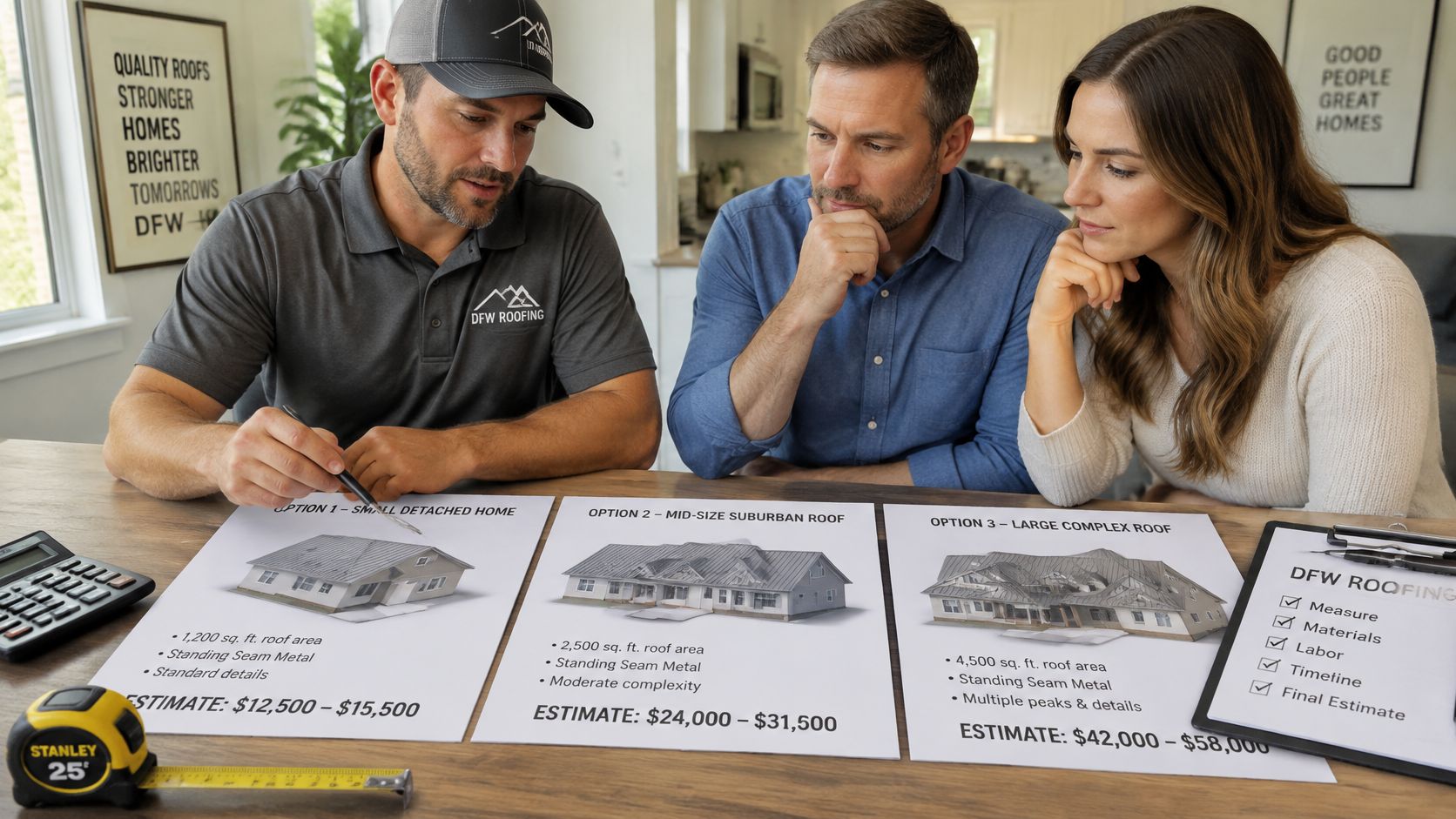
A relatively simple Fort Worth or Arlington reroof
Use the published Texas project illustration as the initial budget benchmark, then replace its assumptions with a measured takeoff. The statewide example is not a guaranteed Metroplex price, and a regional premium should not be added without support from the actual labor and material scope.
For a straightforward reroof, the working estimate should reflect measured roof area, planned waste, tear-off and disposal, deck-repair treatment, clip and trim package, penetration count, and delivery sequence. Those quantities determine whether the published total is a reasonable comparison or a poor fit for the job. Keep concealed damage outside the base assumption unless inspection has established its extent.
A moderate-pitch steel installation
The earlier moderate-pitch steel illustration gives a second budget reference when its assumptions match the roof. Compare its approximate installed total with the simpler Texas example only after confirming that both include equivalent roof area and scope. The difference between a complete installed assembly and a material-only quote can otherwise make the lower number misleading.
Treat basic flashing as a defined allowance, not coverage for any curb or skylight detail that may arise. Keep the copper illustration as a separately labeled alternate rather than blending its cost into a typical residential steel estimate.
Proposal language: The base price covers the measured roof and listed details. Changes to the substrate, approved assembly, penetration schedule, or delivery sequence require written pricing and authorization.
A detail-heavy Forest Hill or south Tarrant job
A roof with valleys, HVAC curbs, skylights, or difficult slopes may exceed the earlier installed range. Use that published range as a reference point, then account for the added fabrication and field labor required by the actual design. It is not a cap on a complex job.
For budgeting, distinguish the ordinary roof area from details that add work, such as curb flashing, valley transitions, and difficult access. Confirm material availability and dispatch timing before promising a same-day run for missing components. Matching floor areas do not establish matching roof quantities or installation costs. The estimate should reflect the roof the crew will build.
How to Price the Next Standing Seam Job
A published per-square-foot figure is a benchmark, not an installed bid. For a Fort Worth or Arlington project, start with the takeoff and approved system, then reconcile the selling price against the actual scope. Record panel gauge and coating, clip type, underlayment, valley and penetration details, tear-off, access, and delivery assumptions. Supplier package comparisons only hold when those items match.
Close the specification gaps
Fort Worth's manufacturer-or-code requirement makes generic panel allowances risky if they leave out required components or installation methods. Before presenting an exposed-fastener or simplified-panel option as a savings, compare it against the same roof area, substrate condition, insulation package, and accessory scope.
Performance claims also depend on the whole assembly. An Oak Ridge National Laboratory study of metal roofing assemblies found substantially lower roof and ceiling heat flow and smaller daily attic-temperature fluctuations than an asphalt-shingle control. Reflectance, insulation, ventilation, and air sealing all affect performance, so the finding does not establish a guaranteed reduction in utility bills.
- Confirm slope: Check the roof against the approved assembly and manufacturer instructions.
- Count penetrations: Set flashing details before ordering.
- Separate deck repairs: Define how hidden conditions will be approved and priced.
- Price labor hours: Include measured work rather than relying on panel margin to absorb it.
- Confirm dispatch: Verify package completeness, unloading, and delivery sequence.
The final review should trace each material and labor line to the measured scope. A profitable bid is one the estimator, supplier, foreman, and owner can interpret consistently. Before releasing the order, reconcile the takeoff, proposal, and approved installation details. A clear scope is more defensible than a low headline rate.
Blue Lake Roofing Supply offers standing-seam panels, trim, fasteners, and clips with contractor pricing for DFW crews. Contractors can open a trade account or arrange will-call at 5609 Wichita St, Forest Hill, TX 76119. Confirm same-day jobsite delivery availability for orders placed by noon within the supplier's stated delivery radius. Bring the takeoff and accessory schedule when requesting a material package for the bid.