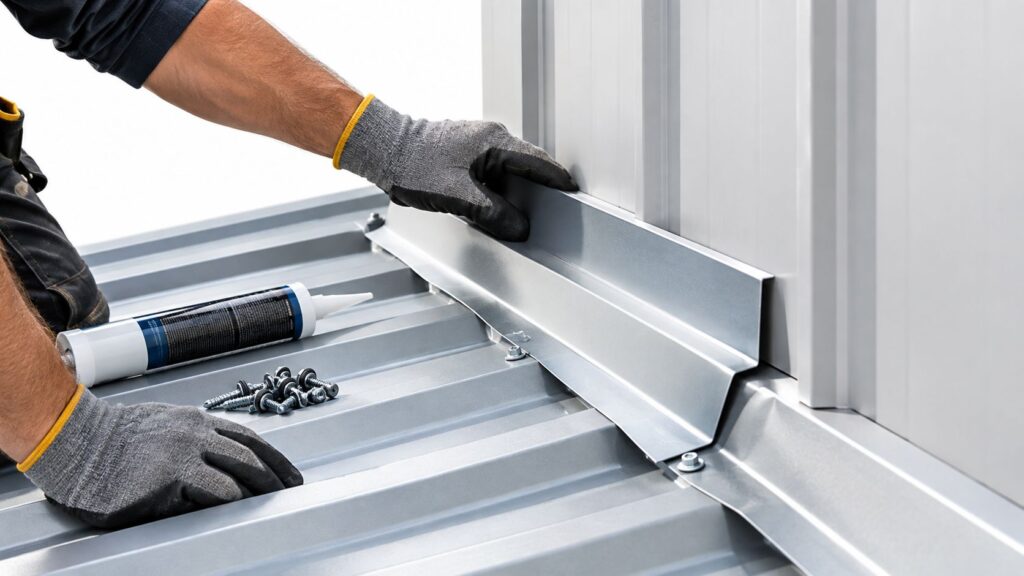
A contractor in Tanglewood or Arlington can end up with two very different bids on the same driveway. One uses composition shingles and keeps the framing conversation simple. The other uses clay roof tiles, carries a heavier structural question, and may be the only option that satisfies a homeowner's design expectations or an HOA review in Colleyville or Southlake.
That choice isn't settled by appearance alone. DFW's expansive clay soils, spring hail, strong ultraviolet exposure, and marginal freeze-thaw conditions all affect how a clay tile system performs. The material can make excellent sense for the right home, but only when the structure, detailing, storm exposure, replacement plan, and delivery logistics are considered together.
Table of Contents
- Why Clay Roof Tiles Keep Coming Up on DFW Job Sites
- What a Clay Roof Tile Actually Is and the Main Styles
- Pros and Cons Contractors Should Weigh
- Weight, Framing, and Structural Considerations
- Installation, Underlayment, and the System That Actually Fails First
- Cost Factors and Lifecycle Math for Tile Roofs
- Regional Suitability Across the Dallas-Fort Worth Metroplex
Why Clay Roof Tiles Keep Coming Up on DFW Job Sites
Clay tile isn't a rare heritage specification in North Texas anymore. Contractors see it on custom homes, high-value renovations, and neighborhoods where Spanish, Mediterranean, or Southwestern architecture is part of the expected streetscape. A homeowner may compare a conventional roof with a tile roof because the tile profile fits the house, not because they're chasing a decorative upgrade.
The category also has genuine staying power. Clay roof tiles have been used across the Mediterranean and Asia for thousands of years, including Roman-era applications. A recent market forecast valued the global clay roof tiles market at USD 9.36 billion in 2026 and projected USD 13.98 billion by 2033, with Europe representing 41.2% of the market in 2026 and residential buildings accounting for 43.6% of demand, according to the market overview and roofing guide published by EcoWatch. Those figures describe a mainstream product category, not a material reserved only for historic restorations.
The DFW conditions that change the conversation
North Texas gives clay tile a mixed test. Expansive clay soils can move foundations and framing over time, so a tile specification needs more than a visual approval. Spring supercells bring hail that can crack individual tiles, while freeze-thaw exposure along the I-35 corridor can punish tiles with higher moisture absorption. Strong sun also puts pressure on exposed roofing membranes and sealants.
HOA expectations matter, too. In Keller, Westlake, Southlake, Plano, Frisco, and parts of Arlington, the roof profile and color blend may influence whether a project gets approved. A contractor who treats clay tile as a simple material swap can lose time after the bid. A contractor who checks the structure, profile availability, fastening requirements, and storm-repair plan early can make a defensible recommendation.
Practical rule: Clay belongs on the shortlist when the building can carry it, the owner accepts its storm and maintenance trade-offs, and the crew can source matching components after the first severe weather event.
The Fort Worth market already supports that specialty. A Fort Worth-area contractor profile identifies service across Dallas-Fort Worth since 2008 and lists natural slate and clay tile among its roofing specialties, alongside commercial and composition systems, as shown in this local contractor profile. That doesn't mean every DFW roof should be tiled. It does mean contractors should know how to evaluate the request instead of dismissing it as impractical.
What a Clay Roof Tile Actually Is and the Main Styles
A clay roof tile is a shaped piece of fired clay, shale, or terracotta installed as part of a water-shedding roof assembly. The tile surface handles weather and directs water toward the eaves, but the underlayment, flashing, fasteners, battens, and deck provide the secondary protection that keeps the roof dependable.
Profile selection starts with roof geometry. Pitch, exposure, headlap, side joints, drainage paths, and fastening all work together. A tile that performs well on a steep roof may need different detailing on a lower-pitched roof, and the manufacturer's installation requirements control the final layout.
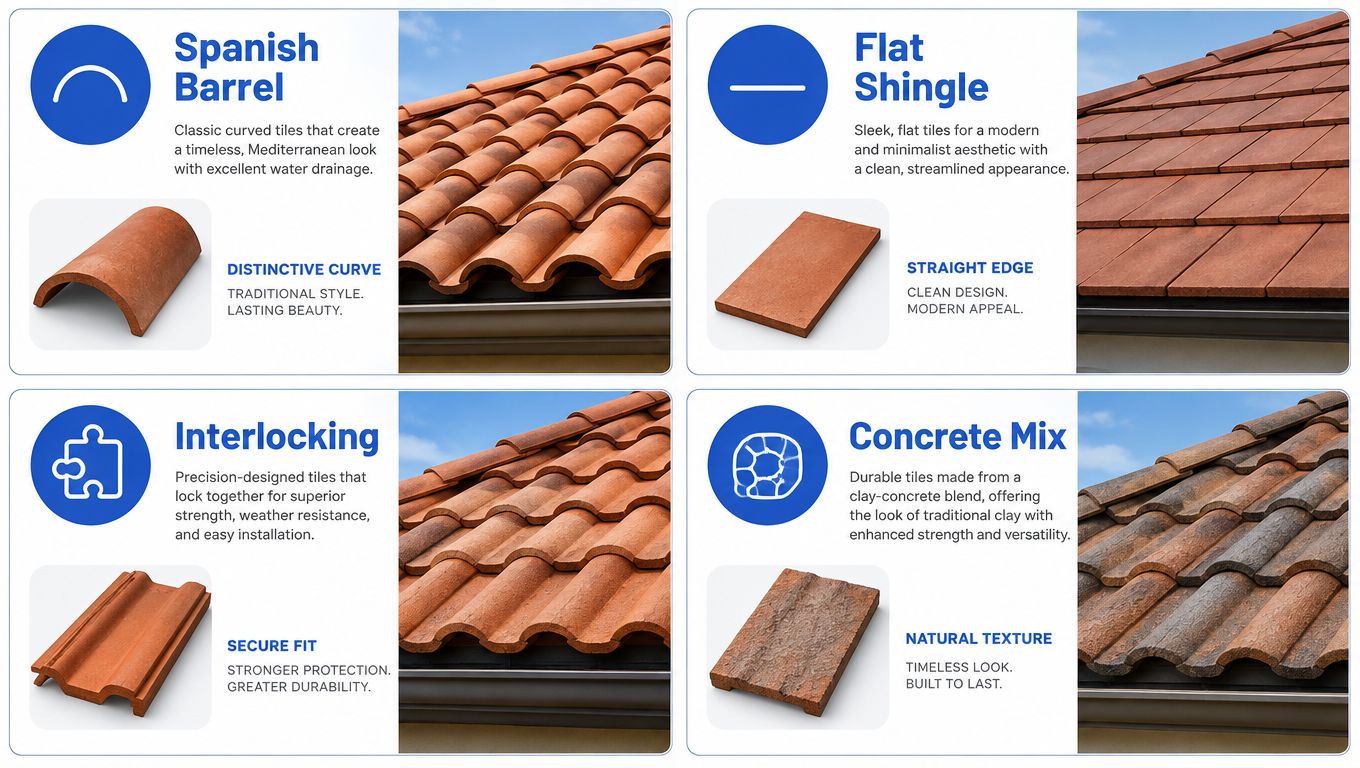
Four profiles contractors commonly encounter
Spanish barrel, also called Mission or S-curve, uses a curved channel and a covering section. The channel carries water, while the cover protects the joint. A two-piece Mission system needs careful alignment at starters, hips, ridges, and penetrations. On a steeper roof, gravity helps drainage. On a lower pitch, headlap, side closure, and underlayment detailing become more important because water has more opportunity to travel beneath the exposed profile.
Flat shingle tile has a flatter face and may use interlocking edges or overlapping courses. It suits a cleaner, more restrained appearance and can be easier to blend into certain French or contemporary designs. The installer still has to confirm minimum pitch and exposure because a flat-looking tile doesn't eliminate the need for correct water management.
Riviera tile generally gives the roof a lower, more organized profile than a deep barrel. It can work where the owner wants the character of clay without the full visual depth of a Mission roof. The exact geometry varies by manufacturer, so crews should lay out the actual product rather than estimate from a catalog photograph.
Pan-and-cover uses separate lower pans and upper covers. It creates a traditional rhythm but demands consistent course spacing and accurate alignment. Handmade versions can show intentional variation in size, thickness, and color. Machine-made tile usually offers tighter tolerances and more predictable installation, while handmade tile can add character and may require more sorting, adjustment, and budget.
Pitch changes the installation
Don't judge a profile by its name. Verify the manufacturer's minimum slope, necessary headlap, fastening pattern, ridge treatment, and accessory compatibility. A 2-piece Mission roof at a 6:12 pitch is not just a slower version of the same roof at 12:12. The water path, tile exposure, wind forces, and layout all change.
Pros and Cons Contractors Should Weigh
A clay roof can suit a DFW project, but the tile is only one part of the roof system. Properly installed and maintained clay tile is commonly given a service life of 80 to 100 or more years, with some systems lasting beyond a century, as summarized by this roofing-material service-life guide. Fired clay resists fire, rot, and insects, and its color runs through the material rather than relying on a thin surface coating.
That durability has to be weighed against brittleness. Hail is a regular concern across North Texas, and freeze-thaw swings can expose cracked or poorly supported tiles. Building America notes that clay tiles may crack or blow off during high-wind or hail events, leaving the underlayment, flashing, and sheathing to provide the effective weather barrier. Its guidance points contractors toward Class 4 impact testing under FM 4473 for hail-rated assemblies and wind compliance based on the IRC site wind speed and exposure category, as explained in the Building America clay and concrete tile roof guide.
A bid-level comparison
| Advantage | Drawback |
|---|---|
| Long design life when the complete system is installed and maintained correctly | Individual tiles can crack under hail, impact, or careless foot traffic |
| Fired clay resists rot, insects, and fire exposure | Underlayment and flashing may age before the tile field |
| Strong architectural appeal in Keller, Westlake, Colleyville, and Southlake | Matching discontinued profiles and colors can become difficult |
| Reusable tile can support a lower-waste replacement strategy | Tile repair requires trained access and careful foot placement |
| Profiles suit high-end and heritage-inspired construction | Structural verification can add cost and schedule risk |
What works, and what does not
Clay performs best when the owner values longevity and appearance, the framing has been verified, and the contractor is pricing the complete assembly rather than treating tile as a decorative skin. The bid should also account for spare tiles, replacement availability, sorting, and delivery. A local distributor's stocking position can affect labor planning and downtime, while reliable delivery can reduce handling and rescheduling costs. Confirming availability early matters when a profile or color is less common in the DFW market.
The system is a poor fit when a homeowner expects shingle-level walkability, selects a profile without checking the slope, or assumes new decking will solve an undersized structure. Contractors should explain that hail damage may not resemble a conventional shingle claim. A broken tile, damaged flashing, and compromised underlayment call for different repair decisions.
For comparison with another heavy roofing category, review concrete roof tile options and compare the actual profile, structural demand, accessories, and local availability rather than choosing by product label.
Weight, Framing, and Structural Considerations
On a DFW reroof, the framing review belongs before the color, profile, or delivery date. Clay tile systems commonly fall within a planning range of 600 to 1,100 pounds per square, according to this industry service-life reference. That load can change a retrofit from a straightforward replacement into a structural project, especially where the original house was framed for composition shingles.
Start with the structure, not the sample board
An empty-barrel Mission profile, a two-piece Spanish system, and a machine-made flat S-tile do not place the same demand on the roof. Barrel products may create a different dead-load pattern than flatter tiles, while hip, valley, ridge, and eave accessories add concentrated weight. Use the manufacturer's specification for the selected assembly, then have the framing review confirm the actual design load.
Older pier-and-beam ranches in DFW deserve close inspection. Slab-on-grade homes in Arlington, Mansfield, and Frisco can also require verification, even when the structure appears substantial from the street. Many newer tract homes were framed around composition-shingle loads rather than a heavy clay assembly.
A re-deck over existing shingles provides a cleaner nailing surface, but it does not strengthen undersized rafters, change truss design, or correct concentrated loading at a valley. Depending on the review, a framer may need to add mid-span blocking, sister rafters, reinforce ridge members, or improve load transfer at hips and valleys. Obtain the structural letter before ordering tile.
For contractors, the timing affects project economics. A Forest Hill distributor that confirms the profile, accessories, and stock position early can help schedule framing, delivery, and labor in the right order. Holding material at the yard or arranging a coordinated delivery also reduces the risk of moving heavy pallets twice while the structure is still under review.
A practical profile screen
| Profile Type | Approx. Weight per Square | Typical Use |
|---|---|---|
| Flat machine-made tile | Lighter end of the clay-tile range | New construction and lower-profile architectural designs |
| Riviera profile | Mid-range system demand, subject to manufacturer | Custom residential roofs seeking moderate visual depth |
| Spanish barrel or S-curve | Heavier system demand, depending on assembly | Mediterranean, Spanish, and Southwestern designs |
| Two-piece Mission or pan-and-cover | Often among the most demanding assemblies | High-character custom and heritage-inspired roofs |
The table is a screening tool, not structural approval. Before ordering, confirm truss or rafter size and spacing, species and grade, bearing points, sheathing condition, and point loads. Check hips and valleys first, because those areas often collect accessories and framing demands that a broad roof-area estimate misses.
Installation, Underlayment, and the System That Actually Fails First
A clay tile roof can still have serviceable field tiles while the layers beneath them need work. Install the system from the deck upward, because underlayment, flashing, battens, and fasteners usually set the maintenance schedule before the clay does. Industry guidance places underlayment replacement at roughly 25 to 40 years in many assemblies. Contractors should explain that difference clearly when discussing a reroof.
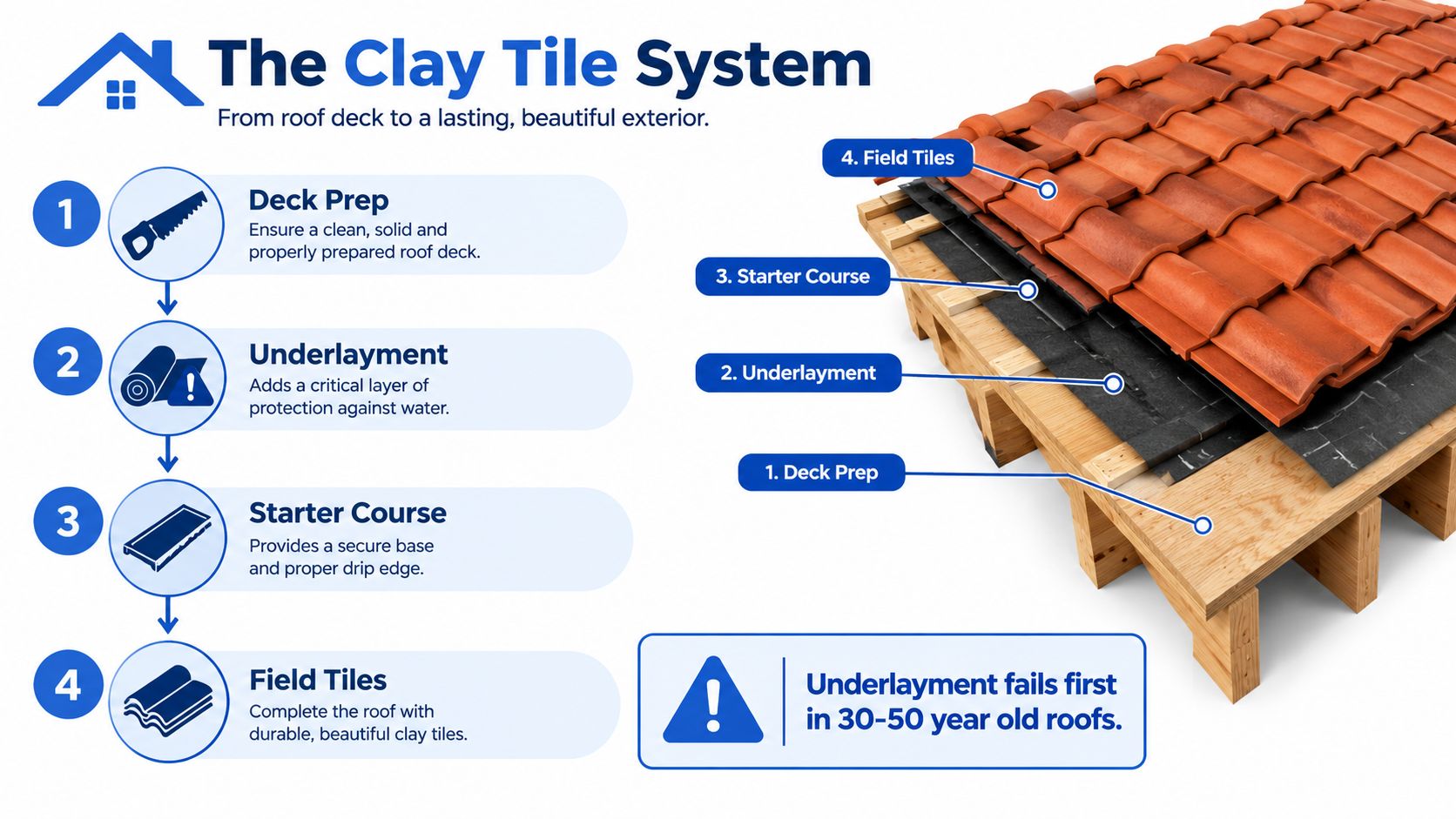
Build a reliable water-shedding assembly
Start with a clean, sound, nailable deck. Replace damaged sheathing, correct soft areas, and confirm that the substrate supports the specified fastening method. The deck must provide a continuous base for underlayment and flashing, rather than conceal an old leak or structural defect.
Specify underlayment for the exposure and the tile assembly. Basic felt may meet a minimum requirement in some applications, but DFW roofs face hail, high heat, wind-driven rain, and strong ultraviolet exposure. Depending on the manufacturer and code, the assembly may call for layered felt, self-adhered protection at eaves and valleys, or a high-temperature synthetic product. Compatibility matters more than familiarity with a brand. Blue Lake Roofing Supply carries asphalt shingle underlayment products, but confirm that any selected material is approved for clay tile use.
The ASTM C1167 standard for clay roof tiles addresses fired clay tiles for weather-resistant roofing and includes cold-water absorption requirements. Under its stated sampling conditions, absorption may reach 6% for a random five-tile sample, with no more than one tile above that limit and that tile below 8%. Lower pore connectivity generally reduces capillary uptake and improves resistance to freeze-thaw damage.
Treat details as primary work
Use compatible copper, stainless steel, or hot-dipped ring-shank nails when the tile specification calls for them. Electro-galvanized fasteners from the truck are not an automatic substitute. Nail-on, screw-on, and foam-set systems have different application limits, and wind exposure west of Fort Worth deserves careful review.
Integrate flashing at headwalls, sidewalls, chimneys, skylights, and other penetrations. At valleys, use the specified W-valley or ribbed valley metal where required, rather than asking woven tile to manage the drainage alone. Batten and direct-to-deck systems also differ in ventilation, alignment, fastening, and repair access.
A local distributor affects the installation plan as much as the material line. Confirming tile profiles, compatible accessories, and actual stock before mobilization helps prevent a crew from waiting on ridge pieces or moving pallets repeatedly. In Forest Hill and across DFW, coordinated yard staging and delivery can protect labor time when weather changes the schedule.
Watch the video below for a visual look at the clay tile system and installation sequence.
Sell and install clay tile as one system. Replacing cracked field tiles while leaving deteriorated membrane or flashing may improve the roof's appearance without stopping the route water uses to enter the building.
Cost Factors and Lifecycle Math for Tile Roofs
Clay tile pricing is easy to misunderstand because the visible product line is only one part of the job. A contractor has to price the tile, accessories, sorting, handling, structural review, deck preparation, underlayment, flashing, fastening, ridge and hip work, tear-off, disposal, and future service access.
The material line isn't the project cost
Imported Spanish or Italian profiles can carry different freight, availability, and replacement risks than domestic machine-made products. Color blends, glazes, handmade variation, and special accessories can shift the order from a standard pallet to a managed procurement exercise. A lower material price can disappear if the crew spends extra time sorting inconsistent pieces or if a missing ridge component delays the roof.
Labor also changes. Clay tile requires careful staging, controlled movement across the roof, accurate layout, and protection from breakage. It isn't priced responsibly by applying a shingle crew's production assumption to a heavier, more detail-sensitive system.
Structural work may determine whether the project proceeds. If the framing review finds insufficient capacity, reinforcement can affect the roof scope, interior access, engineering coordination, and schedule. Price that work as a real line item instead of burying it in an allowance.
Think in replacement events
The long-life case depends on maintaining the assembly, not just installing durable tile. A tile field can continue performing while the underlayment needs renewal, and the membrane replacement may require removing and resetting usable tiles. That creates labor even when the owner isn't buying a completely new tile field.
The sustainability case can improve when contractors preserve sound tile rather than discard it. One European source estimates that reusing 100 square meters of reclaimed clay tiles can avoid approximately 1,220 to 2,640 kilograms of carbon dioxide equivalent from new tile manufacturing alone, according to the Opalis clay roof tile reuse document. Reuse still requires inspection, sorting, compatible replacements, and a sound substrate.
A fair lifecycle conversation compares complete roof assemblies, not one pallet of tile against one pallet of shingles.
Give the homeowner three numbers in the proposal, even if some are allowances: the installed system, the structural contingency, and the future underlayment service strategy. That format makes the higher initial price easier to understand and keeps the contractor from promising that the tile alone eliminates future roofing work.
Regional Suitability Across the Dallas-Fort Worth Metroplex
Clay tile can suit DFW, but its fit changes by neighborhood, structure, roof geometry, and storm exposure. The Metroplex combines expansive clay soils, severe spring weather, intense sun, and occasional freeze-thaw conditions. In North Texas, the tile itself may be durable while the supporting details respond poorly to movement, moisture, impact, or poor fastening.
For cold-weather performance, absorption matters. In North Texas applications, Grade 1 clay tile is often specified, and one local roofing source describes that grade as absorbing under 2% of its weight in water, a threshold relevant to freeze-thaw cracking and spalling, as noted in this North Texas clay tile service reference. Another Fort Worth-focused roofing source warns that clay tiles can crack during freeze-thaw cycles and emphasizes proper underlayment and installation for Texas conditions, as described in this local tile roofing guide.
Where the specification is strongest
Westlake, Southlake, Colleyville, and selected parts of Plano and Frisco often have custom or higher-value homes where the architectural case for clay is strong. Newer construction may also provide a better opportunity to design the framing, roof pitch, fastening, and drainage details around the tile from the start.
Older central Dallas and Fort Worth bungalows need a more cautious approach. Their framing, roof geometry, and access constraints can make reinforcement expensive or disruptive. Arlington and Mansfield sit in the middle. Some homes can support the system with suitable verification, while others need a different roof covering that respects the existing structure.
| Submarket | Typical Housing Stock | Framing Capacity | Hail Exposure | Clay Tile Fit |
|---|---|---|---|---|
| Westlake and Southlake | Custom and high-value residential | Often suitable when verified during design | Requires impact and fastening review | Strong candidate for properly engineered projects |
| Colleyville | Custom homes and HOA-influenced neighborhoods | Varies by construction and renovation history | Requires storm-repair planning | Good fit when profile and structure align |
| Plano and Frisco | Newer subdivisions and custom construction | Varies, verify trusses and load paths | Hail detailing remains essential | Selective fit, especially on designed-for-tile homes |
| Arlington and Mansfield | Mixed tract, ranch, and newer housing | Often requires project-specific review | Storm exposure can affect maintenance | Conditional fit |
| Central Dallas and Fort Worth | Older bungalows and remodeled housing | Retrofit reinforcement may be difficult | Existing details may need full correction | Pause until structure and deck are investigated |
Local delivery is part of the specification
A replacement tile order after hail shouldn't become a scavenger hunt across the region. Contractors in Fort Worth, Forest Hill, Benbrook, Burleson, Euless, Hurst, Keller, and surrounding communities need to know whether the profile, color, ridge pieces, flashing, and underlayment can arrive together. A local route can also reduce the time a roof remains exposed between tear-off and dry-in.
Review the service radius and jobsite process before the project starts through DFW delivery areas. For tile work, dependable dispatch isn't a convenience. It affects crew utilization, weather exposure, homeowner communication, and whether a repair can use matching material instead of an improvised substitute.
Blue Lake Roofing Supply stocks clay and concrete tile systems, underlayments, flashing, fasteners, and related roofing materials for contractors working across the Dallas-Fort Worth area, with jobsite-direct delivery from its Forest Hill yard. Visit Blue Lake Roofing Supply with your profile, quantity, and delivery location before you bid, so the tile system and the logistics plan are priced together.